

Wednesday, October 21, 2026
Science
No Result
View All Result
  • Login
  • HOME
  • SCIENCE NEWS
  • CONTACT US
  • HOME
  • SCIENCE NEWS
  • CONTACT US
No Result
View All Result
Scienmag
No Result
View All Result
Home Science News Medicine

PIWI–piRNA regulation varies across species and reproductive contexts

October 21, 2026
in Medicine
Juliet Wilcox
By Juliet Wilcox Scienmag Editorial Profile - Human Genetics
Reading Time: 3 mins read
0
PIWI–piRNA regulation varies across species and reproductive contexts

PIWI–piRNA regulation varies across species and reproductive contexts

65
SHARES
587
VIEWS
Share on FacebookShare on Twitter
ADVERTISEMENT

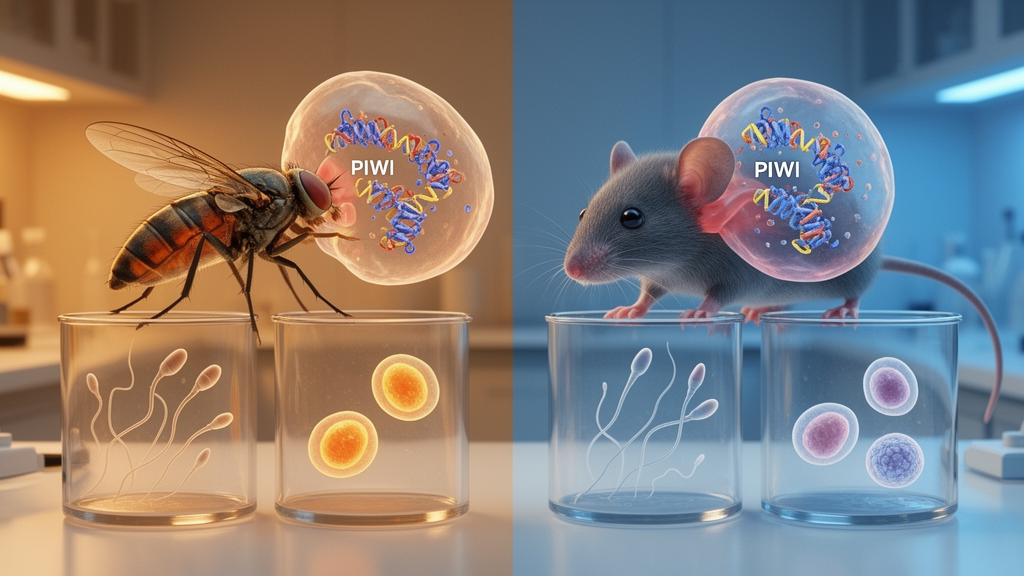
A comparative review reports that PIWI proteins and PIWI-interacting RNAs, or piRNAs, participate in multiple layers of germ-cell and early-embryonic regulation, while their expression, organization and functions differ substantially among species. The review places these RNA–protein complexes within a small RNA regulatory system that helps maintain DNA integrity and proper function of the germ-cell lineage.

Researchers first identified piRNAs as repressors of transposable elements, and later studies identified additional functions. The reviewed evidence links PIWI–piRNA activity to epigenetic programming, maintenance of maternal transcript homeostasis and control of processes involved in early embryonic development. These findings broaden the pathway’s apparent regulatory reach beyond its initial association with transposable-element repression.

The review examines the biogenesis and biological functions of PIWI/piRNA complexes and compares their biology across species. Its central finding is that this regulatory framework is neither uniform nor interchangeable between organisms. Conserved functions coexist with sex-specific and species-specific patterns, making the broader biology of the pathway dependent on the biological context in which it operates.

Three forms of variation stand out in the comparative literature: sex- and species-specific patterns of piRNA expression, differences in the organization of piRNA clusters, and functional diversity among PIWI proteins. The authors suggest that these differences may reflect the range of reproductive strategies and evolutionary adaptations represented among the species examined. The review does not reduce that variation to a single model of PIWI–piRNA control.

Disruption of the piRNA pathway has also been associated with infertility and germ-cell tumors in studies involving various species. The evidence is not uniform, however, because the organisms differ and the reported relationships vary in character. Some associations are described as mechanistic, while others are correlative, leaving their basis and broader relevance uncertain.

This qualification matters for interpreting disease-related findings. An association between pathway disruption and infertility in one species does not by itself establish an equivalent causal mechanism in another, and the reported links with germ-cell tumors likewise cannot be assumed to share one biological basis. The review instead treats these observations as evidence that requires more detailed cellular and clinical assessment.

The authors identify cellular regulation of piRNAs and the clinical relevance of PIWI–piRNA biology as important underexplored areas. They also call for further study of the pathway to clarify where functions are conserved, where they are species-specific and how piRNA organization relates to the reproductive biology of different organisms.

Overall, the review characterizes PIWI–piRNA complexes as a versatile regulatory system involved in genome maintenance, germ-cell function, maternal transcript regulation and early development. It also emphasizes that piRNA expression patterns, cluster organization and PIWI protein functions cannot be assumed to be identical across sexes or species. The work is a synthesis of the existing literature rather than a new experiment or clinical assessment, and its most important conclusion is both structural and cautionary: PIWI–piRNA biology is broadly relevant, but its detailed mechanisms remain context dependent.

Subject of Research: Comparative functions and regulation of PIWI–piRNA complexes in germ cells and early embryonic development

Article Title: The Role of RNA Interactions with PIWI in Regulating Gametogenesis, Fertilization, and Early Development Across Species

Article References: Haddadi, M., Safari-Alighiarloo, N., Mikaeeli, G., Meftagh, M. S., & Jazayeri, M. (2026). The Role of RNA Interactions with PIWI in Regulating Gametogenesis, Fertilization, and Early Development Across Species. Reproductive Sciences. https://doi.org/10.1007/s43032-026-02248-8

Image Credits: AI Generated

DOI: 10.1007/s43032-026-02248-8

Keywords: PIWI proteins, piRNAs, small RNAs, germ cells, early development, epigenetic regulation, maternal transcripts, transposable elements, comparative biology, infertility, germ-cell tumors, Role

Cite Scienmag News

Juliet Wilcox. (October 21, 2026). PIWI–piRNA regulation varies across species and reproductive contexts. Scienmag. https://scienmag.com/piwi-pirna-regulation-varies-across-species-and-reproductive-contexts/

Juliet Wilcox. "PIWI–piRNA regulation varies across species and reproductive contexts." Scienmag, 21 October 2026, https://scienmag.com/piwi-pirna-regulation-varies-across-species-and-reproductive-contexts/. Accessed 21 October 2026.

Juliet Wilcox. "PIWI–piRNA regulation varies across species and reproductive contexts." Scienmag. October 21, 2026. https://scienmag.com/piwi-pirna-regulation-varies-across-species-and-reproductive-contexts/


Tags: comparative biologycomparative molecular biologyearly developmentearly embryonic developmentepigenetic programmingepigenetic regulationgerm cell regulationgerm cell tumorsgerm cellsgerm-line genome integrityinfertilitymaternal transcriptspiRNA cluster organizationpiRNAsPIWI protein functional diversityPIWI proteinsPIWI–piRNA pathway diversityreproductive context-dependent gene regulationrolesex-specific piRNA expressionsmall RNAsspecies-specific small RNA regulationtransposable element repressiontransposable elements
Share26Tweet16
Previous Post

Simulation links Shigella trial design to underestimated vaccine efficacy

Next Post

Two-stage model predicts developers’ perceptions of AI capability across survey years

Related Posts

Retrospective Pediatric Study Finds Divergent PICU Stays at Equal Phoenix Scores
Medicine

Retrospective Pediatric Study Finds Divergent PICU Stays at Equal Phoenix Scores

October 21, 2026
Simulation links Shigella trial design to underestimated vaccine efficacy
Medicine

Simulation links Shigella trial design to underestimated vaccine efficacy

October 21, 2026
Low-Valine Diet Reduces Cardiac Hypertrophy in Hypertensive Male Rodents
Medicine

Low-Valine Diet Reduces Cardiac Hypertrophy in Hypertensive Male Rodents

October 21, 2026
AI-guided physical education trial to test student activity and well-being
Medicine

AI-guided physical education trial to test student activity and well-being

October 21, 2026
Observational Maryland study links chronic care management to lower acute care use
Medicine

Observational Maryland study links chronic care management to lower acute care use

October 21, 2026
Public Health Institutions Face AI-Flooded Information and Defunded Evidence Systems
Medicine

Public Health Institutions Face AI-Flooded Information and Defunded Evidence Systems

October 21, 2026
Next Post
Two-stage model predicts developers’ perceptions of AI capability across survey years

Two-stage model predicts developers’ perceptions of AI capability across survey years

  • Mothers who receive childcare support from maternal grandparents show more optimized

    Mothers who receive childcare support from maternal grandparents show more parental warmth, finds NTU Singapore study

    27656 shares
    Share 11059 Tweet 6912
  • University of Seville Breaks 120-Year-Old Mystery, Revises a Key Einstein Concept

    1061 shares
    Share 424 Tweet 265
  • Bee body mass, pathogens and local climate influence heat tolerance

    682 shares
    Share 273 Tweet 171
  • Researchers record first-ever images and data of a shark experiencing a boat strike

    546 shares
    Share 218 Tweet 137
  • Groundbreaking Clinical Trial Reveals Lubiprostone Enhances Kidney Function

    531 shares
    Share 212 Tweet 133
Science

Embark on a thrilling journey of discovery with Scienmag.com—your ultimate source for cutting-edge breakthroughs. Immerse yourself in a world where curiosity knows no limits and tomorrow’s possibilities become today’s reality!

RECENT NEWS

  • Cross-sectional study finds high self-reported sedentary time at UK university
  • Simulation and prototype test feedback-free scheduling for flexible 6G base-station cooperation
  • Retrospective Pediatric Study Finds Divergent PICU Stays at Equal Phoenix Scores
  • Matrix origin determines how perlecan sugars steer stem cell fate

Categories

  • Agriculture
  • Anthropology
  • Archaeology
  • Athmospheric
  • Biology
  • Biotechnology
  • Blog
  • Bussines
  • Cancer
  • Chemistry
  • Climate
  • Earth Science
  • Editorial Policy
  • Marine
  • Mathematics
  • Medicine
  • Pediatry
  • Policy
  • Psychology & Psychiatry
  • Science Education
  • Science News
  • Social Science
  • Space
  • Technology and Engineering

Subscribe to Blog via Email

Enter your email address to subscribe to this blog and receive notifications of new posts by email.

Join 5,151 other subscribers

© 2025 Scienmag - Science Magazine

Welcome Back!

Login to your account below

Forgotten Password?

Retrieve your password

Please enter your username or email address to reset your password.

Log In
No Result
View All Result
  • HOME
  • SCIENCE NEWS
  • CONTACT US

© 2025 Scienmag - Science Magazine

Discover more from Science

Subscribe now to keep reading and get access to the full archive.

Continue reading