Deep in the karst hills of Yangshuo County, Guangxi Zhuang Autonomous Region, China, botanists have documented a plant so unusual that its discoverers gave it a name meaning change itself: Trichosanthes metamorpha. The new species, a dioecious perennial climber in the gourd family Cucurbitaceae, was first noticed in July 2024 during field investigations, when researchers encountered an odd vine bearing conspicuous white patterns on the upper surfaces of its basal leaves. Living specimens were carried back to the greenhouse of the Wuhan Botanical Garden of the Chinese Academy of Sciences, and when the type locality was revisited at flowering time in July 2025, the plant revealed further surprises: conspicuously enlarged deep-red bracts and a pinkish apricot-colored corolla unlike anything recorded from its closest relatives.
The formal description, published in the journal PhytoKeys, rests on a combination of detailed morphological comparison and molecular phylogenetic analysis. Trichosanthes is one of the most species-rich genera in Cucurbitaceae, comprising roughly 100 species distributed from India and Sri Lanka through China, Japan, and Southeast Asia to Papua New Guinea, northern Australia, and the Pacific islands. Around 40 of those species occur in China, mostly in the south and southwest, and several, most famously Trichosanthes kirilowii, have long histories in traditional medicine. Yet the genus has also been a taxonomically challenging group, its boundaries repeatedly redrawn as accumulating names and extensive morphological variation forced successive revisions of its subgenera and sections.
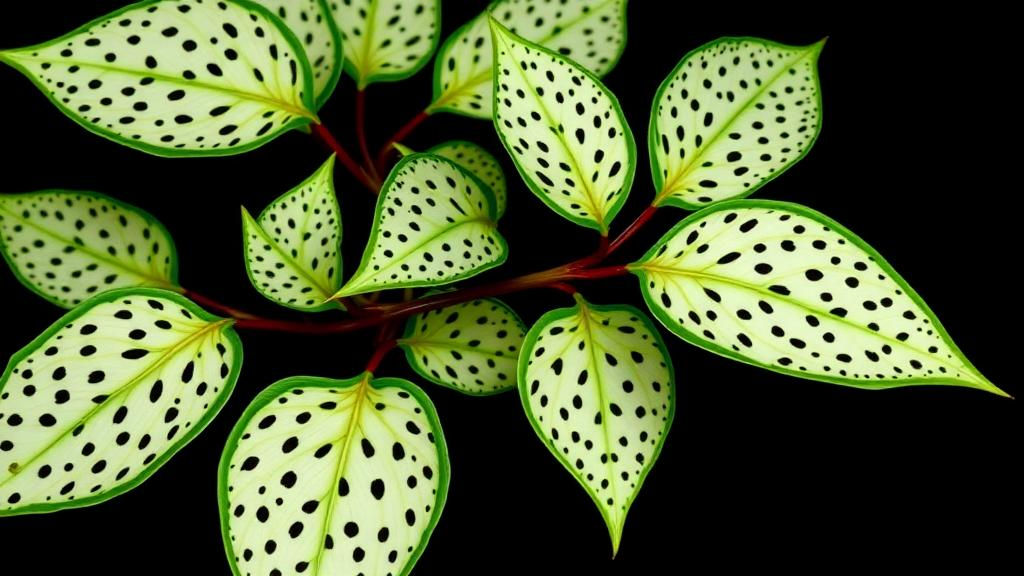
What makes Trichosanthes metamorpha immediately striking is a suite of characters that, taken together, do not overlap with any known relative. Its stems are completely glabrous and marked with tiny black dots about the size of a pinpoint, roughly 0.1 millimeters in diameter, densest at the nodes. Its basal leaves are dark glaucous green with reflective white patterning, a feature not documented in any examined material of its two closest morphological relatives, Trichosanthes dunniana and Trichosanthes pubera. The petals bear very short, dentate fringes, only 2.0 to 2.5 millimeters long, that are incurled and relatively thick yet brittle, in sharp contrast to the long, filiform, flat, and flimsy fringes of 8 to 12 millimeters found in both comparison species. The mature fruit is orange-yellow rather than red, and the seeds are broadly ellipsoid, pale brownish gray, and smooth, lacking the lateral ridges of T. dunniana or the concave surface ornaments typical of T. pubera.
The species also displays pronounced ontogenetic variation in leaf morphology, the trait that inspired its name. Basal leaves are mostly three-lobed and carry the white patterns, while apical or youngest leaves are usually deeply five-lobed and lack patterning altogether. This coordinated change in the degree of lobing and variegation along the stem can serve as an auxiliary diagnostic character, and the authors note that the ecological or developmental drivers of this heteroblastic shift remain to be studied. In the field, the plant grows at 300 to 1200 meters elevation, beneath damp rock walls and on forested slopes in relatively cool and moist environments, often in mountainous cultivated fields where local farmers regard it as a weed that negatively affects citrus cultivation.
To resolve the vine’s taxonomic status, the team combined classical herbarium work with genome-scale sequencing. Type specimens and large numbers of non-type specimens of closely related species were examined on site at herbaria HIB, K, and PE, and through digitized collections including the Chinese Virtual Herbarium, JSTOR Global Plants, and the Global Biodiversity Information Facility. Measurements were taken using ImageJ software, and voucher specimens were deposited in the herbaria of the Wuhan Botanical Garden and the Institute of Botany of the Chinese Academy of Sciences. Leaf material collected in the field and dried in silica gel yielded total genomic DNA, which was sequenced as paired-end reads on an Illumina HiSeq 2000 platform. The complete plastome was assembled with GetOrganelle using a reference sequence of T. pubera subsp. rubriflos, annotated with GeSeq, and manually reviewed, while nuclear ribosomal DNA sequences were assembled through the same workflow.
Two datasets anchored the phylogenetic analysis. The first was a plastid coding sequence dataset comprising 67 protein-coding genes shared among all sampled plastomes, built from 39 accessions of the tribe Sicyeae, including 32 accessions of Trichosanthes plus the newly generated plastome of the new species. This dataset spanned 57,566 aligned positions, of which 89.8 percent were identical, with an overall pairwise sequence identity of 99.1 percent. The second was a concatenated three-locus dataset combining the nuclear ribosomal internal transcribed spacer (ITS), the plastid matK gene, and the rpl20-rps12 region, comprising 72 accessions and 2,177 aligned positions with 52.3 percent identical sites. Luffa, Hodgsonia, and Sicyos served as outgroups, following the methodology of earlier studies of the genus.
Maximum likelihood analysis with IQ-TREE and Bayesian inference with MrBayes recovered identical topologies from the cp-CDS dataset. Trichosanthes metamorpha was placed within T. sect. Involucraria, as sister to T. pubera subsp. rubriflos with bootstrap support of 78 percent and a Bayesian posterior probability of 0.99. In that same analysis, T. dunniana and T. reticulinervis formed a strongly supported clade, with 100 percent bootstrap support and a posterior probability of 1.00, outside this lineage and sister to sect. Foliobracteola. The three-locus dataset, analyzed after an incongruence length difference test found no significant conflict between the nuclear ITS and plastid partitions, again placed the new species within sect. Involucraria, though as sister to a broader clade that includes T. tricuspidata, T. pubera subsp. rubriflos, T. pubera var. fissisepala, T. inthanonensis, T. lepiniana, and T. bracteata, with weaker support. The authors conclude that the combined morphological and molecular evidence firmly supports recognition of the Yangshuo population as a distinct species, even if its precise sister relationship within the section remains uncertain.
The phylogenetic results carry broader implications for the classification of the genus. Both datasets recovered T. dunniana and T. reticulinervis as a strongly supported clade separated from the main sect. Involucraria lineage, a result that agrees with recent large-scale analyses based on whole plastome data suggesting that Trichosanthes may be paraphyletic, with multiple genera nested within it. Those earlier analyses, however, covered only nine of the eleven sections recognized in the current infrageneric framework, leaving species-level representation incomplete. The authors therefore argue that current generic boundaries and infrageneric classification warrant further evaluation and revision with more comprehensive sampling and integrated evidence, while noting that a formal reassessment of sectional boundaries lies beyond the scope of the present study.
Within sect. Involucraria, the new species fits the traditional sectional concept in its persistent probracts, relatively large glandular male bracts, fimbriate petals, and dark green pulp, but its orange-yellow mature fruits and strongly reduced petal fringes broaden the known morphological variation within the group. The notably shortened, thickened, and brittle petal fringes represent one of its most distinctive floral characters. Male flowers open before dawn and emit an odor reminiscent of mushrooms and citrus, suggesting a possible association with nocturnal pollination, as reported in other species of Trichosanthes. Long and elaborate petal fringes have been implicated in pollinator attraction, particularly in moth-pollinated species, so whether the strongly reduced and thickened fringes of T. metamorpha serve a comparable function or reflect a different pollination biology remains an open question requiring direct observation of floral visitors.
The species is currently known only from two localities, Shihuiyao and Chahualing in Yangshuo County, each supporting more than 40 individuals. Analysis of twenty georeferenced records in GeoCAT yielded an extent of occurrence of 20.288 square kilometers and an area of occupancy of 40 square kilometers, and following IUCN Red List criteria the species is provisionally assessed as Vulnerable, VU B1ab(v)+2ab(v). Roadside clearing practices such as herbicide spraying and plant harvesting are current anthropogenic threats, and although access to the surrounding mountain slopes is difficult and additional plants may remain undetected, the picture is complicated by the plant’s own biology: female individuals appeared to be rare in the surveyed populations, severed rootstock fragments resprout along roadsides, and natural mortality sources include fungal infection and root damage caused by pillbugs. Nymphs of the melon stink bug Megymenum brevicorne were observed feeding on stems and leaves, and male inflorescences strongly attract ants, which were commonly seen beneath most male bracts. Dense white fungal mycelia colonizing leaf litter around the root zone were frequently noted in robust flowering individuals, an ecological association whose significance, like so much else about this remarkable new vine, awaits further study.
Subject of Research: Discovery and phylogenetic placement of the new plant species Trichosanthes metamorpha (Cucurbitaceae) from Guangxi, China
Article Title: Trichosanthes metamorpha ( Cucurbitaceae ), a striking new species from Guangxi, China
Article References: Trichosanthes metamorpha ( Cucurbitaceae ), a striking new species from Guangxi, China. (n.d.). https://doi.org/10.3897/phytokeys.280.190832
Image Credits: AI Generated
DOI: 10.3897/phytokeys.280.190832
Keywords: Trichosanthes metamorpha, Cucurbitaceae, new species, Guangxi, Yangshuo, molecular phylogenetics, plastome, taxonomic delimitation, heteroblasty, conservation, sect. Involucraria, China
Cite Scienmag News
Margaret Porter. (October 16, 2026). Pinpoint Black Dots and White-Patterned Leaves Reveal a Striking New Gourd Vine from Guangxi. Scienmag. https://scienmag.com/pinpoint-black-dots-and-white-patterned-leaves-reveal-a-striking-new-gourd-vine-from-guangxi/
Margaret Porter. "Pinpoint Black Dots and White-Patterned Leaves Reveal a Striking New Gourd Vine from Guangxi." Scienmag, 16 October 2026, https://scienmag.com/pinpoint-black-dots-and-white-patterned-leaves-reveal-a-striking-new-gourd-vine-from-guangxi/. Accessed 16 October 2026.
Margaret Porter. "Pinpoint Black Dots and White-Patterned Leaves Reveal a Striking New Gourd Vine from Guangxi." Scienmag. October 16, 2026. https://scienmag.com/pinpoint-black-dots-and-white-patterned-leaves-reveal-a-striking-new-gourd-vine-from-guangxi/