


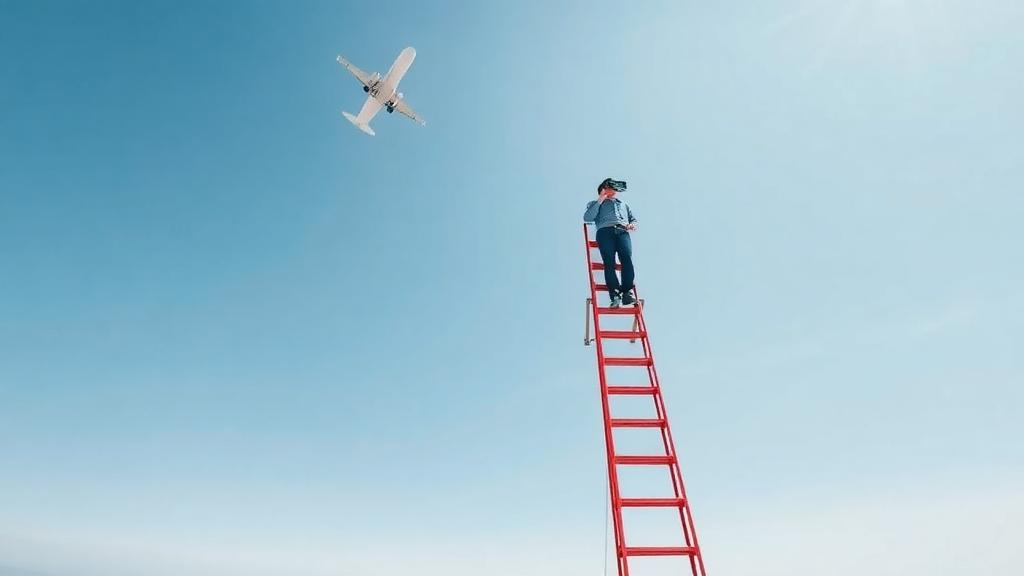
In a 10-person pilot study of virtual-reality ladder climbing, participants increasingly underestimated vertical distance as the simulated elevation rose while also reporting greater fear. The result emerged across eight virtual heights ranging from ground level to 100 meters above a to-scale cityscape. The pilot found no significant height-related differences in that muscle activity, showing that the perceptual and emotional responses did not have a clear physiological counterpart in the recorded leg muscles.
The experiment, conducted by Tianhang Liu and Heejin Jeong at Arizona State University, was designed to test the feasibility of an embodied VR ladder-climbing paradigm and generate preliminary estimates of perceptual, emotional and physiological responses. The participants had a mean age of 24 years with a standard deviation of 3.5 years, and three of the 10 were women. All had normal or corrected-to-normal vision.
Screening with the Visual Height Intolerance Severity Scale indicated that none met the threshold for acrophobic symptoms. Because the study was exploratory, the researchers did not perform a formal a priori power analysis; the small sample was intended to provide initial effect-size estimates and help determine whether a larger confirmatory study would be feasible. For the simulation, the researchers used a Meta Quest Pro headset to display a to-scale cityscape built in Unity, with a virtual ladder leaning against an office building and extending 120 meters from the ground.
Eight anchor locations along the ladder represented simulated elevations of 0, 0.5, 5, 10, 20, 40, 70 and 100 meters. In the laboratory, participants climbed an 8-foot A-frame ladder that was spatially aligned with the virtual ladder. Before data collection, researchers adjusted the virtual model until its lower rungs, side rails and climbing angle corresponded with the physical ladder from the starting position, then refined the alignment through the headset until the expected hand and foot contact locations matched.
The physical ladder remained fixed throughout the experiment. Each participant completed two exposure trials, with the eight heights presented in randomized order within each trial. A 10-second black screen separated successive conditions, after which the virtual viewpoint was moved to the selected elevation.
At each level, participants rated their fear on a scale running from 0 for no fear to 10 for extreme fear. They also estimated two vertical distances from eye level: the distance to the virtual ground directly below and the distance to the center of a red circular target positioned above them. They then climbed two steps up the physical ladder, held still for several seconds and descended two steps.
Participants rested for five minutes between the first and second exposure trials. The researchers defined distance-estimation error as the estimated distance minus the actual distance, meaning positive values indicated overestimation and negative values indicated underestimation. They used a linear mixed-effects model to account for repeated observations within participants while testing actual distance and viewing direction.
Actual distance significantly predicted estimation error, with F(1, 307) = 75.423 and p < 0.001. The negative regression coefficient, beta = -2.864 with a standard error of 0.330, indicated that underestimation became progressively more pronounced as the actual distance increased. The largest underestimation occurred at 70 meters, where the mean estimate was 59.0 meters with a standard error of 4.4 meters, and at 100 meters, where the mean estimate was 73.8 meters with a standard error of 6.4 meters.
Viewing direction did not significantly affect the estimates. The mixed-effects analysis returned F(1, 307) = 0.265 and p = 0.607 for the difference between looking upward and looking down, contrary to the researchers’ prediction that distances would be more strongly overestimated when viewed from above. Instead, the pattern was increasingly compressed at the greatest elevations.
The virtual scene offered limited environmental realism and did not deliberately incorporate additional visual depth cues. Participants later indicated that the greater number of environmental elements visible while looking down may have helped them judge distance. The authors also proposed that nearby features such as buildings and streets would occupy progressively smaller parts of the visual field as height increased, potentially weakening their value as reference points for absolute distance.
They presented this as a possible explanation, not a demonstrated mechanism. Subjective fear followed a separate but significant relationship with simulated height. A second linear mixed-effects model found that actual distance positively predicted fear ratings, with F(1, 134) = 183.464 and p < 0.001.
The regression coefficient was 0.057 with a standard error of 0.004, showing that participants reported more fear as the virtual elevation increased. Visual inspection of the ratings suggested that the increase became less pronounced at the highest elevations, which the authors described as consistent with a possible saturation effect. Visual scaling, environmental realism, prior exposure and the cognitive difficulty of estimating very large vertical distances may also have contributed to the observed pattern.
Fear ratings were lower during the second exposure trial than during the first. The mean was 2.68 with a standard deviation of 3.10 in trial two, compared with 3.07 with a standard deviation of 3.14 in trial one. A Wilcoxon signed-rank test found a significant difference between the trials, with z = -2.49 and p = 0.013.
This result is compatible with short-term familiarization or habituation to the virtual environment, although the study tested only two exposures and cannot establish how long such an effect might persist. The authors also noted that repeated experience with the same task may have influenced emotional responses even though the height sequence was randomized. The result means that a reduction in fear cannot necessarily be interpreted as a parallel normalization of distance perception.
Surface electromyography produced a different result. Eight wireless sensors recorded activity from the tibialis anterior, soleus, lateral gastrocnemius and medial gastrocnemius in each leg during the climbing task. Signals were sampled at 1,259 hertz, filtered between 20 and 500 hertz and normalized using each participant’s maximum voluntary contraction.
The first 20 seconds of inactive recording at each exposure served as a baseline. Baseline activation did not differ significantly across simulated heights for any of the four muscle groups, indicating broadly comparable pre-movement activation. Friedman tests also found no significant differences in activity during climbing across the eight elevations in either leg. For the left tibialis anterior, for example, chi-square(7) = 2.79 and p = 0.90; for the right soleus, chi-square(7) = 2.84 and p = 0.90.
The investigators suggested that the physical movement was mechanically similar in every condition because participants always climbed two rungs and descended two rungs on the same fixed ladder. Muscle activation may therefore have been driven primarily by the biomechanical demands of that movement rather than by the virtual elevation above the participant. The study’s findings remain preliminary because of its small sample, the absence of participants with clinically relevant acrophobic symptoms and the limited realism of the virtual environment, which lacked auditory cues and realistic haptic feedback and may have reduced physiological reactions.
Repeated exposure could also have shaped the fear ratings. Larger and more diverse samples, including people with clinically relevant fear of heights, would be needed to examine the pattern more broadly. Overall, the pilot shows that an embodied VR ladder task can produce height-related changes in subjective fear and vertical distance estimation without a detectable change in lower-limb muscle activity.
As simulated distance increased, participants judged the environment to be shorter than it actually was, most clearly at 70 and 100 meters, while their fear ratings rose. A second exposure was associated with lower fear, but not with evidence that perception had normalized. It does not establish that the same responses occur at real elevations, that virtual reality treats acrophobia or that any safety-training application is effective.
Its central methodological lesson is that perceived distance, fear and muscle activation should be measured separately rather than treated as interchangeable indicators of a user’s response to virtual height.
Subject of Research: Perceptual, emotional and muscle responses during embodied virtual-reality ladder climbing at simulated heights
Article Title: Exploring perceived distance in virtual reality during ladder climbing: a pilot study
Article References: Liu, T., & Jeong, H. (2026). Exploring perceived distance in virtual reality during ladder climbing: a pilot study. Frontiers in Virtual Reality, 7, Article 1785136. https://doi.org/10.3389/frvir.2026.1785136
Image Credits: AI Generated
DOI: 10.3389/frvir.2026.1785136
Keywords: virtual reality, ladder climbing, height perception, distance estimation, fear of heights, embodied perception, surface electromyography, pilot study, Exploring, perceived, distance, virtual
Cite Scienmag News
Glenn Wilkins. (October 21, 2026). Pilot VR ladder study links height to distance underestimation and fear. Scienmag. https://scienmag.com/pilot-vr-ladder-study-links-height-to-distance-underestimation-and-fear/
Glenn Wilkins. "Pilot VR ladder study links height to distance underestimation and fear." Scienmag, 21 October 2026, https://scienmag.com/pilot-vr-ladder-study-links-height-to-distance-underestimation-and-fear/. Accessed 21 October 2026.
Glenn Wilkins. "Pilot VR ladder study links height to distance underestimation and fear." Scienmag. October 21, 2026. https://scienmag.com/pilot-vr-ladder-study-links-height-to-distance-underestimation-and-fear/


