


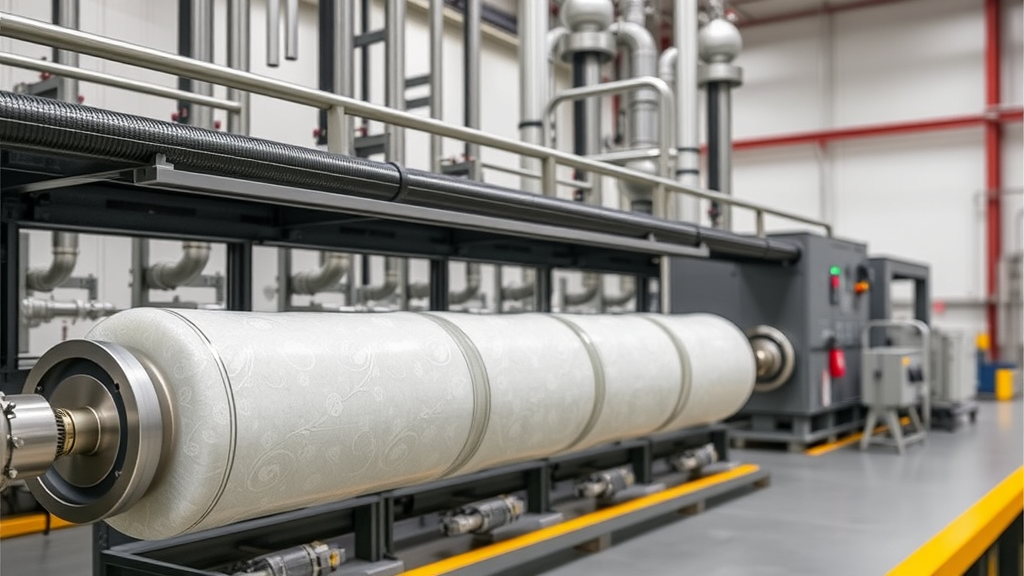
Turning carbon dioxide into useful chemicals rather than pumping it underground has long been one of the most seductive promises of the climate technology world. Now a team of South Korean researchers has moved that promise a significant step closer to industrial reality, demonstrating that an integrated pilot plant can continuously convert CO2-derived urea into battery-grade dimethyl carbonate and then into polymer-grade diphenyl carbonate, running for hundreds of hours without interruption, without catalyst bed plugging, and with material balances that close to within five percent. The study, published open access in Advances in Industrial and Engineering Chemistry, offers some of the most practical, long-duration evidence yet that carbon capture and utilization can anchor a genuinely non-phosgene carbonate manufacturing chain.
The chemicals at the heart of the work matter far beyond the laboratory. Dimethyl carbonate, or DMC, is a low-toxicity, biodegradable solvent with a growing role as an electrolyte component in lithium-ion batteries, whose demand is rising in step with global electrification. It is also the key intermediate for phosgene-free polycarbonate synthesis. Diphenyl carbonate, or DPC, is the canonical carbonate donor for making polycarbonate from bisphenol-A without the phosgene chemistry that has long plagued the industry with toxicity concerns and chlorinated waste streams. If captured CO2 can be converted into these molecules at scale, hard-to-abate sectors such as cement and steel, whose process emissions are largely unavoidable, would gain one of the few credible pathways toward deep emission reductions.
The research team, led by Namgyu Son and Sukyong Jung of the Research Institute of Industrial Science and Technology together with colleagues from Soulbrain, attacked the problem in two linked stages. In the first, urea itself is made from CO2 and ammonia, and the urea is then reacted with methanol over a zirconium-based catalyst to produce DMC. In the second stage, DMC is transesterified with phenol to make DPC. Both routes share a fundamental thermodynamic obstacle: they generate by-products, ammonia in one case and methanol in the other, that push the reactions backward. The entire process design therefore revolves around reaction-separation coupling, continuously stripping the by-products out of the reaction zone so the equilibrium must keep marching forward.
A crucial and often overlooked discovery concerned the catalyst itself. The researchers prepared zirconium precursors from three different commercial suppliers and found that, after identical drying treatments, the materials evolved into different crystallographic phases. Precursors from two suppliers converged to an amorphous, poorly crystalline Zr(OH)2(NO3)2-like network rich in accessible catalytic sites, achieving roughly 85 to 88 percent conversion in batch tests. A third supplier’s material retained a more highly hydrated crystalline phase and delivered only about 52 percent conversion. The lesson is stark: the hydration state and short-range order of the zirconium precursor, governed by supplier lot and drying history, directly determine catalytic performance, and controlling that drying protocol is essential for reproducible industrial operation.
With the high-activity catalyst in hand, the DMC pilot train ran three continuous campaigns totaling 211 hours. Two shorter campaigns focused on start-up stabilization and operating-window optimization, while the third delivered an extended 150-hour run. The reactors, two jacketed stirred packed vessels in series maintained at roughly 190 degrees Celsius and 3 to 5 bar, converted methyl carbamate intermediate into DMC while venting ammonia continuously. Across all three campaigns the plant produced 570.5 kilograms of DMC from 442.3 kilograms of urea, an overall yield of 85.9 percent relative to the 663.9-kilogram theoretical maximum. Productivity was remarkably consistent, averaging 2.70 kilograms per hour with campaign-to-campaign variation of less than six percent.
The product quality was the showstopper. Gas chromatography confirmed 99.93 percent purity, and the water content of 30 to 50 parts per million sits just above the battery-electrolyte specification but is easily removed by routine drying. Most remarkably, when the pilot DMC was formulated into a 1.2 M LiPF6 electrolyte and cycled 400 times in R2032 coin cells with NCM811 cathodes and graphite anodes at 45 degrees Celsius, capacity retention was 85.1 percent versus 84.9 percent for commercial battery-grade DMC. Coulombic efficiency, impedance, and initial efficiency showed no statistically significant differences. In plain terms, a solvent made from captured carbon dioxide performed indistinguishably from the fossil-derived benchmark in one of the most demanding commercial applications.
The second train tackled an even harder equilibrium problem. In batch testing at 200 degrees Celsius with lead oxide catalyst, phenol and DMC reached only about 45 percent phenol conversion, because the intermediate phenyl methyl carbonate accumulates and the second transesterification step is thermodynamically unfavorable. When the team added continuous methanol removal using a reflux configuration, a single batch test leapt to 86 percent conversion and roughly 85 percent DPC yield. That insight drove the pilot design: a fixed-bed PbO reactor at 195 to 200 degrees Celsius coupled directly to a distillation column that strips methanol overhead while recycled phenol returns to the feed, with a pressure step-down helping vaporize the methanol as it forms.
The DPC pilot then ran for roughly 180 hours of steady production following a 20-hour stabilization period, consuming 180.2 kilograms of phenol and 201.8 kilograms of DMC. Phenol conversion remained essentially quantitative throughout, a direct consequence of feeding phenol as the limiting reactant while continuously removing methanol to pull the equilibrium toward product. The final DPC yield, however, was 32.1 percent of the 204.98-kilogram theoretical limit, with 65.8 kilograms collected including an estimated 10.5 kilograms of in-equipment hold-up. Post-run inspection revealed the culprit: substantial quantities of the intermediate phenyl methyl carbonate and polymeric high-boiling residues trapped within the reactor and piping rather than appearing in the product stream. Recovering and reworking these hold-ups is identified as the clearest lever for yield intensification, alongside stronger methanol-removal driving forces and additional reaction stages dedicated to converting PMC into DPC.
The DPC product itself met polymer-grade requirements. Gas chromatography found no residual DMC and no distinct impurity peaks, and trial polymerization with bisphenol-A yielded polycarbonate with a relative viscosity of at least 0.5, comparable to material made from commercial phosgene-route DPC. A caveat remains on the catalyst: lead oxide is toxic, and although no bed plugging or pressure-drop anomalies occurred during the campaign, polymeric films on catalyst surfaces are known to progressively block active sites over longer horizons. Because in-situ regeneration risks lead leaching and creates hazardous waste streams, the team is already developing low-lead PbO-MgO formulations containing only 5 to 10 percent PbO, and in parallel pursuing entirely lead-free alternatives such as Mo-MgO and other non-toxic metal-oxide and solid-acid systems.
Taken together, the two trains sketch out something approaching a blueprint for sustainable carbonate manufacturing. Stable temperature and pressure profiles, controlled reflux ratios, column pressure drops within target bounds, and closed material balances over hundreds of hours demonstrate that this is not a laboratory curiosity but a technically feasible process architecture. The researchers frame the next phase clearly: integrate the DMC and DPC trains with polycarbonate production to realize a fully non-phosgene CO2-to-DMC-to-DPC-to-PC chain, valorize the ammonia by-product from the DMC route, and extend catalyst lifetimes through lower-toxicity formulations. For a chemical industry searching for practical ways to turn its largest liability into feedstock, this pilot-scale demonstration provides exactly the kind of long-duration, specification-compliant evidence that scale-up decisions demand.
Subject of Research: Pilot-scale continuous production of CO2-derived dimethyl carbonate and diphenyl carbonate via integrated reaction-separation coupling
Article Title: CO₂-to-carbonates via reaction–separation coupling: pilot performance of continuous DMC/DPC
Article References: Son, N., Jung, S., Jung, W., Lee, G. M., Kim, J., Yun, J. C., & Lee, S. H. (2025). CO₂-to-carbonates via reaction–separation coupling: pilot performance of continuous DMC/DPC. Advances in Industrial and Engineering Chemistry, 1(1), Article 39. https://doi.org/10.1007/s44405-025-00039-4
Image Credits: AI Generated
DOI: 10.1007/s44405-025-00039-4
Keywords: carbon capture and utilization, dimethyl carbonate, diphenyl carbonate, urea methanolysis, transesterification, zirconium catalyst, lead oxide catalyst, reactive distillation, lithium-ion battery electrolyte, polycarbonate, pilot plant, non-phosgene process
Cite Scienmag News
Faith Mcneil. (September 20, 2026). Pilot Plant Turns Captured CO2 Into Battery-Grade Carbonates in Continuous Runs. Scienmag. https://scienmag.com/pilot-plant-turns-captured-co2-into-battery-grade-carbonates-in-continuous-runs/
Faith Mcneil. "Pilot Plant Turns Captured CO2 Into Battery-Grade Carbonates in Continuous Runs." Scienmag, 20 September 2026, https://scienmag.com/pilot-plant-turns-captured-co2-into-battery-grade-carbonates-in-continuous-runs/. Accessed 5 October 2026.
Faith Mcneil. "Pilot Plant Turns Captured CO2 Into Battery-Grade Carbonates in Continuous Runs." Scienmag. September 20, 2026. https://scienmag.com/pilot-plant-turns-captured-co2-into-battery-grade-carbonates-in-continuous-runs/


