


More than two thousand years ago, on a gentle hill in Lower Austria, people gathered at two small square enclosures and buried the bones of cattle, horses, and pigs in carefully dug trenches. A new archaeozoological study of these deposits, published in the Annals of the Natural History Museum Vienna, reveals that the animals chosen for these rituals were anything but ordinary. The analysis shows that the Iron Age community at Roseldorf-Sandberg selected specific animals, of specific ages and sexes, and butchered them in distinctive ways, painting a vivid picture of ritual practice during the Middle La Tène period.
The site of Roseldorf lies about 70 kilometers northwest of Vienna, on the plateau and southern slope of the Sandberg hill. Covering roughly 38 hectares, it dates to the La Tène period and has been interpreted as a large central settlement. Within the northern part of the settlement, archaeologists identified cult district 2, containing two square enclosures labeled Objects 40 and 41, both interpreted as so-called Small Sanctuaries. The new research focuses on the animal remains recovered from the trenches of these two enclosures, comparing them with material already studied from the settlement itself and from the Great Sanctuary, Object 1, in cult district 1.
The assemblages differ strikingly in size and composition. Object 40 yielded 119 faunal remains weighing 2,739 grams, while Object 41 produced 1,050 remains weighing 6,228 grams. In Object 40, nearly all identified specimens belonged to domesticated species, with cattle dominating at 67.3 percent by specimen count and 81.6 percent by weight, followed by horse at 24.6 percent. Only two fragments, belonging to the European hare, represented wild animals. Object 41 told a very different story: pigs accounted for a remarkable 78 percent of identified specimens, while cattle made up 17.7 percent, and chicken appeared for the first time in the ritual record with two specimens. No wild species were identified there at all.
The age profiles of the slaughtered animals proved equally revealing. In the settlement, cattle were typically slaughtered at an older age, beyond seven years, after a lifetime of secondary exploitation for milk, labor, and breeding. In Objects 40 and 41, by contrast, the available teeth and epiphyseal fusion data indicate that cattle were mainly killed as young adults, between roughly three and seven years old, suggesting an emphasis on prime meat quality rather than economic efficiency. Sex estimation based on metapodial bones showed that castrated individuals predominated among the adult cattle in both enclosures, a pattern also seen in the settlement and the Great Sanctuary.
The pig remains from Object 41 were the most surprising of all. Epiphyseal analysis showed that 96.3 percent of the pig individuals were non-adult, a stark contrast to the settlement record, where adult pigs slaughtered at the optimal meat age of one and a half to two years prevail. Only two permanent third molars were recovered, pointing to animals between one and a half and two years old, while six milk teeth confirmed the young age of the rest. Comparable assemblages with such a strong prevalence of juvenile pigs are known from only one other La Tène site in the region, the sanctuary at Frauenberg near Leibnitz in Styria. The researchers suggest that young pigs, associated in many ancient traditions with fertility, abundance, and luck, played a central role in the rituals performed at Object 41.
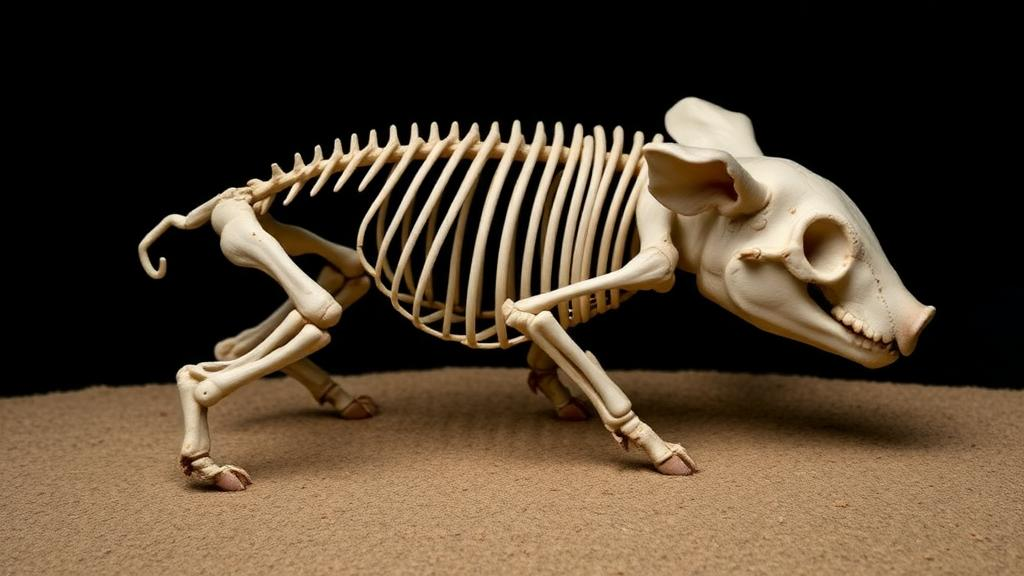
Even more remarkable was the discovery of four partially preserved skeletons of non-adult pigs within the trenches of Object 41, two in the northern trench, one in the eastern, and one in the western. Tooth eruption and wear in two of these skeletons, labeled B and D, indicated ages between six and nine months. Because pigs descend from the European wild boar, whose reproductive cycle typically produces spring births, the researchers concluded that the ritual activities in Object 41 most likely took place during late autumn or early winter. This is the first time seasonality has been reconstructed for ritual practices at Roseldorf, and it offers a rare temporal anchor for ceremonies that otherwise left few traces.
Butchery patterns added another layer of distinction. The bones from Objects 40 and 41 bore numerous chop marks indicating disarticulation, dismemberment, portioning, and marrow extraction, yet the specific techniques differed from those observed in the settlement. Scapulae, tibiae, and metapodials of cattle in the sanctuaries were split longitudinally, whereas the same bones from the settlement showed transverse chops. Horses received similar treatment, with tibiae and metapodials longitudinally split for marrow extraction, a practice not recorded in the settlement assemblage, and horse scapulae from Object 40 carried cut marks absent from the domestic material. Notably, the four piglet skeletons showed no butchery marks at all, setting them apart even from the other pig remains in the same trench.
Skeletal element distribution reinforced the picture of deliberate selection. In Object 41, both cattle and pigs were represented overwhelmingly by cranial elements, ribs, and vertebrae, with meaty limb regions and small foot bones appearing in much lower numbers. This contrasts sharply with the Great Sanctuary, where cattle and horses were mainly represented by fore and hind limbs and pigs by whole individuals, and with the settlement, where all major body regions of all domesticated species occur, indicating whole animals were present. The researchers interpret this strict preference for non-meaty regions in Object 41 as evidence of a different ritual logic governing which parts of which animals were deposited where.
The study also weighed the economic cost of these rituals. Slaughtering young castrated cattle meant forgoing all secondary exploitation of one of prehistory’s most valuable species. Horses, always expensive to keep and traditionally associated with prestige, power, and wealth, appeared in unusually high numbers in Object 40. One unusually large and robust cattle scapula from Object 40 raised the possibility of the exotic large-sized cattle morphotype previously documented at the Great Sanctuary, where genetic analyses have confirmed an allochthonous population originating from the south. Such cattle were rare in La Tène-period Austria, and acquiring them would have been difficult or costly. Taken together, these observations point to rituals of considerable expense, reflecting the great importance these ceremonies held for their participants.
By comparing species composition, age and sex distribution, body part representation, butchery marks, and preservation across the settlement, the Great Sanctuary, and the two Small Sanctuaries, the study demonstrates that ritual and daily life at Roseldorf followed distinct animal-selection strategies. The absence of burnt bones and gnawing marks in the ritual deposits, unlike in the settlement, further underscores the controlled character of these contexts. The findings not only illuminate the spiritual life of an Iron Age community in Lower Austria but also contribute to the broader debate about the function of square enclosures across the La Tène world, showing that even seemingly modest structures could host elaborate, costly, and seasonally timed ceremonies.
Subject of Research: Archaeozoological analysis of animal remains from La Tène period ritual enclosures at Roseldorf, Austria
Article Title: Archaeozoology of rituals: Objects 40 and 41 (“Small Sanctuaries”) of cult district 2 in Roseldorf (Lower Austria, Middle La Tène period)
Article References: Langnitschke, T., Holzer, V., Tiefengraber, G., & Saliari, K. (2025). Archaeozoology of rituals: Objects 40 and 41 (“Small Sanctuaries”) of cult district 2 in Roseldorf (Lower Austria, Middle La Tène period). Annals of the Natural History Museum Vienna, 126, 137-149. https://doi.org/10.3897/anhmw.168394
Image Credits: AI Generated
DOI: 10.3897/anhmw.168394
Keywords: archaeozoology, La Tène period, Iron Age, Roseldorf, ritual, animal sacrifice, square enclosures, Celtic sanctuaries, piglet skeletons, seasonality, Lower Austria, butchery marks
Cite Scienmag News
William Thompson. (October 16, 2026). Piglet Skeletons Reveal Seasonal Secrets of Iron Age Rituals in Austria. Scienmag. https://scienmag.com/piglet-skeletons-reveal-seasonal-secrets-of-iron-age-rituals-in-austria/
William Thompson. "Piglet Skeletons Reveal Seasonal Secrets of Iron Age Rituals in Austria." Scienmag, 16 October 2026, https://scienmag.com/piglet-skeletons-reveal-seasonal-secrets-of-iron-age-rituals-in-austria/. Accessed 16 October 2026.
William Thompson. "Piglet Skeletons Reveal Seasonal Secrets of Iron Age Rituals in Austria." Scienmag. October 16, 2026. https://scienmag.com/piglet-skeletons-reveal-seasonal-secrets-of-iron-age-rituals-in-austria/


