


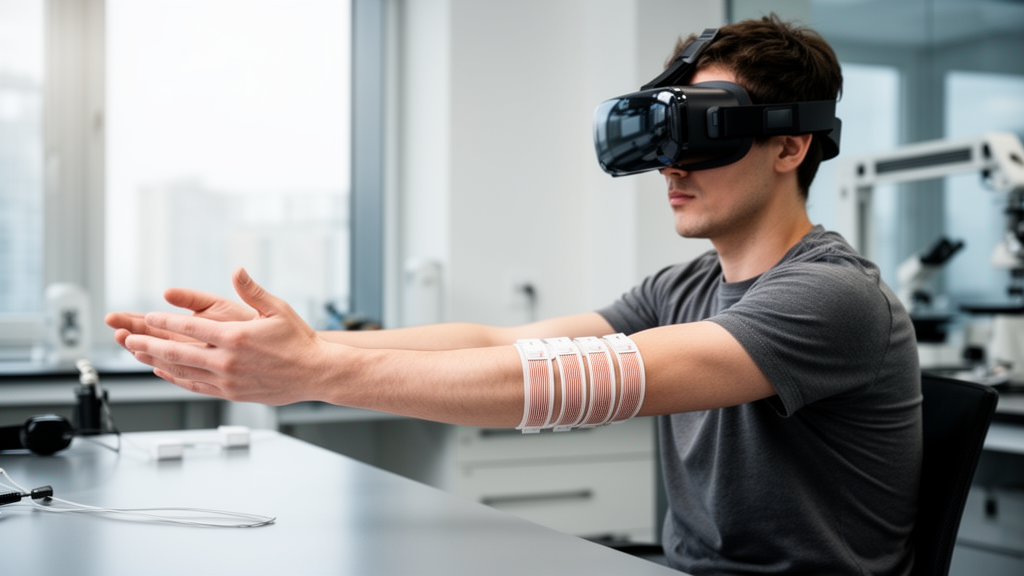
Researchers at the Santa Lucia IRCCS and Sapienza University of Rome have developed and validated an integrated virtual reality and electromyography platform that enables closed-loop, physiology-based motor interaction in immersive environments. Published as a methods evaluation in Frontiers in Human Neuroscience, the work addresses a major limitation in contemporary virtual reality neurorehabilitation, where user interaction has remained predominantly mediated by handheld controllers or motion-tracking hardware rather than directly engaging the physiological motor commands that drive voluntary movement.
The newly presented system combines a standalone virtual reality architecture with wearable electromyography sensors, online signal decoding, and cloud-based performance monitoring within a single unified framework. A standardized motor-command interface allows different electromyography acquisition devices to control both anthropomorphic and non-anthropomorphic virtual effectors without requiring modifications to the decoding algorithms or the virtual rehabilitation tasks.
To evaluate the system, the investigators conducted complementary technical and functional assessments across two supported electromyography acquisition setups. The technical validation assessed critical engineering benchmarks, including signal quality, communication latency, gesture classification accuracy, and overall system reliability, confirming stable closed-loop operation and dependable gesture recognition during interactive use.
Functional validation was performed with both able-bodied control participants and individuals with upper-limb amputation. Study participants completed structured object-interaction tasks across multiple immersive virtual scenarios, demonstrating the feasibility of using physiological motor commands to drive virtual interactions across different user groups.
Throughout the functional trials, the platform quantified multiple objective metrics to assess user performance. These measures included task scores, task completion time, precision errors, gesture classification errors, and the number of correctly recognized gestures, alongside user-reported workload assessments.
The authors emphasized that because the two electromyography hardware setups were assigned to different components of the evaluation, the study does not establish operational equivalence between them. Nonetheless, by dissociating physiological motor control from effector morphology, the platform establishes a versatile framework for prospective applications in neurorehabilitation, prosthetic training, and neuroimaging investigations pairing functional magnetic resonance imaging or high-density electroencephalography to track training-induced changes in brain organization.
The authors emphasize that modern neurorehabilitation increasingly focuses on harnessing experience-dependent neuroplasticity to support motor recovery. Although immersive virtual reality has emerged as a promising tool for enabling task-oriented training within ecologically valid scenarios that are difficult to reproduce in conventional clinical settings, traditional interaction paradigms impose notable operational limitations. In most existing virtual reality rehabilitation systems, interaction remains primarily mediated by external interfaces, such as motion tracking or handheld controllers, rather than by the user’s own physiological motor activity. Consequently, existing rehabilitation approaches often fail to directly engage the physiological motor commands that naturally drive voluntary movement. To resolve this shortcoming, the integrated platform unites a standalone virtual reality architecture with wearable electromyography systems, online electromyography decoding, and cloud-based performance monitoring within a single unified framework.
A pivotal architectural characteristic of the platform is its standardized motor-command interface, which decouples neuromuscular signal decoding from specific task environments. This standardized interface allows different electromyography acquisition systems to control both anthropomorphic and non-anthropomorphic virtual effectors without requiring any modifications to the underlying decoding strategy or the virtual rehabilitation scenarios. By dissociating motor control from the physical morphology of the controlled virtual effector, the system provides a versatile and flexible framework suitable for diverse therapeutic applications and experimental configurations. The engineering evaluation confirmed that this architectural separation operates reliably, allowing wearable electromyography sensors to communicate directly with standalone virtual environments.
Validation of the system incorporated complementary technical and functional assessments conducted across the two supported electromyography acquisition devices. The technical evaluation specifically targeted system-level performance benchmarks, examining communication latency, raw signal quality, gesture classification accuracy, and overall system reliability. These technical tests demonstrated dependable gesture recognition and confirmed that the closed-loop architecture operates with the stability required for interactive applications. During the subsequent functional validation, individuals with upper-limb amputation and able-bodied control participants performed object-interaction tasks across multiple immersive virtual scenarios. The functional trials verified the feasibility of the physiology-driven framework in practical use, showing that both clinical and non-clinical participants could effectively interact with virtual objects. Throughout these sessions, the integrated cloud-based infrastructure recorded objective performance metrics, including task score, task completion time, precision errors, gesture classification errors, correctly recognized gestures, and user-reported workload assessments.
Addressing the comparative scope of the hardware evaluation, the authors explicitly noted that because the two supported electromyography acquisition systems were utilized for different components of the validation process, the study does not establish operational equivalence in their performance. Despite this specific limitation, the findings substantiate the feasibility, technical reliability, and functional versatility of the proposed platform for physiology-driven motor interaction. Looking ahead, the researchers identify multiple prospective applications for the integrated technology. Beyond standard clinical rehabilitation and upper-limb prosthetic training, the platform offers a quantitative research tool for future neuroscience investigations. Specifically, the authors point to prospective studies combining the virtual reality electromyography platform with functional magnetic resonance imaging and high-density electroencephalography, which will enable researchers to directly investigate whether systematic motor training using physiology-driven virtual environments induces measurable changes in functional brain organization.
Subject of Research: Closed-loop electromyography-driven virtual reality motor interaction platform
Article Title: An EMG-driven virtual reality platform for physiology-based motor interaction: technical and functional validation
Article References: Betti, V., Marucci, M., Perciballi, C., Di Francesco, N., & Sili, D. (2026). An EMG-Driven Virtual Reality Platform for Physiology-Based Motor Interaction: Technical and Functional Validation. Frontiers in Human Neuroscience, 20, 1943080. https://doi.org/10.3389/fnhum.2026.1943080
Image Credits: AI Generated
DOI: 10.3389/fnhum.2026.1943080
Keywords: electromyography, virtual reality, neurorehabilitation, closed-loop interaction, motor control, upper-limb amputation, online EMG decoding, neuroplasticity, gesture classification, wearable EMG, virtual effectors, communication latency, performance monitoring, prosthetic training, task-oriented training, functional validation, technical validation
Cite Scienmag News
Ophelia Keating. (November 11, 2026). Physiology-Driven Virtual Reality System Enables Closed-Loop Motor Interaction Using Electromyography. Scienmag. https://scienmag.com/physiology-driven-virtual-reality-system-enables-closed-loop-motor-interaction-using-electromyography/
Ophelia Keating. "Physiology-Driven Virtual Reality System Enables Closed-Loop Motor Interaction Using Electromyography." Scienmag, 11 November 2026, https://scienmag.com/physiology-driven-virtual-reality-system-enables-closed-loop-motor-interaction-using-electromyography/. Accessed 11 November 2026.
Ophelia Keating. "Physiology-Driven Virtual Reality System Enables Closed-Loop Motor Interaction Using Electromyography." Scienmag. November 11, 2026. https://scienmag.com/physiology-driven-virtual-reality-system-enables-closed-loop-motor-interaction-using-electromyography/




