


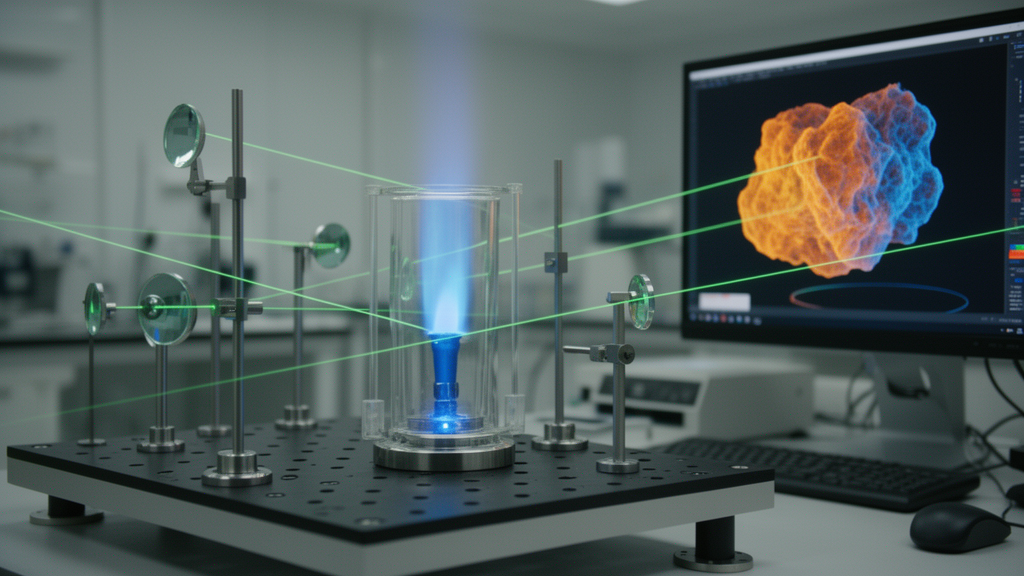
Reconstructing the temperature and concentration fields of a flame from a handful of laser beams is one of the stubborn problems in combustion diagnostics. A study published in Applied Physics B on 28 July 2026 reports a physics-guided stepwise tomography framework, or PSTF, that tackles this problem by breaking a single ill-posed inversion into three guided stages. Tested on large-eddy-simulation flame data and on an experimentally derived axisymmetric flame case, the framework achieved dataset-averaged temperature and concentration mean relative errors of 1.35% and 2.51%, with structural similarity indices of 0.991 and 0.989, on an in-distribution test set using only 40 optical paths and 2 absorption lines.
The physical setting explains why the problem is hard. Tunable diode laser absorption spectroscopy is prized in combustion research because it is nonintrusive, sensitive and quantitative, but it is a line-of-sight technique: a single beam yields only a path-integrated absorbance, not a spatial map. Tomographic absorption spectroscopy therefore needs many beams crossing the flame from different positions and directions. In real combustors, geometrically complex hardware often restricts optical access, so the number, angular coverage and spacing of beams are limited, and these layout factors cap the achievable spatial resolution. How well a reconstruction algorithm exploits the available projections then determines how close the result comes to that limit.
Classical algorithms each carry trade-offs under such sparse conditions. Filtered back-projection is computationally efficient and can deliver high-resolution reconstructions when projection data are dense and complete, but it is prone to significant artifacts when views are limited. Algebraic reconstruction techniques iterate toward feasible solutions from sparse data and are common in engineering practice, yet they typically invert temperature and concentration pixel by pixel through the nonlinear relation between absorption coefficients and temperature, which can amplify errors in the reconstructed absorption coefficients and produce structural distortions. Tikhonov regularization can suppress some artifacts, and simulated annealing offers an indirect route, but the latter usually requires many spectral lines for high accuracy. The authors argue that a methodology combining high accuracy and high resolution under sparse projections has remained a central challenge.
The PSTF answers with a staged design that embeds spectroscopic relations, the projection matrix and structural priors into separate steps rather than treating reconstruction as one end-to-end mapping. In the first stage, a physics-data collaborative reconstruction network called PDR-Net solves the nonlinear temperature inversion and produces a low-resolution temperature field. Its dual-branch structure is central: a pseudoinverse branch, initialized from the Moore-Penrose pseudoinverse of the projection matrix and constrained by two-line thermometry, supplies a physically grounded linear estimate, while a parallel data-driven convolutional branch learns from training data. A spatially adaptive weighting layer fuses the two, leaning on the pseudoinverse branch in smooth background regions and on the data-driven branch in intensely fluctuating flame interiors.
Two details of this network stand out. Direct use of the fixed pseudoinverse solution tends to produce star-shaped artifacts, streak-like distortions in which compact high-value regions spread along the available projection directions; under the four-direction layout, local high-absorption structures grow star-like tails along the 0°, 45°, 90° and 135° beam directions. Training therefore adjusts the pseudoinverse-initialized weights with a small learning rate, and the study shows that after training the weights of beams that do not traverse a given pixel are pushed toward near zero while contributions from beams that do pass through are retained. Compared with random initialization and initialization from the transpose of the projection matrix, the pseudoinverse start converged faster and its validation error tracked the training error, suggesting better generalization. The temperature output is also constrained to the physically meaningful 300 to 2000 K interval.
The second stage inverts concentration. Because water vapor is a typical combustion product, the framework uses two of its absorption lines, at 7185.6 and 7444.4 cm⁻¹, selected from the HITRAN database, and applies two-line thermometry to recover temperature from the ratio of absorbances. An improved multiplicative algebraic reconstruction technique, based on the general MART algorithm, then solves the linear concentration problem, using the reconstructed temperature field as a structural prior. A periodic fusion strategy blends the current iterative solution with the initial guess at fixed intervals, a weighted averaging that acts as spatial structure regularization and keeps the concentration field’s structure similar to the temperature field, suppressing error amplification without complex regularization terms. Parameters including the relaxation factor, fusion weight and fusion period were optimized with a genetic algorithm, converging to values of 1.55, 0.074 and 10, with a maximum of 90 iterations.
The third stage restores spatial detail. A superresolution network takes the low-resolution temperature and concentration fields as a dual-channel input, extracts shared spatial features, and upsamples both to 50 by 50 grids through subpixel convolution, followed by a convolutional postcorrection module that mitigates superresolution artifacts. The authors note that traditional bicubic interpolation, widely used in TDLAS studies, blurs fine-scale flow structures and is poorly suited to turbulent flames with sharp gradients. In comparisons on the test set, the superresolution network outperformed both bicubic interpolation and a baseline version without the postcorrection module in error and structural similarity, and in a representative sample with a hot central jet core, a surrounding vortex transition zone and an outer recirculation ring, it preserved the multiscale structure most clearly.
Validation proceeded through three cases of increasing distribution shift. Case A used in-distribution testing on a premixed methane flame dataset generated by large eddy simulation, built on an OpenFOAM tutorial case whose solver had been validated against prior experiments; 24,750 samples were split into training, validation and test sets, and a spatial generalization test trained on only 15 cross-sections per transient flame, representing 48% of the data, yet reconstructed unseen sections across the flame height. Case B applied the framework to a new simulated flame with modified inlet boundary conditions, a methane-air mixture at equivalence ratio 1 and different perturbation parameters; performance there was section-dependent, with representative noise-free longitudinal sections giving temperature errors of 4.54% to 7.67%, concentration errors of 5.55% to 14.11%, and structural similarity indices of 0.742 to 0.974 for temperature and 0.763 to 0.965 for concentration. Near-axis sections showed a systematic overestimation bias traced to the network being anchored to the training data’s value range. Case C, an experimentally derived axisymmetric flame case constructed from Sandia Flame D measurements by rotating axial and radial mean profiles around the central axis, showed that main jet, reaction-zone and diffusion-region structures could still be captured, with representative cross-sections achieving temperature errors below 5%, concentration errors below 8%, and structural similarity above 0.98 and 0.96 respectively.
Robustness and speed were also quantified. Under added Gaussian measurement noise rising from 0% to 15%, the framework’s averaged temperature and concentration errors on 50 test samples rose only from 1.76% and 4.36% to 2.63% and 5.44%, while an end-to-end comparison network and bicubic interpolation fared worse; structural similarity for concentration stayed above 0.97. Ablation experiments confirmed that removing the pseudoinverse branch mainly degraded temperature reconstruction, removing the MART structural constraint chiefly hurt concentration accuracy and structure, and removing the superresolution correction blurred fine-scale detail. Training all networks took about 18 minutes, and the three reconstruction stages together run in roughly 72 milliseconds per frame, about 13.9 frames per second, which the authors describe as potential for near-real-time reconstruction.
The authors are careful about scope. Because no public experimental datasets with ground-truth two-dimensional distributions for complex turbulent flames were available, the validation rests mainly on numerically generated projection data, and the Sandia-derived case, while experimentally informed, is not a direct tomographic measurement. The paper states that direct experimental TAS validation remains necessary before practical deployment in complex combustion environments, and future work will address laser linewidth broadening, etalon effects and calibration errors, along with data augmentation and measurement-only fine-tuning to improve behavior on unseen flame structures. Within those limits, the study presents a measured case that decoupling an ill-posed inverse problem and embedding physical laws as constraints can improve the reliability of neural-network tomography under sparse optical access, a route the authors suggest toward real-time combustion diagnostics in geometrically constrained settings.
Subject of Research: Physics-guided stepwise tomographic reconstruction of combustion temperature and concentration fields from sparse laser absorption measurements
Article Title: Physics-guided stepwise tomography framework for high-precision reconstruction of temperature and concentration
Article References: Jia, Y., Pang, D., Lei, J., Liu, P., & Zhou, X. (2026). Physics-guided stepwise tomography framework for high-precision reconstruction of temperature and concentration. Applied Physics B, 132(8), Article 96. https://doi.org/10.1007/s00340-026-08707-z
Image Credits: AI Generated
DOI: 10.1007/s00340-026-08707-z
Keywords: tomographic absorption spectroscopy, TDLAS, combustion diagnostics, temperature reconstruction, concentration reconstruction, neural networks, sparse optical access, large eddy simulation, Sandia Flame D, superresolution, MART algorithm, two-line thermometry
Cite Scienmag News
Katie Riggs. (October 30, 2026). Physics-guided three-step tomography reconstructs flame temperature and concentration from sparse laser views. Scienmag. https://scienmag.com/physics-guided-three-step-tomography-reconstructs-flame-temperature-and-concentration-from-sparse-laser-views/
Katie Riggs. "Physics-guided three-step tomography reconstructs flame temperature and concentration from sparse laser views." Scienmag, 30 October 2026, https://scienmag.com/physics-guided-three-step-tomography-reconstructs-flame-temperature-and-concentration-from-sparse-laser-views/. Accessed 30 October 2026.
Katie Riggs. "Physics-guided three-step tomography reconstructs flame temperature and concentration from sparse laser views." Scienmag. October 30, 2026. https://scienmag.com/physics-guided-three-step-tomography-reconstructs-flame-temperature-and-concentration-from-sparse-laser-views/









