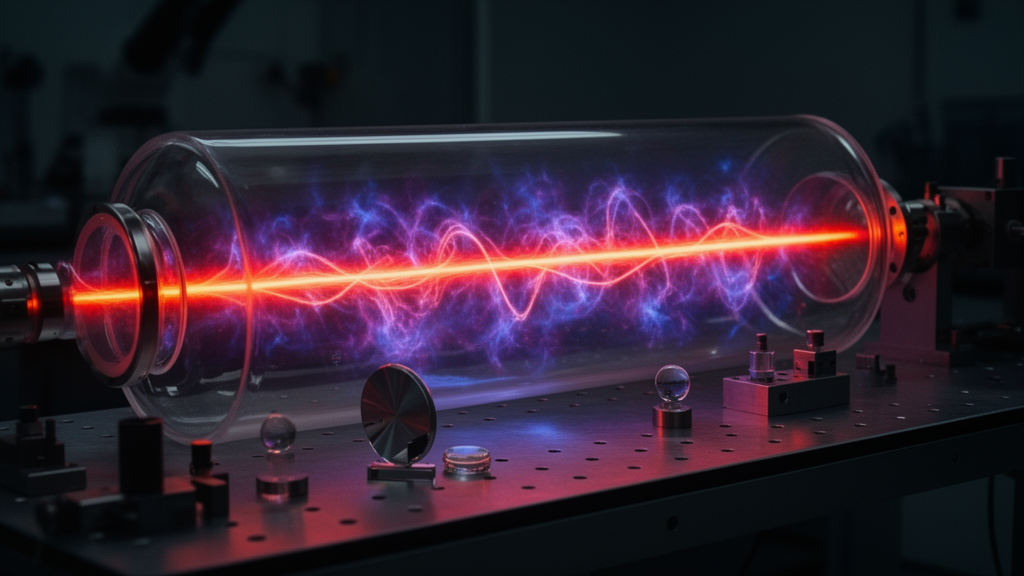
An intense laser beam punching through a dense plasma does not simply travel straight. Its own light field reshapes the plasma’s electrical response, and the plasma in turn squeezes, steers, and sometimes scatters the beam. A new theoretical study published in Applied Physics B by V. S. Pawar, S. R. Kokare and M. V. Takale now offers a fresh mathematical lens on this tug-of-war, treating the widening and narrowing of a finite Airy-Gaussian laser beam in a uniform, dense, collisionless plasma as the motion of an imaginary particle rolling through an energy landscape. The work, published on 4 September 2026, reformulates a long-standing description of beam spreading into a quasi-Hamiltonian framework that exposes the hidden dynamical structure behind self-focusing, self-trapping and defocusing.
The beams in question belong to a family that has fascinated optics researchers for years. Airy beams, named for the mathematical function that describes their amplitude, refuse to diffract in the ordinary way: they can bend sideways as they travel, heal themselves after encountering an obstacle, and hold their shape over surprising distances. A finite Airy-Gaussian beam, or AiG beam, wraps this exotic Airy profile inside a Gaussian envelope, which keeps the total beam energy finite and makes the profile practical for real laser systems. When such a beam enters a plasma, the intensity-dependent dielectric response of the medium — the fact that the plasma’s refractive behavior changes with the local light intensity — becomes the engine of nonlinear effects such as self-focusing, filamentation and beam modulation.
The theoretical scaffolding for this kind of problem goes back decades, to the work of Akhmanov and colleagues and its extension by Sodha and co-workers. Using the Wentzel-Kramers-Brillouin approximation and the paraxial ray approximation, researchers describe the beam by two dimensionless width parameters, f1 and f2, one for each transverse direction. Their evolution is governed by a pair of coupled differential equations — the beam width parameter differential equations — that blend ordinary diffraction with the nonlinear coupling between the laser and the plasma. For the specific case of finite AiG beams, the equations carry coefficients determined by the beam’s modulation parameters a and b, which control the transverse intensity distribution and are deliberately treated asymmetrically along the two orthogonal directions.
What the new paper does differently is to stop reading those equations merely as evolution rules and instead ask what kind of mechanical system they describe. The authors multiply each equation by the corresponding rate of change of its width parameter, add the results, and rewrite the combination as a total derivative with respect to the normalized propagation distance. When the coefficients are symmetric between the two transverse directions, the whole expression collapses to a statement that a certain quantity does not change during propagation. That quantity, which they call the propagational quasi-Hamiltonian functional, behaves like the total energy of a classical particle: a kinetic energy-like term built from the rates of change of the beam widths, plus an effective potential energy-like term combining diffraction, nonlinear plasma response and beam modulation.
The word quasi is doing honest work here. The authors are careful to note that the functional is not strictly conserved under all propagation conditions; the nonlinear coupling terms in the governing equations cannot, in general, be written as the exact gradient of a potential. For that reason they call the associated landscape an effective pseudo-potential rather than a true potential, and they emphasize that energy in this picture is only approximately conserved. In particular parameter regimes, however, the equations do approach the gradient form of a conservative dynamical system, and the functional then acts as an adiabatic invariant — a quantity that changes only very slowly, satisfying a near-conservation condition in which its rate of change stays far below unity even though it is not exactly zero.
Within this framework, the beam width parameters play the role of generalized coordinates and the propagation distance plays the role of time, so the beam’s journey through the plasma becomes the trajectory of an imaginary particle in a two-dimensional potential. The kinetic energy-like term measures how rapidly the beam width changes, characterizing what the authors call the dynamical scattering of the beam, while the pseudo-potential gathers the combined influence of defocusing, nonlinearity and the plasma response. The formulation passes sanity checks that anchor it to established theory: when the modulation parameters tend to zero, the finite AiG beam reduces to a conventional Gaussian beam and the equations recover the classical Gaussian self-focusing equation of Akhmanov and Sodha, while in the weakly nonlinear limit the equations reduce to linear diffraction-dominated propagation.
To judge whether a given propagation regime is stable, the authors turn to the Hessian matrix of the effective pseudo-potential — a two-by-two table of second-order partial derivatives whose diagonal entries measure the local curvature of the potential surface along each transverse direction and whose off-diagonal entries quantify the coupling between the two directions. The eigenvalues of this matrix serve as stability indicators: positive eigenvalues signal a locally stable regime associated with a potential minimum, while decreasing or negative eigenvalues point toward defocusing or instability. With asymmetric modulation parameters, the exact conservation of the quasi-Hamiltonian is generally broken, leading to attenuation and modified beam evolution, which makes the eigenvalue analysis all the more important for diagnosing how the beam actually behaves.
The numerical results, obtained with laser-plasma parameters adopted from earlier work by Nikam and colleagues, sort the beam’s fate into three regimes set by the normalized initial beam radius relative to a critical value. At the critical radius, the beam width parameters exhibit stable self-trapping throughout the propagation: the approximate conservation of the quasi-Hamiltonian reflects an equilibrium in which defocusing is exactly balanced by nonlinear self-focusing, and the beam settles at the minimum of the pseudo-potential with its width parameters reaching unity — the natural equilibrium state of the system. Above the critical radius, the beam width parameters oscillate in a bounded, stable way, with the local curvature of the pseudo-potential generating a restoring force that prevents unbounded spreading; at the turning points of these oscillations the kinetic energy-like term vanishes, the pseudo-potential curvature peaks, and the Hessian eigenvalues take large positive values, confirming a stable regime in which small perturbations produce constrained oscillations rather than runaway growth.
Below the critical radius, the picture changes in an instructive way. The balance between defocusing and nonlinear self-focusing fails, and the beam defocuses — but the authors stress that this happens not because the pseudo-potential itself decreases, rather because its local curvature weakens. As the curvature drops, the restoring forces responsible for confinement fade, the Hessian eigenvalues gradually decline, and the system drifts away from the stable equilibrium toward an unstable, strongly defocusing regime. This distinction between the depth of a potential and its curvature is one of the paper’s more counterintuitive takeaways: unlike a strictly conservative mechanical system, a lower pseudo-potential value does not imply greater stability here. What matters is the shape of the landscape around the beam’s current state.
The authors position the combined quasi-Hamiltonian and Hessian analysis as a physically transparent complement to the conventional beam width parameter approach, one that may be extended to more complex plasma environments. The practical stakes are not trivial: nonlinear beam propagation in uniform dense plasmas matters for plasma-based particle accelerators, laser-driven fusion research, photonic devices and plasma waveguides, all applications where knowing whether a laser beam will stay confined, oscillate stably, or blow apart determines whether an experiment works. Because the study is theoretical, its regimes and criteria rest on model assumptions — a non-relativistic, collisionless, uniformly dense plasma under the WKB and paraxial approximations — and validating them against experiments in real plasma conditions remains the natural next step. Still, by revealing an energy-like invariant and a curvature-based stability criterion hiding inside equations that researchers have manipulated for decades, the work shows that even familiar descriptions of laser-plasma interaction can still conceal unexplored dynamical structure.
Subject of Research: The nonlinear propagation and stability of finite Airy-Gaussian laser beams in uniform dense collisionless plasma, analyzed through a propagational quasi-Hamiltonian functional and effective pseudo-potential framework.
Article Title: Propagational quasi-Hamiltonian functional and stability analysis of finite Airy-Gaussian beams in uniform dense plasma
Article References: Pawar, V. S., Kokare, S. R., & Takale, M. V. (2026). Propagational quasi-Hamiltonian functional and stability analysis of finite Airy-Gaussian beams in uniform dense plasma. Applied Physics B, 132(10), Article 102. https://doi.org/10.1007/s00340-026-08710-4
Image Credits: AI Generated
DOI: 10.1007/s00340-026-08710-4
Keywords: laser-plasma interaction, Airy-Gaussian beams, self-focusing, quasi-Hamiltonian, plasma physics, nonlinear optics, beam stability, Hessian matrix, pseudo-potential, self-trapping, WKB approximation, dense plasma
Cite Scienmag News
Katie Riggs. (October 29, 2026). Physicists Recast Laser Beam Propagation in Plasma as a Dynamical System. Scienmag. https://scienmag.com/physicists-recast-laser-beam-propagation-in-plasma-as-a-dynamical-system/
Katie Riggs. "Physicists Recast Laser Beam Propagation in Plasma as a Dynamical System." Scienmag, 29 October 2026, https://scienmag.com/physicists-recast-laser-beam-propagation-in-plasma-as-a-dynamical-system/. Accessed 29 October 2026.
Katie Riggs. "Physicists Recast Laser Beam Propagation in Plasma as a Dynamical System." Scienmag. October 29, 2026. https://scienmag.com/physicists-recast-laser-beam-propagation-in-plasma-as-a-dynamical-system/