

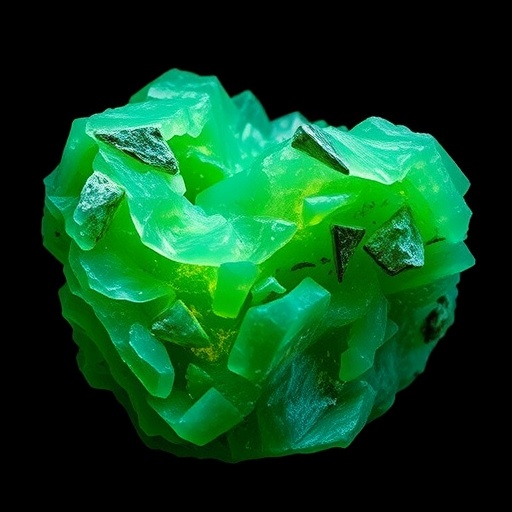
In a groundbreaking study recently published in Nature Communications, researchers have unveiled a critical factor that may have constrained phosphorus availability in early ferruginous oceans, thereby shaping the trajectory of life on ancient Earth. The team, led by Cui, Zhang, and Li, has identified phyllosilicate minerals as significant agents in adsorbing phosphorus, effectively limiting its bioavailability during key periods of Earth’s history. This discovery sheds new light on the complex interplay between geology and biology in primordial marine environments and opens fresh avenues for understanding the evolution of early ecosystems.
Phosphorus, an essential nutrient that serves as a fundamental component of DNA, RNA, ATP, and phospholipids, has long been recognized as a limiting nutrient in modern ecosystems. However, its bioavailability in early oceans, particularly during the Precambrian era, has remained poorly understood due to the scarcity of direct geological evidence and the complex chemistry of ancient seawater. The recent study tackles this enigma by exploring the role of phyllosilicates, a group of layered silicate minerals commonly found in sedimentary environments, in controlling phosphorus dynamics in ferruginous waters—oceans rich in dissolved iron but depleted in oxygen.
The research team employed a multidisciplinary approach combining sedimentology, geochemistry, and mineralogy to reconstruct the conditions prevalent in early marine environments. By simulating ancient ferruginous ocean chemistry in laboratory experiments, they demonstrated that phyllosilicates strongly adsorb phosphate ions, reducing the concentration of freely available phosphorus in seawater. This adsorption effect creates a geochemical sink, potentially limiting the nutrient’s accessibility to early microbial life, which depended on phosphorus for metabolic processes and growth.
One of the striking implications of this study lies in its challenge to prior assumptions about the productivity of ancient oceans. Until now, the availability of phosphorus was often inferred to be comparatively high in early iron-rich oceans, facilitating microbial proliferation and the eventual oxygenation of the atmosphere. However, the binding of phosphorus by phyllosilicates implies that despite an abundance of iron, key nutrients necessary for life were sequestered by mineral surfaces, possibly imposing stringent constraints on primary productivity for significant periods.
Moreover, the work provides fresh insight into the mechanisms governing nutrient cycling in paleo-environments. Phyllosilicates, due to their expansive surface area and layered structures, offer robust adsorption sites for phosphate, a property that intensifies under reducing conditions characteristic of ferruginous oceans. These conditions favor the preservation of iron in its soluble ferrous form, which further influences mineral formation and nutrient interactions, creating a feedback loop that may have stabilized low phosphorus concentrations.
The team’s methodology included advanced spectroscopic and microscopic analyses to characterize the mineral-phosphorus associations at the molecular level. Their findings elucidate the nature of the chemical bonds and coordination environments linking phosphate ions to phyllosilicate surfaces. Such detailed understanding helps reconstruct the geochemical processes of early Earth and offers analogs for interpreting mineral-nutrient interactions in both modern and extraterrestrial aquatic systems.
From a broader perspective, this research highlights the significant role mineralogy has played in directing the evolutionary landscape. Nutrient limitation driven by mineral adsorption not only impacts marine microbial communities but also influences biogeochemical cycles that regulate atmospheric composition over geological timescales. Understanding these constraints provides vital context for the delayed rise of oxygen and complex life forms observed in Earth’s history.
In the realm of astrobiology, these insights carry profound implications. The delicate balance of nutrient accessibility moderated by mineral-water interactions suggests that the habitability of ancient planetary oceans depends not just on elemental abundance but also on the geochemical environment’s capacity to retain or release bioavailable nutrients. Thus, planets or moons harboring ferruginous or clay-rich oceans might face hidden nutrient bottlenecks, influencing the likelihood of sustaining life.
This study further intersects with ongoing discussions about the evolution of phosphorus cycling mechanisms, including biological adaptations that may have emerged to overcome mineral-imposed limitations. Microbial strategies such as phosphatase enzyme production, phosphate uptake systems, and symbiotic relationships could be evolutionary responses fashioned by the selective pressure of low phosphorus availability in mineral-bound forms.
By integrating experimental data with geological modeling, the researchers provide a nuanced narrative of early ocean chemistry that reconciles mineralogical evidence with biological constraints. Their model suggests temporal and spatial variability in phosphorus bioavailability, controlled by factors like sedimentation rates, hydrothermal activity, and oxygenation events, painting a dynamic picture of ancient marine ecosystems.
Furthermore, the implications extend to the interpretation of sedimentary records. Phosphorus enrichment in ancient sediment layers, often interpreted as proxies for biological productivity, may need reassessment considering the mineral adsorption effects outlined in this study. This finding encourages a more critical approach in paleoenvironmental reconstructions and the search for biosignatures in the geologic record.
Future research inspired by this work will likely delve deeper into the kinetic aspects of phosphate adsorption and desorption on phyllosilicates under varying environmental parameters. Such investigations could elucidate the thresholds at which phosphorus becomes accessible or sequestered, influencing microbial ecosystem stability and resilience in early Earth analogs.
The pioneering nature of this research underscores the importance of interdisciplinary collaboration and methodological innovation in Earth sciences. By bridging mineralogy, geochemistry, and microbiology, Cui and colleagues have enhanced our understanding of the fundamental controls on life’s early chemical landscape and set the stage for further explorations into Earth’s formative years and planetary habitability.
In sum, the revelation that phyllosilicate adsorption served as a controlling factor in phosphorus bioavailability challenges existing paradigms, enriching our comprehension of ancient oceans’ nutrient dynamics. This discovery not only advances scientific knowledge of Earth’s past environments but also offers a valuable framework for addressing fundamental questions about the conditions that shape life’s origins and persistence across the cosmos.
Subject of Research: Phosphorus bioavailability limitation in early ferruginous oceans due to phyllosilicate adsorption.
Article Title: Phyllosilicate adsorption limited phosphorus bioavailability in early ferruginous oceans.
Article References:
Cui, X., Zhang, Z., Li, Q. et al. Phyllosilicate adsorption limited phosphorus bioavailability in early ferruginous oceans. Nat Commun (2026). https://doi.org/10.1038/s41467-026-69293-4
Image Credits: AI Generated


