

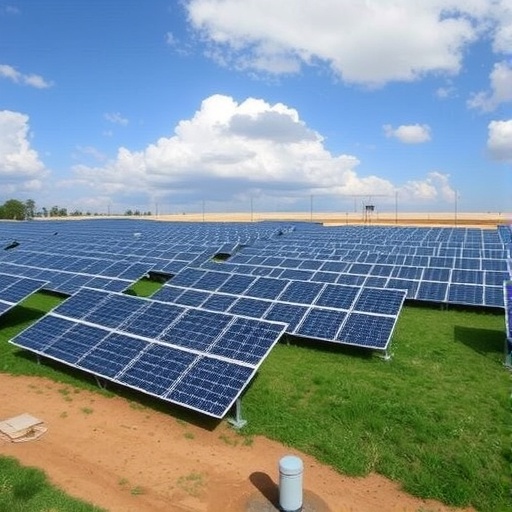
In an era where renewable energy technologies are rapidly transforming the global energy landscape, understanding the myriad factors influencing their performance has never been more crucial. Among these factors, climatic phenomena such as the El Niño–Southern Oscillation (ENSO) stand out as key drivers of variability in environmental conditions. A groundbreaking study by Feron, Cordero, Damiani, and colleagues, recently published in Communications Earth & Environment (2026), reveals the intricate ways ENSO modulates photovoltaic (PV) power generation across diverse regions. This study not only advances scientific understanding of solar energy resilience but also carries profound implications for energy policy and grid management in a warming world.
ENSO, a natural climate oscillation characterized by periodic warming (El Niño) and cooling (La Niña) of the central and eastern tropical Pacific Ocean, affects weather patterns worldwide. It influences temperature, cloud cover, precipitation, and atmospheric circulation—parameters fundamentally linked to solar irradiance reaching the earth’s surface. However, despite the known climatic influence of ENSO on macro-environmental conditions, its direct and quantifiable impacts on solar power generation have eluded comprehensive analysis until now.
The research team employed an extensive dataset integrating satellite-derived solar insolation measurements, ground-based PV performance records, and advanced climate models to dissect how ENSO phases modulate photovoltaic system outputs. Their analysis covered multiple geographical zones, from equatorial regions heavily influenced by ENSO to mid-latitude countries with more sporadic ENSO sensitivity. This multi-region approach illuminated not only regional vulnerabilities but also previously unrecognized patterns of solar energy variability driven by ENSO.
One of the study’s pivotal findings reveals that during El Niño phases, certain regions experience significant decreases in solar power generation, primarily attributable to increased cloud cover and atmospheric moisture. Conversely, La Niña events often bring about clearer skies and enhanced solar irradiance in some locales, improving PV output. However, the magnitude and direction of these effects vary spatially, underscoring the complexity of the ENSO-PV nexus.
At the mechanistic level, the researchers uncovered that the ENSO-induced changes in aerosol concentrations and humidity levels play crucial roles in attenuating or amplifying solar radiation through scattering and absorption processes. These atmospheric modulations translate into measurable changes in the photovoltaic system’s energy yield, sometimes fluctuating by as much as 15% over a typical El Niño or La Niña cycle in the most affected regions.
Importantly, this study also explored temporal aspects of ENSO’s influence on solar power production. Utilizing high-resolution temporal data, the research team demonstrated that photovoltaic output anomalies linked to ENSO events can persist for months, raising challenges for grid operators relying on consistent solar energy flows. Such persistence suggests that climate oscillations introduce a substantial degree of uncertainty into renewable energy forecasting models.
By integrating ENSO forecasts into solar energy yield predictions, utility companies could better plan for periods of diminished or enhanced solar generation, optimizing energy storage and alternative power sourcing. This predictive capability becomes critical as nations increasingly commit to ambitious clean energy targets and grid stability becomes paramount in the face of climate variability.
The implications of this research extend beyond immediate operational considerations. On a policy level, understanding ENSO’s influence on PV systems informs infrastructure investment decisions. Regions prone to significant ENSO-induced solar variability may prioritize hybrid renewable energy configurations or enhanced energy storage to cope with intermittent supply. Moreover, this knowledge enables tailored climate adaptation strategies within energy sectors vulnerable to ENSO-linked shifts.
Furthermore, the authors emphasize that this study is a stepping stone toward unraveling the broader effects of large-scale climate oscillations on renewable energy systems. Future research is encouraged to explore similar interactions with other oscillations such as the North Atlantic Oscillation (NAO) or the Indian Ocean Dipole (IOD), expanding the predictive framework for global renewable energy resilience.
The study also leverages machine learning algorithms to parse complex datasets, illustrating the power of artificial intelligence in climate-energy nexus research. These computational methods enhanced the detection of subtle patterns and enabled robust projections that accommodate nonlinear ENSO impacts on solar irradiance and PV output, heralding a new paradigm in energy climatology.
A salient feature of the findings is the spatial heterogeneity of ENSO effects. For instance, Southeast Asia exhibits pronounced solar power reductions during El Niño due to persistent haze and cloudiness, while parts of the southwestern United States experience moderate increases in solar generation under similar conditions. This geographic variability highlights the necessity for region-specific adaptation and risk management strategies in the renewable energy sector.
Moreover, the study addresses the interplay between ENSO-induced weather changes and photovoltaic system design factors. Variations in temperature can influence solar panel efficiency, as elevated temperatures generally reduce PV cell performance. The ENSO-driven temperature anomalies hence compound the effects of solar irradiance changes, emphasizing the multifaceted climate influence on solar power output.
In conclusion, this pioneering research elucidates the critical connection between large-scale climatic cycles and renewable energy generation, underscoring that the success of the solar transition depends on integrating climate variability into energy planning. As the world accelerates the shift toward sustainable power, insights like those provided by Feron and colleagues are indispensable for crafting resilient, reliable, and adaptive solar energy systems.
Their comprehensive approach, combining empirical data, climate modeling, and advanced analytics, sets a new standard for interdisciplinary studies at the intersection of climate science and renewable energy engineering. Policymakers, engineers, and energy stakeholders worldwide stand to benefit from incorporating ENSO-aware frameworks into renewable energy development and grid management, reaping the rewards of both environmental sustainability and energy security.
This research not only marks a milestone in solar energy climatology but also catalyzes a broader conversation about the dynamic challenges posed by climate variability to renewable infrastructures—challenges that demand innovative solutions and collaborative global efforts. As climate change intensifies, unmasking the nuanced influences of natural oscillations like ENSO will remain critical to safeguarding the future of clean energy.
Subject of Research: The study investigates the impact of the El Niño–Southern Oscillation (ENSO) on photovoltaic (solar) power generation, exploring the atmospheric and climatic mechanisms through which ENSO phases affect solar energy yield across different regions.
Article Title: Photovoltaic power response to El Niño–Southern Oscillation
Article References:
Feron, S., Cordero, R.R., Damiani, A. et al. Photovoltaic power response to El Niño–Southern Oscillation. Commun Earth Environ (2026). https://doi.org/10.1038/s43247-026-03343-z
Image Credits: AI Generated


