


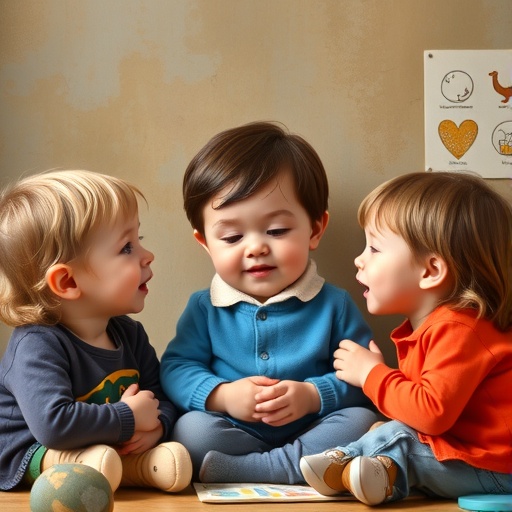
The formative years of childhood are a critical period in human development, laying the foundation for social, emotional, and cognitive abilities that persist throughout life. Recent research emerging from the interdisciplinary field combining philosophy, psychology, and early childhood education offers a compelling new perspective on how nurturing philosophical ethics during these early years can profoundly influence a child’s social–emotional competence and theory of mind. A study authored by Arda Tuncdemir, T.B., Burroughs, M.D., and Moore, G. published in 2022 sheds illuminating light on this intersection, suggesting that integrating philosophical discussions within early childhood can catalyze deeper social understanding and emotional regulation in young children.
Philosophical ethics, often perceived as an abstract discipline reserved for adult thinkers, concerns itself with concepts of right and wrong, justice, fairness, and empathy. Traditionally, these ideas have not been considered accessible or even suitable for preschool-aged children. However, recent pedagogical approaches challenge this notion, proposing that children as young as three or four are capable of engaging with rudimentary ethical reasoning. This research provides empirical evidence supporting the view that the development of philosophical ethics in early childhood is not only feasible but also immensely beneficial in fostering advanced cognitive skills linked to social cognition.
At the core of this investigation is the intricate relationship between philosophical ethics and theory of mind—a capacity for understanding that other people have thoughts, feelings, and perspectives different from one’s own. Theory of mind is foundational to complex social interactions and is typically assessed via tasks that measure a child’s ability to anticipate the beliefs and intentions of others. The researchers posit that through dialogic engagement with ethical scenarios, children enhance their meta-cognitive abilities, learning to navigate different viewpoints and cultural norms with greater sophistication and empathy.
The methodology underlying this study involved a longitudinal intervention where groups of preschool children participated in guided philosophical discussions framed within everyday ethical dilemmas. These sessions were carefully crafted to be developmentally appropriate, employing storytelling, questions, and role-playing exercises that invited children to consider scenarios involving fairness, harm, cooperation, and responsibility. Observations and standardized assessments of social–emotional competence and theory of mind abilities were conducted pre- and post-intervention, revealing marked improvements compared to control groups engaged in conventional early childhood curricula.
Social–emotional competence, encompassing skills such as emotional recognition, regulation, empathy, and effective interpersonal communication, serves as a key predictor of later life success and psychological well-being. The study highlights how philosophical ethics enrich this competence by continuously inviting children to reflect on moral principles and interpersonal dynamics in varied contexts. This reflective practice cultivates a heightened awareness of emotional states—both self and other—and nurtures the ability to respond adaptively in social settings, promoting prosocial behavior and reducing aggression.
One striking outcome of the research is the observable enhancement in children’s capacity for conflict resolution. As children engage with ethical principles such as fairness and justice, they develop constructive approaches to disagreement that emphasize dialogue and mutual understanding. The philosophical inquiry format encourages children to verbalize their reasoning, justify choices, and negotiate differences, fostering an internal framework conducive to peaceful conflict management. Such skills are vital, as early mastery of conflict resolution predicts improved peer relationships and academic readiness.
Beyond social behavior, the effect on theory of mind development is equally profound. Theory of mind is a multifaceted construct involving recognizing others’ mental states, understanding false beliefs, and predicting behavior based on others’ perspectives. The researchers found that children exposed to philosophical ethics interventions exhibited greater accuracy and speed in theory of mind tasks, suggesting that ethical discussions act as cognitive exercises that sharpen perspective-taking. This enhancement likely stems from the frequent practice children get when asked to put themselves in others’ shoes and weigh competing moral viewpoints, strengthening neural networks supporting social cognition.
Notably, the research underscores the importance of a supportive environment for optimal results. Teachers and caregivers trained to facilitate philosophical ethics discussions created safe, inclusive spaces where children felt encouraged to express thoughts without fear of judgment. This environment of respect and validation nurtured intellectual curiosity and emotional security, critical ingredients for sustained engagement and learning. The findings thus recommend professional development for early childhood educators to master the art of steering age-appropriate philosophical conversations.
The implications of these findings ripple through education policy and curriculum design. Incorporating philosophical ethics into early childhood programs promises to deepen cognitive and emotional development, equipping children with transferable skills indispensable in an increasingly complex social world. Given the rising concerns about childhood behavioral issues and mental health, interventions grounded in ethical reasoning may serve as preventive tools promoting resilience, empathy, and cooperation from the outset of formal education.
Furthermore, the study’s results contribute to theoretical debates about the nature of moral development in early childhood. Contrary to long-standing beliefs rooted in Piaget and Kohlberg’s stages—which posited that young children’s moral understanding is limited and egocentric—this research reveals a surprisingly rich ethical sensibility that can be catalyzed through appropriate methods. This challenges existing paradigms, opening avenues for multidisciplinary inquiry into how philosophical inquiry intersects with developmental psychology and neuroscience.
Technologically, future explorations could harness digital platforms to scale ethical discussions in diverse settings, particularly in under-resourced areas where trained facilitators are scarce. Interactive educational software designed to simulate philosophical dilemmas tailored to preschoolers could enhance accessibility and engagement, blending AI-driven personalization with human mentorship. The study thus lays the groundwork not only for theoretical advancement but also for innovative practical applications harnessing technology to democratize access to ethical education.
Ethical education in early childhood also carries profound societal ramifications. Cultivating empathy and moral reasoning from an early age can foster more inclusive societies, reducing instances of bullying, discrimination, and social exclusion. As children internalize concepts of justice and respect through playful but meaningful philosophical discourse, they potentially become agents of social change, promoting peace and cooperation on a global scale. This aligns with broader educational missions advocating holistic development that transcends academic achievement alone.
Nonetheless, challenges remain in implementing philosophical ethics widely within early childhood frameworks. Cultural variability in moral norms necessitates sensitive adaptations ensuring relevance and inclusiveness. Researchers must also dissect the nuanced interactions between philosophy, culture, language, and cognitive maturation to tailor interventions optimally. Additionally, longitudinal studies tracking long-term outcomes beyond preschool years are necessary to establish the enduring impact of such programs on life trajectories.
In conclusion, the pioneering research by Tuncdemir and colleagues signals a paradigm shift in how educators and psychologists conceptualize and nurture moral development during childhood. By embedding philosophical ethics in early education, we unlock untapped potential within young minds to process, reflect, and act upon complex social realities with empathy and insight. These findings beckon a future where holistic child development encompasses not only intellectual growth but also ethical wisdom, equipping generations for the multifaceted challenges of modern life.
Cite Scienmag News
Courtney Benton. (May 15, 2025). Philosophical Ethics Boost Preschoolers’ Social and Emotional Skills. Scienmag. https://scienmag.com/philosophical-ethics-boost-preschoolers-social-and-emotional-skills/
Courtney Benton. "Philosophical Ethics Boost Preschoolers’ Social and Emotional Skills." Scienmag, 15 May 2025, https://scienmag.com/philosophical-ethics-boost-preschoolers-social-and-emotional-skills/. Accessed 4 September 2026.
Courtney Benton. "Philosophical Ethics Boost Preschoolers’ Social and Emotional Skills." Scienmag. May 15, 2025. https://scienmag.com/philosophical-ethics-boost-preschoolers-social-and-emotional-skills/


