


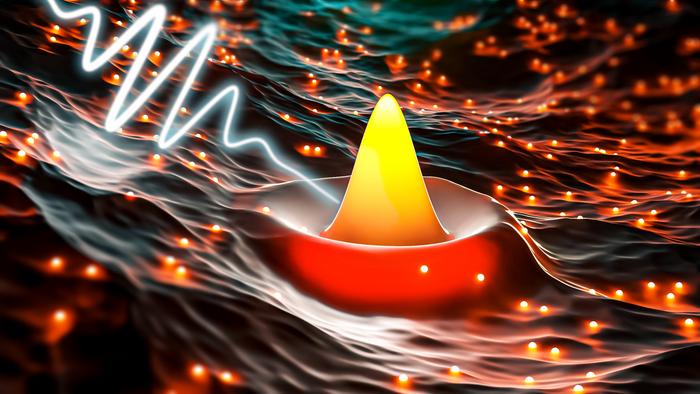
Thousands of particles of light can merge into a type of “super photon” under suitable conditions. Physicists call such a state a photon Bose-Einstein condensate. Researchers at the University of Bonn have now shown that this exotic quantum state obeys a fundamental theorem of physics. This finding now allows one to measure properties of photon Bose-Einstein condensates which are usually difficult to access. The study has been published in the journal Nature Communications.

Credit: Image: A. Erglis/Albert-Ludwigs University of Freiburg
Thousands of particles of light can merge into a type of “super photon” under suitable conditions. Physicists call such a state a photon Bose-Einstein condensate. Researchers at the University of Bonn have now shown that this exotic quantum state obeys a fundamental theorem of physics. This finding now allows one to measure properties of photon Bose-Einstein condensates which are usually difficult to access. The study has been published in the journal Nature Communications.
If many atoms are cooled to a very low temperature confined in a small volume, they can become indistinguishable and behave like a single “super particle.” Physicists also call this a Bose-Einstein condensate or quantum gas. Photons condense based on a similar principle and can be cooled using dye molecules. These molecules act like small refrigerators and swallow the “hot” light particles before spitting them out again at the right temperature.
“In our experiments we filled a tiny container with a dye solution,” explains Dr. Julian Schmitt from the Institute of Applied Physics at the University of Bonn. “The walls of the container were highly reflective.” The researchers then excited the dye molecules with a laser. This produced photons that bounced back and forth between the reflective surfaces. As the particles of light repeatedly collided with dye molecules, they cooled down and finally condensed into a quantum gas.
Super photons flicker like a candle
This process still continues afterwards, however, and the particles of the super photon repeatedly collide with the dye molecules, being swallowed up before being spat out again. Therefore, the quantum gas sometimes contains more and sometimes less photons, making it flicker like a candle. “We used this flickering to investigate whether an important theorem of physics is valid in a quantum gas system,” says Schmitt.
This so-called “regression theorem” can be illustrated by a simple analogy: Let us assume that the super photon is a campfire that sometimes randomly flares up very strongly. After the fire blazes particularly brightly, the flames slowly die down and the fire returns to its original state. Interestingly, one can also cause the fire to flare up intentionally by blowing air into the embers. In simple terms, the regression theorem predicts that the fire will then continue to burn down in the same way as if the flare up had occurred at random. This means that it responds to the perturbation in exactly the same way as it fluctuates on its own without any perturbation.
Blowing air into a photon fire
“We wanted to find out whether this behavior also applies to quantum gases,” explains Schmitt, who is also a member of the transdisciplinary research area (TRA) “Building Blocks of Matter” and the “Matter and Light for Quantum Computing” Cluster of Excellence at the University of Bonn. For this purpose, the researchers first measured the flickering of the super photons to quantify the statistical fluctuations. They then – figuratively speaking – blew air into the fire by briefly firing another laser at the super photon. This perturbation caused it to briefly flare up before it slowly returned to its initial state.
“We were able to observe that the response to this gentle perturbation follows precisely the same dynamics as the random fluctuations without a perturbation,” says the physicist. “In this way we were able to demonstrate for the first time that this theorem also applies to exotic forms of matter as quantum gases.” Interestingly, this is also the case for strong perturbations. Systems usually respond differently to stronger perturbations than they do to weaker ones – an extreme example is a layer of ice that will suddenly break when the load placed on it becomes too heavy. “This is called nonlinear behavior,” says Schmitt. “However, the theorem remains valid in these cases, as we have now been able to demonstrate together with our colleagues from the University of Antwerp.”
The findings are of huge relevance for fundamental research with photonic quantum gases because one often does not know precisely how they will flicker in their brightness. It is much easier to determine how the super photon responds to a controlled perturbation. “This allows us to learn about unknown properties under very controlled conditions,” explains Schmitt. “It will enable us, for example, to find out how novel photonic materials consisting of many super photons behave at their core.”
Participating institutes and funding:
The Institute of Applied Physics at the University of Bonn, the University of Antwerp (Belgium) and the University of Freiburg participated in the study. The project was supported by the German Research Foundation (DFG), the European Union (ERC Starting Grant), the German Aerospace Centre (DLR) and the Belgium funding agency FWO Flanders.
Publication: Alexander Sazhin, Vladimir N. Gladilin, Andris Erglis, Göran Hellmann, Frank Vewinger, Martin Weitz, Michiel Wouters and Julian Schmitt: Observation of nonlinear response and Onsager regression in a photon Bose-Einstein condensate; Nature Communications;
Contact:
Dr. Julian Schmitt
Institute of Applied Physics
University of Bonn
Tel. +49 228 73-60122
E-mail: schmitt@iap.uni-bonn.de
Journal
Nature Communications
Method of Research
Experimental study
Subject of Research
Not applicable
Article Title
Observation of nonlinear response and Onsager regression in a photon Bose-Einstein condensate
Article Publication Date
3-Jun-2024
Cite Scienmag News
Bethany Barker. (June 7, 2024). Perturbations simplify the study of “super photons”. Scienmag. https://scienmag.com/perturbations-simplify-the-study-of-super-photons/
Bethany Barker. "Perturbations simplify the study of “super photons”." Scienmag, 7 June 2024, https://scienmag.com/perturbations-simplify-the-study-of-super-photons/. Accessed 4 September 2026.
Bethany Barker. "Perturbations simplify the study of “super photons”." Scienmag. June 7, 2024. https://scienmag.com/perturbations-simplify-the-study-of-super-photons/

