


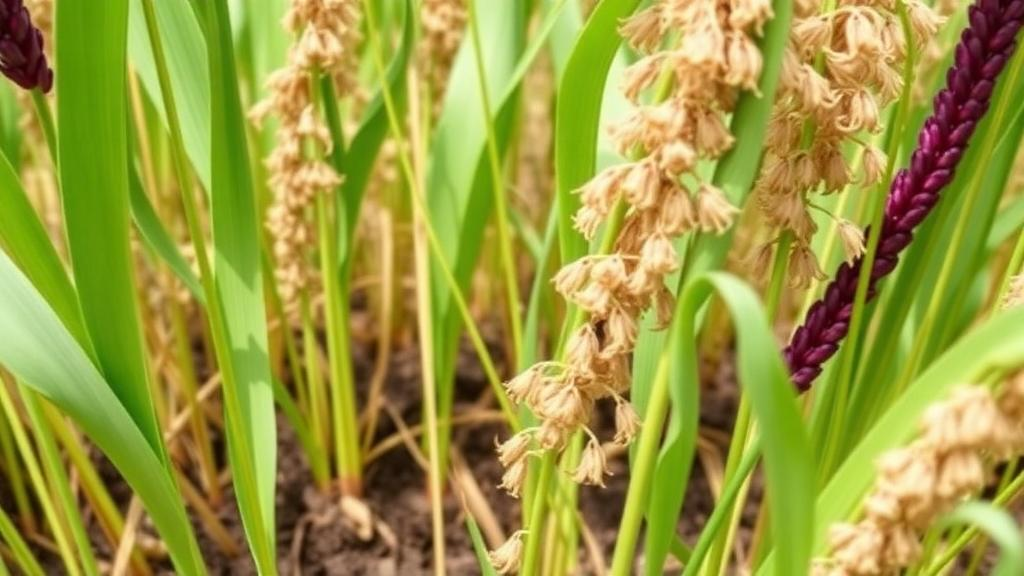
Perennial grain crops have long been promoted as a way to reconcile agriculture with soil health, but the genetics of staying alive through the winter has remained stubbornly opaque. A new study published in BMC Plant Biology by Pheonah Nabukalu of The Land Institute and colleagues, including Andrew H. Paterson of the University of Georgia and Auburn University, takes a careful, method-driven look at the genetic architecture of rhizome development in a diploid-derived perennial sorghum population. The work is notable less for delivering definitive answers than for the unusual rigor with which it frames what can and cannot be concluded from a single population with modest sample size and low trait heritability.
The researchers focused on S3011, an interspecific population derived from a cross between cultivated annual sorghum, Sorghum bicolor, and its wild perennial relative, Sorghum halepense, commonly known as Johnson grass. After hybridization, diploid progeny were recovered, and a structured F4 panel was developed for field evaluation. This material is scientifically valuable because perenniality in sorghum is thought to have been lost during domestication, and reintroducing it from the wild relative could, in principle, allow grain crops that regrow year after year without replanting. Rhizomes, the underground stems from which new shoots emerge, are a central component of that perennial persistence.
The team phenotyped the population under field conditions for two related but distinct traits: rhizome number and overwinter regrowth. Accession-level best linear unbiased predictors, or BLUPs, were computed to reduce noise from environmental and spatial variation, and these adjusted values were then used for genome-wide association analyses. Genotyping-by-sequencing yielded 43,317 single-nucleotide polymorphisms across the genome, providing a dense enough marker framework to scan for associations between genetic variants and the perenniality traits.
The headline statistical result is a study in transparency: no association exceeded the Bonferroni-adjusted genome-wide significance threshold of P at or below 1.15 times ten to the minus six, and none remained significant after Benjamini-Hochberg false discovery rate correction at a q-value below 0.05. In other words, by the strictest standards, the genome-wide association study produced no confirmed quantitative trait loci. Rather than burying this outcome, the authors used a predefined suggestive threshold of P below 0.0001, corresponding to a negative log10 P-value greater than 4, to identify 13 SNPs, which they consolidated into seven spatially distinct exploratory signals for rhizome number.
What elevates the study beyond a standard suggestive-threshold exercise is the battery of complementary analyses applied to each candidate region. The researchers examined high-low allele-dosage contrasts, asking whether plants carrying more copies of the associated allele produced more rhizomes than those carrying fewer. They characterized local linkage disequilibrium to understand how far each signal extended across the chromosome. They checked historical positional correspondence, comparing their regions with genomic intervals previously implicated in perenniality-related traits. They annotated positional candidate genes within each region. Finally, they ran a descriptive marker-based genome scan as an independent analytical method on the same dataset.
The strongest allele-dosage differentiation occurred at a signal the authors designate chromosome 1 cluster 2, marked by SNP S1_63359080, with a contrast value of plus 0.3364 that placed it at the 100.0th chromosome-relative percentile. A neighboring signal, chromosome 1 cluster 1 at SNP S1_62967991, showed a contrast of plus 0.3002 at the 99.3rd percentile. These two adjacent regions on chromosome 1 emerged as the most compelling of the seven exploratory signals, combining suggestive GWAS evidence with pronounced allele-dosage differentiation. The complementary marker scan showed within-dataset cross-method concordance for selected rhizome-number signals, including a region on chromosome 3, suggesting that the association patterns were not artifacts of a single analytical pipeline.
Overwinter regrowth told a different story. The trait produced three exact marker-level matches between the GWAS and the marker scan, but it lacked the localized multi-marker regional structure observed for rhizome number. This contrast is biologically meaningful: rhizome development appears to leave a more coherent genomic footprint, with several nearby markers reinforcing one another, whereas overwinter regrowth may be controlled by a more diffuse set of loci, by stronger environmental influences, or by both. The authors emphasize that rhizome development and overwinter regrowth, though both components of perennial persistence, may differ genetically and environmentally, and their data support treating them as separable breeding targets rather than a single trait.
The authors are unusually explicit about the limits of their concordance evidence. Because both the GWAS and the marker scan used the same S3011 dataset, agreement between them represents cross-method concordance rather than independent validation. Given the modest sample size, the low heritability of the traits, and the absence of associations surviving multiple-testing correction, all identified signals remain exploratory. The paper states plainly that the results do not establish confirmed QTL or causal loci. This kind of calibrated language is rare and welcome in a field where suggestive associations are sometimes oversold, and it sets a clear agenda: the seven rhizome-number regions and the regrowth markers now need testing in independent populations and environments before any breeding utility can be claimed.
For the perennial agriculture movement, the study is best understood as a prioritization tool. By ranking candidate regions according to allele-dosage differentiation, local linkage disequilibrium structure, historical correspondence with prior QTL, and candidate-gene content, the researchers have generated a short list of genomic neighborhoods worth pursuing. The chromosome 1 clusters stand out, the chromosome 3 region gains support from cross-method agreement, and the candidate-gene annotations provide starting points for functional work. Validation in larger, independent populations, ideally with higher heritability through multi-environment testing, will determine whether any of these exploratory signals can be converted into markers useful for breeding perennial sorghum.
The broader significance lies in the honest template the study offers for complex-trait genomics in orphan and emerging crop systems. Perenniality is a polygenic, environmentally sensitive trait, and the reality is that a single F4 panel will rarely deliver definitive loci. By combining a conventional GWAS with allele-dosage contrasts, linkage disequilibrium profiling, historical QTL comparison, candidate-gene annotation, and a parallel genome scan, and by reporting every negative result, Nabukalu and colleagues have shown how exploratory genomic signals can be characterized responsibly. The work was supported by the Malone Family Land Preservation Foundation and the Perennial Agriculture Project, a joint initiative of The Land Institute and the foundation. If the prioritized regions hold up in validation, the study will be remembered as an early step toward grains that come back on their own each spring; if they do not, the framework for evaluating them will remain a model worth copying.
Subject of Research: Genetic architecture of rhizome development and overwinter regrowth in diploid perennial sorghum
Article Title: Genetic architecture of rhizome development in diploid perennial sorghum reveals exploratory genomic signals with heterogeneous complementary support
Article References: Nabukalu, P., Kong, W., Cox, S., Reeves, J., & Paterson, A. H. (2026). Genetic architecture of rhizome development in diploid perennial sorghum reveals exploratory genomic signals with heterogeneous complementary support. BMC Plant Biology. https://doi.org/10.1186/s12870-026-09930-8
Image Credits: AI Generated
DOI: 10.1186/s12870-026-09930-8
Keywords: perennial sorghum, rhizome development, overwinter regrowth, genome-wide association study, Sorghum halepense, allele dosage, linkage disequilibrium, quantitative trait loci, plant genetics, perennial agriculture, SNP markers, interspecific hybridization
Cite Scienmag News
Juliet Wilcox. (October 1, 2026). Perennial Sorghum Study Maps Exploratory Genomic Signals Behind Rhizome Growth. Scienmag. https://scienmag.com/perennial-sorghum-study-maps-exploratory-genomic-signals-behind-rhizome-growth/
Juliet Wilcox. "Perennial Sorghum Study Maps Exploratory Genomic Signals Behind Rhizome Growth." Scienmag, 1 October 2026, https://scienmag.com/perennial-sorghum-study-maps-exploratory-genomic-signals-behind-rhizome-growth/. Accessed 4 October 2026.
Juliet Wilcox. "Perennial Sorghum Study Maps Exploratory Genomic Signals Behind Rhizome Growth." Scienmag. October 1, 2026. https://scienmag.com/perennial-sorghum-study-maps-exploratory-genomic-signals-behind-rhizome-growth/


