


When someone collapses in cardiac arrest outside a hospital, the first few minutes are everything. Survival depends overwhelmingly on whether a bystander steps in to start cardiopulmonary resuscitation, the simple but physically demanding rhythm of chest compressions that keeps blood flowing to the brain and heart until defibrillation or advanced care arrives. Yet across much of the world, including Malaysia, most laypeople have never been trained to do it, or trained so long ago that their skills and confidence have faded. A new two-phase study published in PLOS One by Siew-Keah Lee and colleagues at a tertiary institution in Selangor, Malaysia, offers a detailed snapshot of this gap among university students and a promising, low-cost way to begin closing it: a two-hour workshop taught not by professional instructors but by the students’ own peers.
The research team set out to answer two questions. First, how much do university students actually know about CPR, and how willing and confident are they to perform it in an emergency? Second, can a brief, peer-delivered workshop measurably shift those variables? The answer to the first question, drawn from a cross-sectional survey of 431 students, was sobering but nuanced. Students generally held positive attitudes toward CPR and expressed willingness to help a stranger in cardiac arrest, but their actual knowledge of how to perform it and their belief in their own ability to do so lagged well behind. In other words, the will was there; the skill and the self-assurance were not.
To measure these dimensions systematically, the researchers used a validated questionnaire covering knowledge, attitudes, behavioral intention, and self-efficacy, a combination abbreviated as KABSE. Self-efficacy, a concept rooted in psychological theory, refers to a person’s belief in their own capacity to execute a specific behavior, and it is widely regarded as a critical predictor of whether training translates into action. Someone can memorize the compression rate of 100 to 120 per minute and the depth of 5 to 6 centimeters, but if they do not believe they can actually push hard enough on a stranger’s chest in a crowded shopping mall, the knowledge may never be used. The survey design allowed the team to examine not just each domain separately but the statistical associations among them.
The demographic patterns that emerged were striking. Female students scored higher on knowledge and attitudes, while male students reported greater self-efficacy, a divergence the authors suggest may reflect gendered differences in confidence rather than competence. Older and married participants showed better attitudes, plausibly reflecting greater life experience and a heightened sense of responsibility for others. Unsurprisingly, students with a healthcare-related background scored higher on knowledge, attitudes, and self-efficacy than their peers from other disciplines, although notably their behavioral intention was not significantly different, suggesting that even clinical training does not automatically convert into a stronger stated resolve to intervene.
Three factors stood out as consistently linked to better scores across the domains: awareness of automated external defibrillators, the ability to use one, and recent CPR training. AEDs are portable devices that analyze the heart’s rhythm and deliver a shock if needed, and they are increasingly installed in public spaces, yet many people walk past them daily without knowing what they are or how to deploy them. The finding that AED awareness and hands-on capability tracked so closely with overall CPR readiness underscores a central theme of resuscitation science: these skills are perishable, and they decay quickly without reinforcement. Students trained within the past two years were meaningfully better prepared than those whose training was older or absent altogether.
The statistical analysis also revealed significant interconnections among the four KABSE domains, reinforcing the idea that knowledge, attitude, intention, and confidence do not operate in isolation. A student who knows what to do is more likely to feel able to do it; a student who feels able is more likely to intend to act. This web of relationships matters for intervention design, because it suggests that a training program targeting only one link, say, knowledge alone, may fail to produce a bystander willing to kneel down and begin compressions. Effective programs must move the whole system at once.
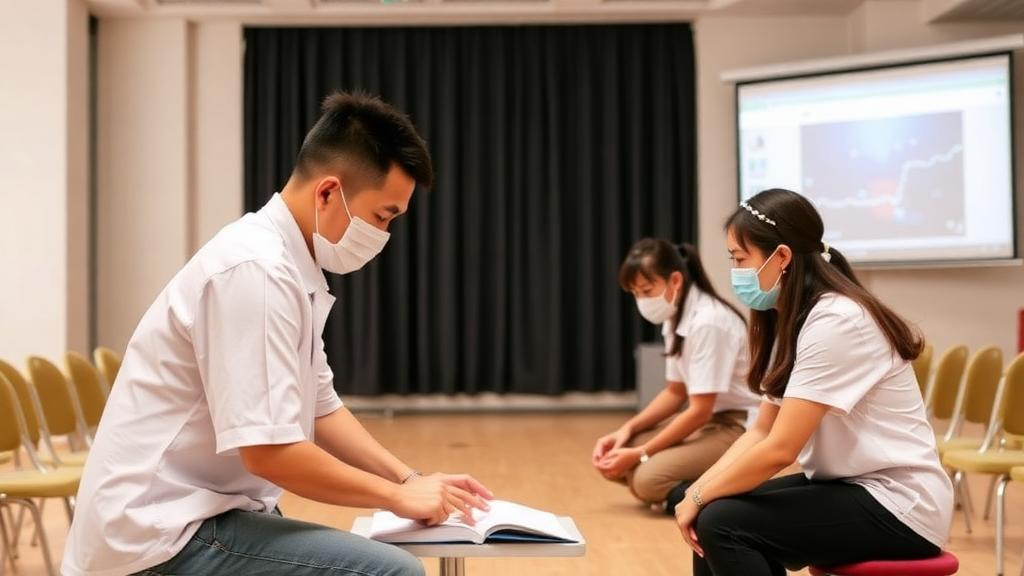
That is precisely what Phase 2 attempted. The researchers recruited 33 students who had received no CPR training in the previous two years and enrolled them in a two-hour workshop delivered by medical students rather than professional resuscitation instructors. The peer-led model has an appealing economics and sociology to it: medical students consolidate their own learning by teaching, the cost is minimal, the instructors are culturally and linguistically closer to their audience, and the informal setting may lower the intimidation barrier that sometimes accompanies formal certification courses. The workshop was explicitly framed as a proof of concept rather than a definitive trial, with a small sample and no control group, but the results were nonetheless compelling.
Comparing pre- and post-workshop questionnaire scores, the team found statistically significant improvements in every domain measured. Knowledge rose sharply, with p-values below 0.001, as did attitude and self-efficacy. Behavioral intention, the domain that had been relatively high to begin with, also improved significantly, at p below 0.01. In the space of a single afternoon, students who had arrived with faded or nonexistent training reported not only knowing more about CPR but believing more strongly that they could and would perform it. The magnitude and consistency of these gains, across all four psychological domains simultaneously, is what distinguishes the finding from studies that improve knowledge alone while leaving confidence untouched.
The caveats are real and the authors are candid about them. Thirty-three participants is a small cohort, the absence of a control group means some of the improvement could reflect test-retest effects or enthusiasm rather than the workshop itself, and the outcomes were self-reported rather than demonstrated on manikins under objective assessment. Self-efficacy measured by questionnaire is not the same as compression quality measured by a feedback device, and the durability of the gains over weeks and months remains unknown. Whether a two-hour session produces bystanders who actually intervene months later is the question that only a larger, controlled, longitudinal study can answer.
Even so, the study lands at a moment when the case for universal bystander CPR training has never been stronger. Out-of-hospital cardiac arrest remains a leading cause of death worldwide, and survival rates in most countries hover in the single digits, largely because help arrives too late. University students, socially active, densely concentrated on campuses, and positioned to carry skills into families and workplaces, are an ideal vector for community-wide preparedness. If a peer-led model can be scaled, validated with objective skill assessments, and refreshed at regular intervals to counteract skill decay, it could offer Malaysian institutions, and institutions elsewhere, a practical template for turning a generation of willing but unprepared students into confident first responders. The heart of the finding is simple: the willingness was already there, waiting for the knowledge and confidence to catch up, and two hours of peer teaching proved enough to start closing that gap.
Subject of Research: CPR knowledge, willingness, and self-efficacy among Malaysian university students and the effect of a peer-led CPR workshop
Article Title: Knowledge, willingness, and self-efficacy in CPR: A two-phase study of prevalence and preliminary peer-led workshop in a Malaysian tertiary institution
Article References: Lee, S.-K., Hoo, L. J., Koh Raj, R. Z., Yeo, I. K. L., Beh, Y. W., Ibrahim, R., Liew, K. B., Chew, Y.-L., Tan, E. S. S., & Chua, A.-L. (2026). Knowledge, willingness, and self-efficacy in CPR: A two-phase study of prevalence and preliminary peer-led workshop in a Malaysian tertiary institution. PLOS One, 21(10), e0360510. https://doi.org/10.1371/journal.pone.0360510
Image Credits: AI Generated
DOI: 10.1371/journal.pone.0360510
Keywords: cardiopulmonary resuscitation, CPR training, peer-led workshop, self-efficacy, out-of-hospital cardiac arrest, university students, Malaysia, automated external defibrillator, bystander response, public health, health education, PLOS One
Cite Scienmag News
Courtney Benton. (October 14, 2026). Peer-Led CPR Workshop Boosts Knowledge and Confidence Among Malaysian University Students. Scienmag. https://scienmag.com/peer-led-cpr-workshop-boosts-knowledge-and-confidence-among-malaysian-university-students/
Courtney Benton. "Peer-Led CPR Workshop Boosts Knowledge and Confidence Among Malaysian University Students." Scienmag, 14 October 2026, https://scienmag.com/peer-led-cpr-workshop-boosts-knowledge-and-confidence-among-malaysian-university-students/. Accessed 14 October 2026.
Courtney Benton. "Peer-Led CPR Workshop Boosts Knowledge and Confidence Among Malaysian University Students." Scienmag. October 14, 2026. https://scienmag.com/peer-led-cpr-workshop-boosts-knowledge-and-confidence-among-malaysian-university-students/


