


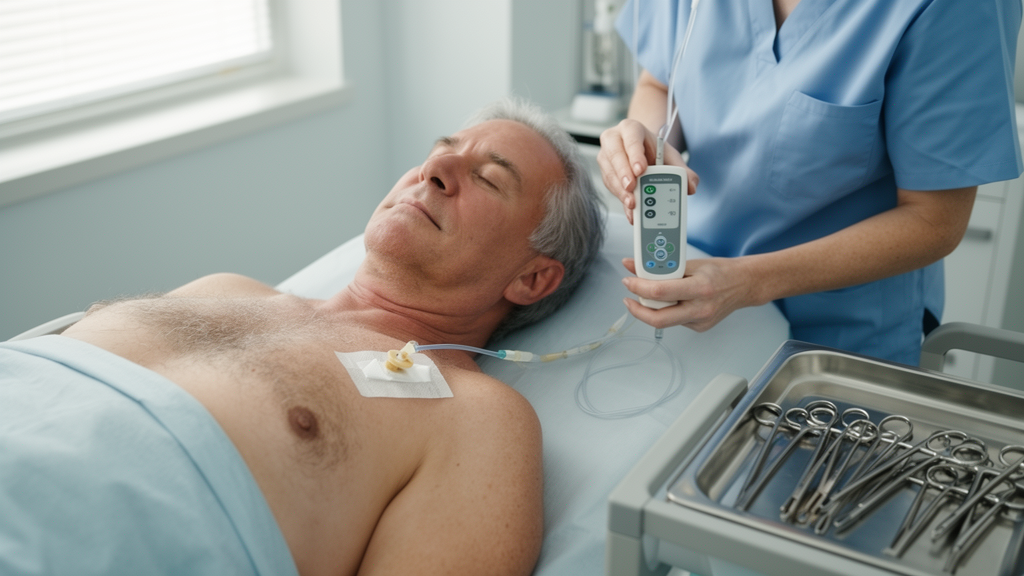
Patient-controlled sedation added to local anaesthesia did not improve overall postoperative recovery compared with local anaesthesia alone in a prespecified substudy of the PACSPI-2 randomised, open-label trial involving adults with cancer undergoing subcutaneous venous port implantation. The analysis found no overall difference in total Quality of Recovery-15 (QoR-15) scores between the treatment groups, although recovery patterns differed over time and a transient within-group improvement in emotional state and psychological support was observed before discharge in the sedation group.
The substudy was conducted at two Swedish anaesthesia departments, Linköping University Hospital and Ryhov County Hospital in Jönköping. Eligible participants were adults aged 18 years or older with a confirmed cancer diagnosis who were scheduled for port implantation. They were allocated in a 1:1 ratio to local anaesthesia alone or local anaesthesia combined with patient-controlled sedation using propofol and alfentanil. The parent trial’s primary endpoint was maximal intraprocedural pain, while the primary outcome of this substudy was the difference in postoperative total QoR-15 scores between groups.
The QoR-15 is a validated patient-reported measure covering pain, physical comfort, physical independence, psychological support and emotional state. Scores range from 0 for very poor recovery to 150 for excellent recovery, and the published minimal clinically important difference used in the analysis was 6 points. The questionnaire was administered before surgery, after the procedure but before discharge, and by telephone on postoperative day 1. Secondary outcomes included changes in QoR-15 domains and individual items, postoperative pain and analgesic consumption.
The trial was unblinded, and the repeated-measures analysis used available observations from randomised participants within the intention-to-treat population. Of 340 patients randomised, six were excluded after investigators identified that they met exclusion criteria. The final population comprised 334 patients: 168 received local anaesthesia alone and 166 received local anaesthesia plus patient-controlled sedation. One patient in the local-anaesthesia group had an unsuccessful implantation and lacked primary outcome data. Postoperative day 1 follow-up was incomplete for 16 patients, or 9.6%, in each group. A complete-case sensitivity analysis was consistent with the primary analysis.
Preoperative mean QoR-15 scores were 122.4 with a standard deviation of 19.3 in the local-anaesthesia group and 119.9 with a standard deviation of 21.6 in the sedation group. There was no overall difference in total postoperative QoR-15 scores between groups (P = 0.61). Before discharge, the between-group mean difference was 1.9 points (95% confidence interval −0.6 to 4.4; P = 0.14), and on postoperative day 1 it was −2.4 points (95% confidence interval −5.1 to 0.2; P = 0.07). These comparisons did not show a statistically significant between-group difference at either postoperative assessment.
Total QoR-15 scores changed significantly over time in both groups (P < 0.001), with a significant group-by-time interaction (P = 0.02). By postoperative day 1, mean scores had increased from baseline by 2.9 points in the local-anaesthesia group and by 3.1 points in the sedation group, with P = 0.02 for both changes. Neither increase exceeded the published minimal clinically important difference of 6 points. The sedation group recorded its largest within-group increase before discharge: 5.6 points (95% confidence interval 3.1 to 8.1; P < 0.001), also below that threshold.
The emotional-state and psychological-support domains changed significantly over time, and their patterns differed between treatment groups. Both domains reached their highest scores before discharge in the sedation group but not in the local-anaesthesia group. Individual-item analyses identified differences over time for support from hospital staff, feeling sad or depressed, and ability to breathe easily. These domain and item findings were exploratory because the analysis did not adjust for multiple comparisons, so the authors cautioned that isolated statistically significant results could reflect chance findings. The transient pattern was not a demonstrated causal effect of sedation; the authors noted that relief after completing the procedure and support from the healthcare team might also have contributed.
Postoperative pain remained common. The pain domain was the only QoR-15 domain to decline significantly from baseline in both groups on postoperative day 1. Maximum pain that day had a median numerical rating scale score of 3, with an interquartile range of 2 to 5, in both groups (P = 0.86). Ratings of at least 4 were reported by 74 of 151 evaluable patients in the local-anaesthesia group, or 49.0%, and by 71 of 148 in the sedation group, or 48.0% (odds ratio 1.042, 95% confidence interval 0.66 to 1.64; P = 0.86).
Additional pain medication was taken by 98 patients, or 64.9%, in the local-anaesthesia group and 108 patients, or 73%, in the sedation group; paracetamol was the most commonly used analgesic in both groups. The findings have important limitations. Approximately one-third of those who declined participation wanted sedation, potentially limiting generalisability to patients most likely to seek it. The lack of blinding may have affected subjective patient-reported outcomes, and incomplete day 1 follow-up further constrained the repeated-measures analysis. Because the recovery analysis was a prespecified secondary analysis and domain and item tests were not adjusted for multiple comparisons, the authors classified the findings as exploratory.
Subject of Research: Postoperative recovery after patient-controlled sedation during venous port implantation in adults with cancer
Article Title: Quality of recovery (QoR-15) after patient-controlled sedation during venous port implantation: A prespecified substudy of the PACSPI-2 randomised clinical trial
Article References: Seifert, S., Nilsson, A., Azman, J., Eriksson, O., Chew, M. S., Hammarskjöld, F., & Taxbro, K. (2026). Quality of recovery (QoR-15) after patient-controlled sedation during venous port implantation: A prespecified substudy of the PACSPI-2 randomised clinical trial. PLOS One, 21(10), e0360479. https://doi.org/10.1371/journal.pone.0360479
Image Credits: AI Generated
DOI: 10.1371/journal.pone.0360479
Keywords: patient-controlled sedation, venous port implantation, Quality of Recovery-15, postoperative recovery, cancer care, local anaesthesia, postoperative pain, randomised clinical trial, Quality, recovery, QoR-15, patient-controlled
Cite Scienmag News
Nathaniel Bowman. (October 20, 2026). Patient-controlled sedation did not improve overall recovery after venous port implantation in adults with cancer. Scienmag. https://scienmag.com/patient-controlled-sedation-did-not-improve-overall-recovery-after-venous-port-implantation-in-adults-with-cancer/
Nathaniel Bowman. "Patient-controlled sedation did not improve overall recovery after venous port implantation in adults with cancer." Scienmag, 20 October 2026, https://scienmag.com/patient-controlled-sedation-did-not-improve-overall-recovery-after-venous-port-implantation-in-adults-with-cancer/. Accessed 20 October 2026.
Nathaniel Bowman. "Patient-controlled sedation did not improve overall recovery after venous port implantation in adults with cancer." Scienmag. October 20, 2026. https://scienmag.com/patient-controlled-sedation-did-not-improve-overall-recovery-after-venous-port-implantation-in-adults-with-cancer/


