


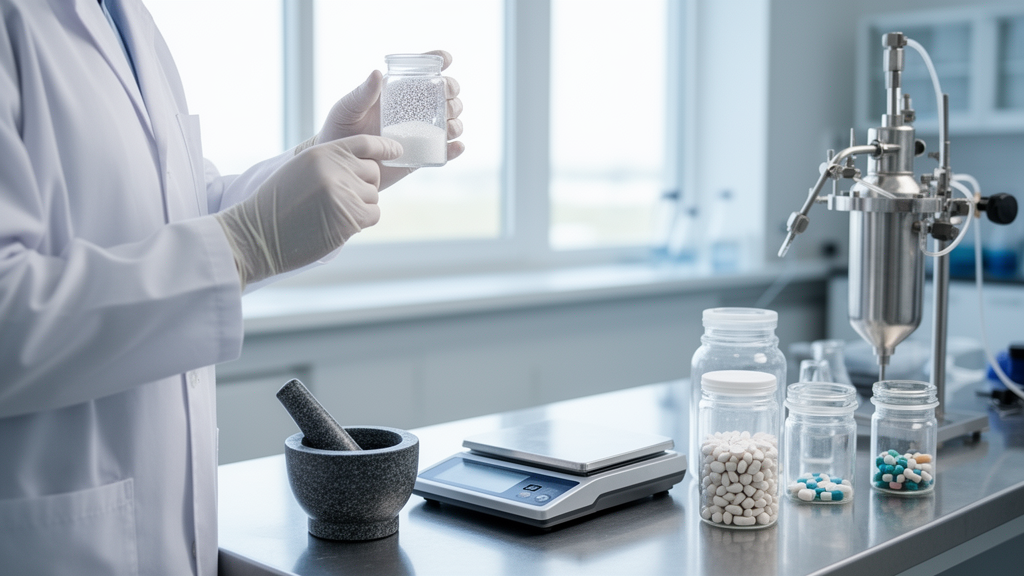
The Journal of Pharmaceutical Investigation has announced a special issue devoted to translational advances in pharmaceutical dosage form development, with a focus on particle engineering and formulation science. The issue, tentatively titled Translational Advances in Pharmaceutical Dosage Form Development Based on Particle Engineering and Formulation Science, is scheduled for publication in January 2027, with a submission deadline of June 30, 2026. Guest editors Sung-Joo Hwang of Yonsei University, Min-Soo Kim of Pusan National University, and Heejun Park of Duksung Women’s University in South Korea are assembling contributions that span the full journey of a drug product, from engineered particles in the laboratory to scaled-up commercial manufacturing.
The announcement arrives at a moment when the pharmaceutical industry faces a widening gap between molecular discovery and deliverable medicine. A large share of drug candidates emerging from modern discovery pipelines are poorly soluble in water, a property that can undermine oral absorption, injectable formulation, and inhalable delivery alike. Particle engineering has become one of the most powerful responses to this challenge, because the physical characteristics of a powder, including particle size, size distribution, shape, surface area, and crystalline form, directly govern how a drug dissolves, how stable it remains on the shelf, and how much of it reaches the bloodstream.
At the heart of this field lies a deceptively simple principle articulated decades ago by the Noyes Whitney equation: the rate at which a solid dissolves is proportional to its surface area. Reducing particle size from the micrometer to the nanometer scale can increase surface area per unit mass by orders of magnitude, dramatically accelerating dissolution. Technologies such as wet media milling, high pressure homogenization, and supercritical fluid processing can therefore transform a practically insoluble compound into a nanocrystalline suspension suitable for oral dosing or injection. The special issue explicitly invites work on such particle engineering approaches for solubility, stability, and bioavailability enhancement, signaling that these techniques remain central to translational formulation research.
Yet size reduction is only one lever. Formulators also manipulate the solid state of a drug itself. Many active pharmaceutical ingredients can exist as polymorphs, distinct crystalline arrangements of the same molecule that differ in melting point, solubility, and mechanical behavior. Others can be converted into amorphous solids, which lack long range order and offer higher apparent solubility, but carry a thermodynamic drive to recrystallize over time. Stabilizing amorphous solid dispersions in polymeric carriers, controlling hydrate and salt formation, and characterizing these states with techniques such as powder X-ray diffraction, differential scanning calorimetry, and solid-state nuclear magnetic resonance all fall under the umbrella of solid-state characterization and control, another of the special issue’s stated topics.
The scope of the call extends well beyond oral tablets and capsules. The editors welcome advanced formulation strategies for injectable, inhalable, transdermal, and other dosage forms, along with advanced drug delivery systems. Each route imposes its own particle science. Inhaled medicines, for example, must deposit particles in the deep lung, which generally requires aerodynamic diameters in the range of roughly one to five micrometers, achieved through micronization, spray drying, or engineered carrier interactions in dry powder inhalers. Injectable nanosuspensions must balance dissolution advantages against sterilization constraints and the risk of aggregation. Transdermal systems depend on drug physicochemical properties, vehicle design, and sometimes permeation enhancement to push molecules across the stratum corneum. A single special issue that covers all of these routes reflects how broadly particle and formulation science now permeate drug development.
Translational formulation science and scale-up form another pillar of the issue. A formulation that performs brilliantly at the one milliliter bench scale can fail at the thousand liter production scale for reasons that are often subtle: mixing energy changes droplet size in emulsions, drying rates alter the residual moisture and glass transition behavior of amorphous powders, and compression behavior of granules shifts with equipment geometry. Translational research in this area seeks to identify which material attributes and process parameters actually determine product quality, so that a laboratory prototype can be converted into a reproducible commercial product without years of trial and error. This discipline, sometimes called pharmaceutical development science, has grown into a field of its own, with dedicated modeling tools, material science databases, and regulatory frameworks built around it.
Two acronyms dominate that regulatory conversation: QbD and PAT. Quality by Design is the principle that quality should be built into a product by design rather than tested in at the end of the line. In practice, formulators identify critical quality attributes of a drug product, link them to critical material attributes and critical process parameters, and establish a design space within which the product reliably meets specifications. Process Analytical Technology complements this philosophy by placing sensors directly into manufacturing equipment, using tools such as near infrared spectroscopy, Raman spectroscopy, and laser diffraction to monitor blends, granulations, and drying processes in real time. Together, QbD and PAT enable continuous manufacturing and real time release testing, both of which are reshaping how dosage forms are produced. The special issue’s explicit invitation for QbD and PAT applications underscores how thoroughly these frameworks have moved from regulatory aspiration to everyday research practice.
Emerging manufacturing technologies constitute a further theme. Additive manufacturing, best known in pharmacy through semisolid extrusion and fused deposition modeling approaches to three dimensional printed dosage forms, allows drug loading and release kinetics to be tailored within a single printed pill. Hot melt extrusion continuously converts drug and polymer into amorphous solid dispersions. Continuous powder feeding, blending, and tableting lines compress what was once a batch process into a flowing operation monitored by inline analytics. Spray drying has matured from a dehydration technique into a precision particle engineering platform capable of producing engineered composite particles for inhalation and oral delivery. Contributions on such technologies in dosage form design and commercial production are among the topics the guest editors have listed, and they represent the interface where formulation science meets chemical engineering and digital manufacturing.
The guest editorial team brings complementary perspectives to the project. Sung-Joo Hwang of Yonsei University has a long record in pharmaceutical formulation and drug delivery research, Min-Soo Kim of Pusan National University works extensively on particle engineering and solubility enhancement technologies, and Heejun Park of Duksung Women’s University contributes expertise in formulation and physical pharmacy. Their combined interests map closely onto the issue’s topic list, suggesting that accepted papers will be expected to connect mechanistic particle science to practical dosage form outcomes rather than remain purely theoretical.
For researchers, the January 2027 issue offers a snapshot of a discipline in transition. The pharmaceutical sciences are increasingly defined by the movement of molecules out of the discovery funnel and into patients, and the bottleneck is often not the molecule but the medicine: its solubility, its stability, its manufacturability, and its regulatory defensibility. By gathering work on particle engineering, solid-state control, advanced delivery routes, scale-up, and quality by design under one cover, the Journal of Pharmaceutical Investigation is framing formulation science not as a downstream service activity but as a driver of translational success. Submissions are due by June 30, 2026, and the topics outlined in the call give researchers across academia and industry a clear map of where the field believes the next generation of drug products will come from.
Subject of Research: Translational pharmaceutical dosage form development through particle engineering and formulation science
Article Title: Special Issue: Translational Advances in Pharmaceutical Dosage Form Development Based on Particle Engineering and Formulation Science
Article References: Special Issue: Translational Advances in Pharmaceutical Dosage Form Development Based on Particle Engineering and Formulation Science. (n.d.). Original publication
Image Credits: AI Generated
DOI: Not provided
Keywords: particle engineering, formulation science, drug delivery, bioavailability, solid-state characterization, Quality by Design, Process Analytical Technology, scale-up, amorphous solid dispersions, nanocrystals, continuous manufacturing, Journal of Pharmaceutical Investigation
Cite Scienmag News
Louis Brooks. (October 10, 2026). Particle Engineering and Formulation Science Drive Next Generation of Drug Dosage Forms. Scienmag. https://scienmag.com/particle-engineering-and-formulation-science-drive-next-generation-of-drug-dosage-forms/
Louis Brooks. "Particle Engineering and Formulation Science Drive Next Generation of Drug Dosage Forms." Scienmag, 10 October 2026, https://scienmag.com/particle-engineering-and-formulation-science-drive-next-generation-of-drug-dosage-forms/. Accessed 10 October 2026.
Louis Brooks. "Particle Engineering and Formulation Science Drive Next Generation of Drug Dosage Forms." Scienmag. October 10, 2026. https://scienmag.com/particle-engineering-and-formulation-science-drive-next-generation-of-drug-dosage-forms/


