

Tuesday, April 28, 2026
Science
No Result
View All Result
  • Login
  • HOME
  • SCIENCE NEWS
  • CONTACT US
  • HOME
  • SCIENCE NEWS
  • CONTACT US
No Result
View All Result
Scienmag
No Result
View All Result
Home Science News Policy

Partially-hiding functional encryption for degree-2 polynomials with fine-grained access control

July 5, 2024
in Policy
Reading Time: 2 mins read
0
Table 1
66
SHARES
601
VIEWS
Share on FacebookShare on Twitter
ADVERTISEMENT

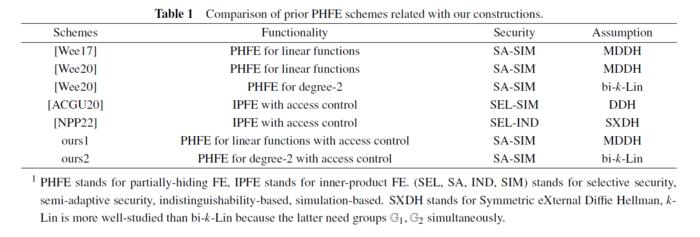
Functional Encryption overcomes all-or-nothing limitation of traditional public key encryption. However, there are still very few works that combine access control and function evaluation with concrete schemes. Access control helps maintain the confidentiality of sensitive data by limiting access to authorized personnel only, provides centralized control over access permissions and reduces administrative overhead.

Table 1

Credit: Haifeng QIAN, Cheng LIN, Qiaohan CHU, Jie CHEN

Functional Encryption overcomes all-or-nothing limitation of traditional public key encryption. However, there are still very few works that combine access control and function evaluation with concrete schemes. Access control helps maintain the confidentiality of sensitive data by limiting access to authorized personnel only, provides centralized control over access permissions and reduces administrative overhead.

To solve the problems, a research team led by Haifeng QIAN published their new research on 15 June 2024 in Frontiers of Computer Science co-published by Higher Education Press and Springer Nature.

The team proposed partially-hiding functional encryption schemes with fine-grained access control. Briefly speaking, ciphertexts are generated in accordance with an access policy and secret keys are associated to an attribute and also to being bound to a function. Decryption succeeds only when the attribute in the key satisfies the access policy in the ciphertext.

They follow the framework of Wee’s work (TCC’ 2020) and use the underlying inner product FE with access control (ASIACRYPT’ 2020) relying on the dual system encryption methodology. They give a clear solution to combine PHFE for linear functions with inner product FE with access contro. Then, use the the PHFE for linear functions with access control as a building block and leverage it to achieve PHFE for degree-2 polynomials with access control.

Their two constructions both achieve semi-adaptive, simulation-based security under standard assumptions. The security relies on the reduction from FE for quadratic functions to that for linear functions.

Future work can explore more general functional encryption with access control and apply into practical constructions.

DOI: 10.1007/s11704-023-3461-6


Journal

Frontiers of Computer Science

DOI

10.1007/s11704-023-3461-6

Method of Research

Experimental study

Subject of Research

Not applicable

Article Title

Partially-hiding functional encryption for degree-2 polynomials with fine-grained access control

Article Publication Date

15-Jun-2024

Share26Tweet17
Previous Post

How our brain decodes other people’s gaze

Next Post

Isolation and characterization of amylase enzyme produced by indigenous bacteria from sugar factory waste

Related Posts

Deforestation Policies Fall Short as Brazilian Amazon Faces an Even Greater Threat — Policy
Policy

Deforestation Policies Fall Short as Brazilian Amazon Faces an Even Greater Threat

April 27, 2026
Grant Fuels Development of Comprehensive Atlas Mapping Medicaid Expenditures — Policy
Policy

Grant Fuels Development of Comprehensive Atlas Mapping Medicaid Expenditures

April 27, 2026
Study Finds Medicaid Expansion Boosts Enrollees’ Long-Term Financial Well-Being — Policy
Policy

Study Finds Medicaid Expansion Boosts Enrollees’ Long-Term Financial Well-Being

April 27, 2026
ISSCR Calls for Ongoing NIH Funding to Advance Human Embryonic Stem Cell Research and Drive Therapeutic Breakthroughs
Policy

ISSCR Calls for Ongoing NIH Funding to Advance Human Embryonic Stem Cell Research and Drive Therapeutic Breakthroughs

April 24, 2026
New Study Reveals Key Strategies for Businesses to Scale Sustainable Chemicals
Policy

New Study Reveals Key Strategies for Businesses to Scale Sustainable Chemicals

April 23, 2026
Breakthrough in Rapid Breakdown of Short Chain PFAS Unveiled
Policy

Breakthrough in Rapid Breakdown of Short-Chain PFAS Unveiled

April 23, 2026
Next Post
Isolation and characterization of amylase enzyme produced by indigenous bacteria from sugar factory waste

Isolation and characterization of amylase enzyme produced by indigenous bacteria from sugar factory waste

  • Mothers who receive childcare support from maternal grandparents show more parental warmth, finds NTU Singapore study

    Mothers who receive childcare support from maternal grandparents show more parental warmth, finds NTU Singapore study

    27637 shares
    Share 11051 Tweet 6907
  • University of Seville Breaks 120-Year-Old Mystery, Revises a Key Einstein Concept

    1040 shares
    Share 416 Tweet 260
  • Bee body mass, pathogens and local climate influence heat tolerance

    677 shares
    Share 271 Tweet 169
  • Researchers record first-ever images and data of a shark experiencing a boat strike

    539 shares
    Share 216 Tweet 135
  • Groundbreaking Clinical Trial Reveals Lubiprostone Enhances Kidney Function

    526 shares
    Share 210 Tweet 132
Science

Embark on a thrilling journey of discovery with Scienmag.com—your ultimate source for cutting-edge breakthroughs. Immerse yourself in a world where curiosity knows no limits and tomorrow’s possibilities become today’s reality!

RECENT NEWS

  • Sleep Rebound After Restriction Lowers Mortality Risk
  • Self-Supervised ECG Model Advances Heart Disease Prediction
  • Mapping Inflammatory Bowel Disease with Spatial Transcriptomics
  • Virtual Nutrition Program Boosts Older Veterans’ Diets, Engagement

Categories

  • Agriculture
  • Anthropology
  • Archaeology
  • Athmospheric
  • Biology
  • Biotechnology
  • Blog
  • Bussines
  • Cancer
  • Chemistry
  • Climate
  • Earth Science
  • Editorial Policy
  • Marine
  • Mathematics
  • Medicine
  • Pediatry
  • Policy
  • Psychology & Psychiatry
  • Science Education
  • Social Science
  • Space
  • Technology and Engineering

Subscribe to Blog via Email

Success! An email was just sent to confirm your subscription. Please find the email now and click 'Confirm Follow' to start subscribing.

Join 5,145 other subscribers

© 2025 Scienmag - Science Magazine

Welcome Back!

Login to your account below

Forgotten Password?

Retrieve your password

Please enter your username or email address to reset your password.

Log In
No Result
View All Result
  • HOME
  • SCIENCE NEWS
  • CONTACT US

© 2025 Scienmag - Science Magazine
