


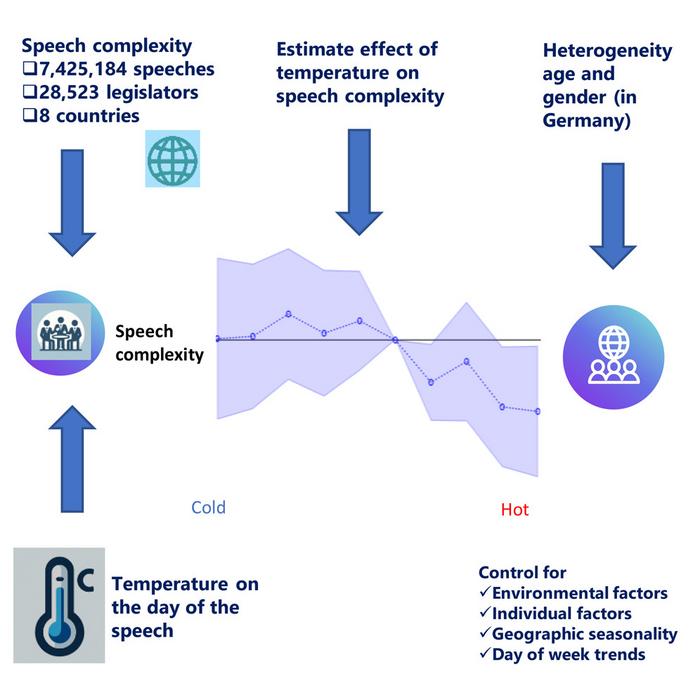
Climate change has many widespread and complicated effects on the well-being of people and the planet, and a new study in iScience on June 13 has now added a surprising one to the list. After analyzing the language used in seven million parliamentary speeches around the world, it shows that high temperatures lead to a significant and immediate reduction in politicians’ language complexity.

Credit: iScience/Keivabu et al.
Climate change has many widespread and complicated effects on the well-being of people and the planet, and a new study in iScience on June 13 has now added a surprising one to the list. After analyzing the language used in seven million parliamentary speeches around the world, it shows that high temperatures lead to a significant and immediate reduction in politicians’ language complexity.
The results suggest that rising heat may come with impacts on our cognitive abilities with real and immediate consequences, the researchers say. The study also showcases an innovative use of computational methods, including automated text analysis combined with global meteorological data, to assess the broader impacts of climate change on human health and performance.
“Heat has long been associated with a range of negative health outcomes, including increased risk of decreased productivity and cognitive performance,” says Risto Conte Keivabu (@ConteRisto) of the Max Planck Institute for Demographic Research in Rostock, Germany. “Our study highlights that this phenomenon extends to politicians, who are tasked with critical responsibilities.”
“Specifically, we found that higher temperatures lead to a reduction in the complexity of language used in parliamentary speeches across eight different countries,” says Tobias Widmann (@TobiasWidmann) of the Aarhus University, Denmark. “This suggests that heat can negatively affect cognitive functions even in professional settings where precise and complex language is crucial.”
Conte Keivabu and Widmann made the discovery by collecting millions of parliamentary speeches. The collection represents more than 28,000 politicians in eight different countries over several decades. To explore connections between the language in those speeches and precise daily temperature and weather, they used a modeling strategy that leveraged the seemingly random variations in daily temperatures to analyze their impact.
They explain that the approach allowed them to isolate the effect of temperature on the complexity of politicians’ language, yielding results that were surprisingly clear. Their findings show that hot days reduce language complexity. Cold days did not have the same effect. To learn more, they looked more closely at any variable effects in Germany based on age or gender.
“One surprising finding was the larger effect size observed in older politicians compared to their younger counterparts in Germany,” Conte Keivabu says. “This result not only stands out as interesting on its own but also increases our confidence in the study’s findings. It is logical that older individuals might be more susceptible to extreme temperatures, which aligns with our observation and underscores the robustness of our conclusions.”
The researchers say that the findings offer new evidence that human behavior is influenced not only by strategic considerations but also by environmental factors.
“The simplification of political discourse has mixed implications; while simpler language can enhance public understanding and engagement, it might also signal reduced cognitive performance due to heat,” Widmann says. “This could have negative consequences for the productivity of parliament members, affecting legislative decision-making, citizen representation, and budget planning. Considering the critical role of politicians in democratic processes, the impact of extreme temperatures on their cognitive performance could have profound and far-reaching consequences for society as a whole.”
They say that future research could delve deeper into how extreme temperatures impact the overall productivity and performance of politicians, leading to real downstream consequences for legislative decision-making and more. They suggest that managing these effects will be essential for mitigating the impacts of climate change on democratic processes and governance.
###
iScience, Keivabu et al. “The effect of temperature on language complexity: Evidence from seven million parliamentary speeches”
iScience (@iScience_CP) is an open-access journal from Cell Press that provides a platform for original research and interdisciplinary thinking in the life, physical, and earth sciences. The primary criterion for publication in iScience is a significant contribution to a relevant field combined with robust results and underlying methodology. Visit https://www.cell.com/iscience. To receive Cell Press media alerts, contact press@cell.com.
Journal
iScience
Method of Research
Observational study
Subject of Research
People
Article Title
The effect of temperature on language complexity: Evidence from seven million parliamentary speeches
Article Publication Date
13-Jun-2024
Cite Scienmag News
Sloane Callahan. (June 13, 2024). Parliamentary members use simpler language on hot days. Scienmag. https://scienmag.com/parliamentary-members-use-simpler-language-on-hot-days/
Sloane Callahan. "Parliamentary members use simpler language on hot days." Scienmag, 13 June 2024, https://scienmag.com/parliamentary-members-use-simpler-language-on-hot-days/. Accessed 5 September 2026.
Sloane Callahan. "Parliamentary members use simpler language on hot days." Scienmag. June 13, 2024. https://scienmag.com/parliamentary-members-use-simpler-language-on-hot-days/

