


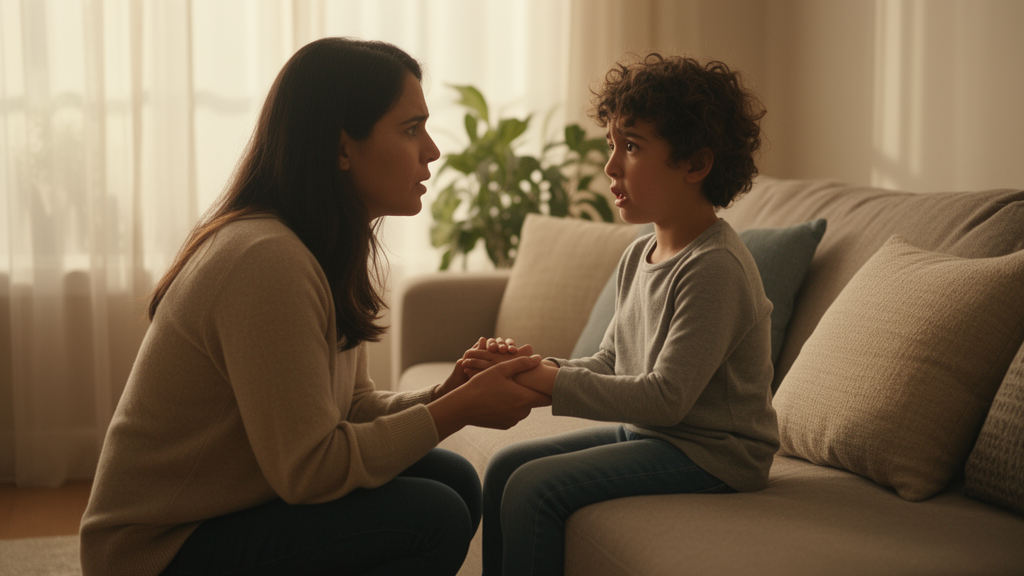
When parents and children sit down to talk about feelings, parents in a new observational study encouraged emotional expression frequently and discouraged it only rarely, regardless of which emotion was under discussion. The study, conducted by Stephanie N. Pham, Michelle Le, Charity Majusiak and Rosanna Breaux at Virginia Tech and published as an original research article in Frontiers in Developmental Psychology, offers preliminary insight into how parents encourage or discourage emotion-related discussions with their children, and whether those behaviors differ by child age or relate to psychopathology symptoms. The team recruited a community sample of 104 children and adolescents, with an average age of 8.78 years and 53.8 percent girls, along with their parents, 85.2 percent of whom were mothers.
Each parent-child pair completed lab-based emotion discussions built around three discrete emotion scenarios: one involving worry or fear, one involving anger or frustration, and one involving happiness or excitement. The researchers observed how often parents used emotion encouragement and emotion discouragement during these discussions. The clearest pattern was one of abundance and scarcity.
Parents used emotion encouragement frequently and emotion discouragement infrequently, regardless of the emotion being discussed. Bivariate analyses found that child age was unrelated to parents' use of either encouragement or discouragement across the developmental span sampled. One result ran counter to the study's hypotheses.
Parents were significantly more likely to use emotion encouragement during the angry/frustrated and worried/scared discussions than during the happy/excited discussion. By contrast, parents did not differ significantly in their likelihood of using emotion discouragement across the three emotion types. The study also examined whether parents' own psychopathology symptoms were associated with these conversational behaviors.
Parent attention-deficit/hyperactivity disorder symptoms, but not parent internalizing symptoms, were associated with observed emotion discouragement during the worried/scared discussion. No other significant associations between parent psychopathology and encouragement or discouragement were found. Two significant interactions emerged between child age and parent emotion encouragement in predicting children's internalizing symptoms.
Parent emotion encouragement showed positive associations with child internalizing symptoms among young children aged 4 to 7 years, but not among youth in middle childhood or adolescence. The authors frame these as preliminary findings, and the associations do not establish that encouragement affects children's symptoms. Taken together, the authors conclude that the findings suggest a need for emotion socialization research and interventions to consider both the child's developmental period and parent attention-deficit/hyperactivity disorder symptoms.
Because the sample was a community group and the discussions were observed in structured laboratory sessions, the results are preliminary rather than definitive, and the associations reported do not establish causal direction.
Subject of Research: Parental encouragement and discouragement of emotion discussions with children and links to psychopathology symptoms
Article Title: Parental en(dis)couragement of emotional discussions with their children: relations with psychopathology symptoms across developmental periods
Article References: Pham, S. N., Le, M., Majusiak, C., & Breaux, R. (2026). Parental en(dis)couragement of emotional discussions with their children: relations with psychopathology symptoms across developmental periods. Frontiers in Developmental Psychology, 4, Article 1847792. https://doi.org/10.3389/fdpys.2026.1847792
Image Credits: AI Generated
DOI: 10.3389/fdpys.2026.1847792
Keywords: emotion socialization, parenting, emotion discussion, child development, ADHD symptoms, internalizing symptoms, psychopathology, family interactions, developmental psychology, parent-child relationship, Parental, couragement
Cite Scienmag News
Glenn Wilkins. (October 26, 2026). Parents Encourage Emotional Talk Most When Children Feel Worried or Angry. Scienmag. https://scienmag.com/parents-encourage-emotional-talk-most-when-children-feel-worried-or-angry/
Glenn Wilkins. "Parents Encourage Emotional Talk Most When Children Feel Worried or Angry." Scienmag, 26 October 2026, https://scienmag.com/parents-encourage-emotional-talk-most-when-children-feel-worried-or-angry/. Accessed 26 October 2026.
Glenn Wilkins. "Parents Encourage Emotional Talk Most When Children Feel Worried or Angry." Scienmag. October 26, 2026. https://scienmag.com/parents-encourage-emotional-talk-most-when-children-feel-worried-or-angry/


