

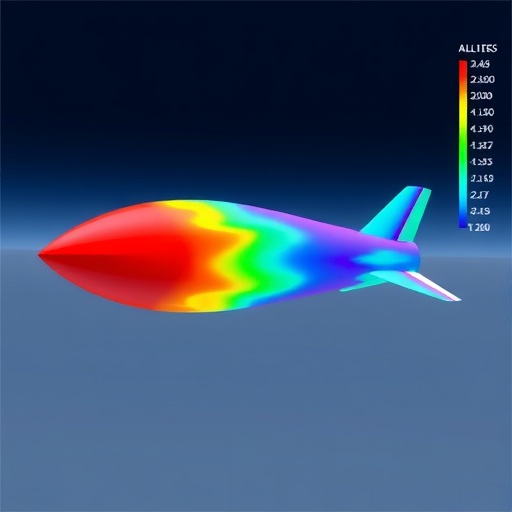
The study of missile aerodynamics has taken a significant leap forward with the recent publication which details an extended parametric Computational Fluid Dynamics (CFD) analysis of supersonic missile grid fins. Conducted by M.P. Arul, S. Chinnasamy, and P. Venugopal, this research employs the HiFUN solver to investigate how varying sweep angles impact the aerodynamic performance of these crucial components. As missile technology continues to evolve, understanding the effects of design modifications on flight characteristics is essential to enhance effectiveness and maneuverability.
Grid fins have emerged as a pivotal component in the aerodynamics of missiles. Their distinctive design, characterized by multiple strut-like structures, allows for improved control during flight. This particular study focuses on how the orientation of these fins—specifically, their sweep angles—can affect aerodynamic forces at high speeds. With missile systems requiring precise control and stability, fine-tuning the geometry of grid fins offers a pathway to enhanced performance in combat scenarios.
Utilizing the HiFUN solver provides a sophisticated platform for this type of analysis. This highly efficient computational tool is capable of simulating the complex flow dynamics encountered by supersonic missiles. Through the parametric study, the researchers could manipulate the sweep angles at multiple levels, offering a broad spectrum of aerodynamic behaviors to analyze. This is crucial in determining the optimal fin configuration for various flight conditions, ultimately increasing the missile’s operational versatility.
In their extensive analysis, the researchers not only examined the forces experienced by the grid fins but also the corresponding moments that affect the missile’s trajectory. By comprehensively quantifying the lift and drag coefficients as a function of sweep angle, insights were gained into which configurations might yield the best performance. The study effectively demonstrates how minor adjustments in design can lead to significant differences in how a missile behaves during flight.
Another vital aspect tackled within the study is the trade-off between maneuverability and stability. Grid fins are known to improve a missile’s ability to alter its path mid-flight, especially during terminal phases of a trajectory. However, certain configurations may lead to increased aerodynamic stalls or loss of control. Striking the right balance is crucial for future missile designs, and this study aims to shed light on these intricate dynamics.
Moreover, the findings of this study have implications much broader than just military applications. The aerodynamic principles uncovered may benefit the design of aircraft or even space vehicles, where efficiency and stability at high speeds are paramount. By expanding on existing CFD methodologies, the researchers are paving the way for future innovations in aerospace engineering.
Understanding supersonic travel inevitably involves grappling with the unique challenges posed by compressible flow. The HiFUN solver’s adeptness at resolving such complex issues was put to the test thoroughly in this research. The intricate simulations revealed not only the baseline aerodynamic coefficients but also highlighted the perturbations caused by real-world conditions like shockwaves and boundary layer interactions.
The research team took meticulous effort to validate their findings with experimental data, ensuring soundness in their computational methods. Validation is essential in CFD studies, particularly when the results can influence critical military strategies. This robust approach to both simulation and validation underscores the integrity of the computational findings presented.
The study culminates with particular emphasis on future directives for missile design based on the findings concerning sweep angles. The authors suggest a need for iterative testing and ongoing CFD analyses to refine and incorporate these aerodynamic insights into practical missile technologies. As military capabilities evolve, continuously enhancing the understanding of aerodynamic mechanics remains a priority.
Ironically, in a world where unmanned aerial technologies are becoming commonplace, ground-based missiles equipped with advanced grid fins may still represent a cornerstone of tactical advantage. Knowing how to optimize these systems through comprehensive studies such as this one will be crucial in shaping future defense mechanisms and technologies.
Furthermore, the research emphasizes that the intricate interaction of design, aerodynamics, and operational requirements will always be a delicate balance to maintain. Engineers and defense analysts must work hand-in-hand to ensure that these improvements are not only theoretical but are practically applicable within the constraints of reality.
In summation, the extensive parametric CFD study of supersonic missile grid fins as presented by Arul and colleagues represents a significant advance in the field of missile aerodynamics. The implications of their findings extend beyond the immediate application of missile technology, heralding potential benefits for various aerospace applications. As the military landscape continues to shift toward more advanced technologies, studies like this form the backbone of innovation moving forward.
In conclusion, the exploration of how varying sweep angles impact the performance of missile grid fins not only enhances current design methodologies but also informs future innovations in the field. This vital research could lead to safer, more agile, and more effective missile systems, marking a critical step toward futuristic military defense strategies.
Subject of Research: Supersonic missile grid fins design and optimization.
Article Title: An extended parametric CFD study of supersonic missile grid fins with varying sweep angles using HiFUN solver.
Article References:
Arul, M.P., Chinnasamy, S., Venugopal, P. et al. An extended parametric CFD study of supersonic missile grid fins with varying sweep angles using HiFUN solver.
AS (2026). https://doi.org/10.1007/s42401-026-00452-7
Image Credits: AI Generated
DOI: 10.1007/s42401-026-00452-7
Keywords: Missile aerodynamics, grid fins, Computational Fluid Dynamics, HiFUN solver, supersonic travel, aerodynamic performance, military technology, aerospace engineering.


