


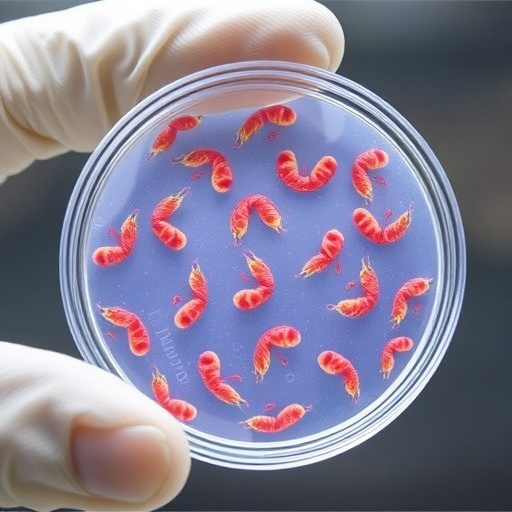
In a groundbreaking advancement poised to revolutionize the diagnosis of neglected tropical diseases, researchers have unveiled a novel paper-based enzyme-linked immunosorbent assay (ELISA) leveraging recombinant thioredoxin peroxidase-1 (rTPx-1) for the detection of human schistosomiasis. This innovative approach marks a critical leap toward affordable, accessible, and rapid diagnostics, particularly for populations living in endemic regions where traditional laboratory infrastructure remains scarce or non-existent. With schistosomiasis continuing to affect over 200 million people worldwide, primarily in resource-limited settings, this technology promises to significantly enhance disease surveillance and control efforts across the globe.
At the heart of this research lies the utilization of recombinant thioredoxin peroxidase-1, an enzyme implicated in the redox regulation within Schistosoma parasites. By harnessing this protein as an antigen in a paper-based ELISA format, the researchers developed an assay that not only ensures specific antibody detection but also reduces reliance on complex instrumentation commonly required for standard serological tests. The substitution of conventional plastic ELISA plates with cellulose paper sheets offers a compelling advantage in terms of cost, ease of transport, and disposal, making it ideal for point-of-care screening in remote areas.
The sensitivity and specificity of diagnostic tests play critical roles in controlling infectious diseases, and the application of recombinant TPx-1 antigen addresses these parameters with commendable precision. Diagnostic performance was evaluated against sera samples from individuals with confirmed schistosomiasis and controls, revealing a promising capacity to distinguish true positives with minimal cross-reactivity. This confirms that rTPx-1 serves as an effective biomarker, empowering health workers to accurately identify infected patients, initiating timely treatment interventions and interrupting transmission cycles.
Moreover, the paper-based ELISA platform stands as an exemplar of sustainable innovation. Its minimal reliance on electricity and sophisticated equipment renders it particularly beneficial in tropical, economically disadvantaged regions where laboratory services are often restricted. The assay enhances operational feasibility by simplifying the test procedure into a few straightforward steps, thus reducing technician training requirements and augmenting the potential for widespread deployment. Such accessibility is pivotal in catalyzing community-wide screening programs that are vital for mapping disease prevalence and evaluating intervention impacts.
The transparent and highly porous nature of cellulose paper underpins the assay’s remarkable fluid dynamics, enabling consistent reagent flow and facilitating prompt antigen-antibody interactions. This structural characteristic optimizes the incubation times and reaction efficiency without compromising the integrity of the detection signal. Consequently, the visual readout generated on the paper substrate is both conspicuous and stable, enhancing result interpretability even under field conditions. Additionally, the assay’s compatibility with smartphone-based image analysis may usher in a new era of digital diagnostics, further empowering remote healthcare providers with rapid and objective test evaluations.
At a molecular level, thioredoxin peroxidase-1 is recognized for its role in defending Schistosoma parasites against oxidative damage, rendering it abundantly expressed and immunogenic during infection. This biological relevance aligns well with its selection as a diagnostic target, as host immune responses are reliably mounted against rTPx-1 during parasite exposure. The recombinant production of the protein ensures batch-to-batch consistency and circumvents ethical concerns associated with sourcing antigens from live parasites. This not only safeguards assay reproducibility but also escalates scalability, facilitating mass production to meet the vast diagnostic demands in endemic regions.
The integration of rTPx-1 into a paper-based assay typifies the paradigm shift toward frugal innovation in medical diagnostics. It mirrors a global trend wherein affordability, portability, and ease of use are prioritized alongside analytical performance. The cost-effectiveness of this platform is further underscored by the minimal reagent volumes employed and the elimination of cold chain requirements. These factors collectively enhance the feasibility of large-scale screening initiatives, which are essential to the World Health Organization’s goals of schistosomiasis control and eventual elimination.
Clinical validation studies undertaken by the research team underscore the assay’s potential utility not only as a diagnostic tool but also as a means for treatment monitoring and epidemiological surveys. The ability to detect antibody titers corresponding to infection intensity provides clinicians with actionable insights that facilitate personalized patient management. Additionally, public health authorities stand to gain from high-resolution infection data, enabling targeted deployment of mass drug administration campaigns and optimizing resource allocation for prevention efforts.
Importantly, this study also confronts the technical challenges traditionally associated with paper-based diagnostics. Factors such as non-specific binding, reagent stability, and environmental influences were rigorously addressed through surface modifications and optimized formulation protocols. The use of blocking agents and stabilizers within the assay design mitigated false positives and ensured prolonged shelf life under varying ambient conditions. These advancements attest to the robustness of the assay and its readiness for real-world applications.
The socio-economic implications of such accessible diagnostics are profound. Schistosomiasis predominantly affects marginalized populations, where health inequities perpetuate poor outcomes. By democratizing access to reliable diagnostic tools, this paper-based ELISA leverages scientific ingenuity to confront neglected diseases, thereby advancing health equity. Empowered with early detection capabilities, communities can break the cycle of morbidity, reduce the disease burden, and promote socioeconomic development through healthier populations.
Furthermore, this research contributes to the broader field of point-of-care testing (POCT), a domain rapidly evolving through integration with digital health platforms and artificial intelligence. The assay’s design is compatible with smartphone cameras and cloud-based data management systems, enabling centralized tracking of case numbers and spatial distribution. Real-time data collection fosters dynamic response strategies and could revolutionize disease surveillance frameworks, transcending schistosomiasis to benefit numerous infectious diseases.
The environmental sustainability of the assay is also noteworthy. The biodegradable nature of the paper substrate minimizes biomedical waste, aligning with global initiatives to reduce plastic pollution in healthcare. This eco-conscious approach exemplifies how innovation need not compromise environmental stewardship—a critical consideration as diagnostics scale globally.
Looking ahead, the translation of this paper-based ELISA from laboratory bench to extensive field implementation will necessitate collaborative efforts among researchers, policymakers, and healthcare providers. Field trials encompassing diverse epidemiological settings are essential to validate performance and adapt protocols to local contexts. Capacity-building initiatives focusing on training and supply chain integrity will further ensure successful integration into national health programs.
While the rTPx-1 paper-based ELISA offers remarkable promise, complementary diagnostic strategies remain crucial to tackle schistosomiasis comprehensively. Molecular techniques such as PCR and antigen detection assays might complement serological tests by providing direct parasitological evidence, especially in low-transmission settings. Nonetheless, the affordability and deployability advantages of this assay position it as a frontline tool in schistosomiasis control.
In conclusion, this research heralds a transformative advance in the fight against schistosomiasis, employing cutting-edge recombinant protein technology and innovative paper-based ELISA formats to create a diagnostic tool that is economical, scalable, and tailored for challenging environments. By bridging the gap between molecular biology and practical, field-ready applications, it exemplifies how scientific progress can fuel global health equity, driving progress toward the ultimate goal of schistosomiasis elimination.
Cite Scienmag News
Ophelia Keating. (August 7, 2025). Paper-Based ELISA Detects Human Schistosomiasis Efficiently. Scienmag. https://scienmag.com/paper-based-elisa-detects-human-schistosomiasis-efficiently/
Ophelia Keating. "Paper-Based ELISA Detects Human Schistosomiasis Efficiently." Scienmag, 7 August 2025, https://scienmag.com/paper-based-elisa-detects-human-schistosomiasis-efficiently/. Accessed 9 September 2026.
Ophelia Keating. "Paper-Based ELISA Detects Human Schistosomiasis Efficiently." Scienmag. August 7, 2025. https://scienmag.com/paper-based-elisa-detects-human-schistosomiasis-efficiently/


