

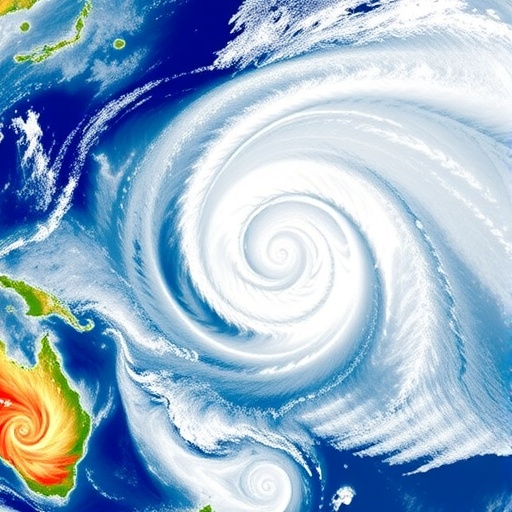
Since the 1980s, the relentless march of tropical cyclones toward Earth’s poles has intrigued and alarmed scientists and policymakers alike. This poleward migration raises daunting questions about the future intensity and geographic spread of these destructive storms in an evolving climate. Although rising global temperatures intuitively suggest that such shifts might be the hallmark of long-term climate change, a groundbreaking study published in Nature Geoscience presents compelling evidence pointing instead to the dominant role of natural climate variability, particularly Pacific Ocean temperature patterns, as the principal drivers of this phenomenon over the past four decades.
This research, led by Zhou, Leung, Chang, and colleagues, leverages a suite of observational datasets alongside state-of-the-art global climate models that uniquely permit the explicit simulation of tropical cyclones. Their multi-dimensional approach disentangles the complex interplay between various climatic forces, revealing that a tripolar sea surface temperature (SST) variability pattern in the Pacific Ocean substantially modulates the latitudinal position of tropical cyclone formation and tracks. This tripolar mode emerges as a far more influential factor than the traditionally cited El Niño/Southern Oscillation or shifts in the Hadley circulation, both of which have historically commanded significant focus in tropical cyclone studies.
By meticulously analyzing data from 1980 to 2024, the team demonstrates that the observed poleward migration aligns closely with periods when the Pacific tripolar pattern exhibited positive phases. This relationship greatly complicates the simplistic narrative that human-induced warming alone is shifting cyclone genesis zones poleward. In scenarios where this tripolar SST pattern’s influence is statistically removed, the researchers found the net poleward migration to be negligible, effectively challenging the assumption that this trend is a direct consequence of anthropogenic climate change.
Moreover, through model simulations, the study reveals that a negative trend in this tripolar pattern results in tropical cyclones reversing course and migrating equatorward rather than poleward. This finding implies that the poleward shift witnessed in recent decades is not a unidirectional, sustainable trend, but rather a product of natural climate oscillations operating on multi-decadal timescales. Notably, the tripolar SST variability exhibits alternating phases with no discernible long-term trend since 1970, casting doubt on the likelihood that the current poleward migration will persist into the future.
Intriguingly, the investigation also sheds light on the relative insignificance of the poleward expansion of the Hadley cell in determining tropical cyclone latitudinal migration over recent decades. While the Hadley circulation’s outward spread has often been implicated as a key driver allowing cyclones to form at higher latitudes, the models suggest that shifts in large-scale atmospheric circulation alone cannot account for the migration pattern without factoring in Pacific SST variability. Consequently, this calls for a recalibration in how climatologists interpret the drivers of cyclone activity, emphasizing ocean-atmosphere feedback mechanisms over atmospheric dynamics exclusively.
The implications of these findings extend beyond deciphering recent trends; they also offer critical insights for future projections of tropical cyclone behavior in a warming world. Ensemble climate model projections under high-emission scenarios suggest an overall decrease in tropical cyclone frequency, particularly in high latitude regions. This decline occurs despite continued poleward expansion of the Hadley circulation, underscoring that temperature alone is insufficient to drive cyclone prevalence at higher latitudes without the oceanic SST patterns acting as a permissive environmental template.
The decreasing tropical cyclone activity forecasted raises important questions about regional vulnerabilities and preparedness. Lower cyclone occurrences at high latitudes could temporarily reduce storm-related risks in some traditionally less-affected areas. However, the study’s results emphasize the unpredictability introduced by natural climate variability. Policymakers and disaster management agencies should remain vigilant and adaptive, recognizing that decades of variability could bring alternating periods of enhanced or diminished cyclone activity well into the future.
This study essentially reframes the discourse about tropical cyclone migration within the broader conversation about climate change versus natural variability. It demonstrates how complex and multifaceted climate systems are, with ocean patterns like the Pacific tripolar SST variability capable of overriding or masking the impacts of long-term anthropogenic trends. Such distinctions are crucial for interpreting historical observations accurately and for improving the skill of predictive models that guide disaster risk reduction strategies.
Additionally, this research highlights the importance of using comprehensive climate models capable of resolving tropical cyclones explicitly. Traditional models that represent cyclones through parameterizations may miss subtle but critical interactions between ocean and atmosphere that govern cyclone paths and intensities. By capturing these fine-scale processes, the study advances our ability to anticipate not just whether cyclones will intensify with warming but how their geospatial footprint may evolve dynamically.
Future research avenues inspired by these findings include further exploration of how multi-decadal oceanic oscillations modulate extreme weather phenomena globally. Understanding whether similar tripolar or multipolar SST variability patterns exist in other ocean basins and their effects on regional weather could illuminate analogous processes elsewhere. Moreover, integrating paleoclimatic records with model experiments may yield insights into how these oscillations have shaped tropical cyclone behavior over centuries, bolstering confidence in anticipating future shifts.
In summary, this landmark study dispels the notion that the recent poleward migration of tropical cyclones is a straightforward symptom of climate warming. Instead, it reveals a nuanced picture driven predominantly by multi-decadal Pacific variability, rooted in oceanic temperature patterns, which currently dominates cyclone latitude changes. While climate change remains a critical backdrop influencing many aspects of tropical cyclone activity, the intricate natural rhythms of ocean-atmosphere systems wield a surprisingly outsized influence over where these powerful storms occur.
By parsing out these natural oscillations from long-term trends, scientists gain a more sophisticated understanding of tropical cyclone dynamics, crucial for crafting resilient coastal policies amid uncertainty. As we enter an era of unprecedented climate change, appreciating the dominant role of natural variability is essential to grounding expectations realistically, guiding adaptive responses, and ultimately protecting lives and economies vulnerable to the shifting fury of tropical cyclones.
Subject of Research: Tropical cyclone poleward migration and its driving mechanisms in the context of Pacific Ocean sea surface temperature variability.
Article Title: Poleward migration of tropical cyclones over 1980–2024 is dominated by Pacific variability.
Article References:
Zhou, W., Leung, L.R., Chang, CC. et al. Poleward migration of tropical cyclones over 1980–2024 is dominated by Pacific variability. Nat. Geosci. (2025). https://doi.org/10.1038/s41561-025-01866-2
Image Credits: AI Generated


