


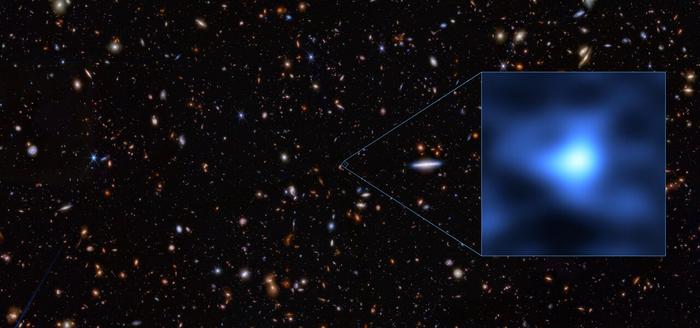
Astronomers have recently made a groundbreaking discovery regarding the galaxy JADES-GS-z14-0, now recognized as the most distant confirmed galaxy known to mankind. Situated within the remote depths of the Fornax constellation, this minuscule galaxy reveals insights into the cosmos as it existed only 300 million years after the Big Bang. The implications of this finding are monumental, challenging prior notions about the formation and evolution of galaxies during the Universe’s infancy.
The light emitted from JADES-GS-z14-0 has traveled an astounding 13.4 billion years before reaching Earth, allowing researchers a glimpse into a time when the Universe was merely 2 percent of its current age. Two independent research teams utilized the Atacama Large Millimeter/submillimeter Array (ALMA), an observatory renowned for probing the cold Universe, to uncover something extraordinary. Through their studies, they identified the presence of oxygen in the galaxy, marking the most distant detection of this critical element ever recorded. This discovery has sent ripples through the scientific community, prompting a reevaluation of existing theories regarding galaxy development in the early cosmic epochs.
Traditionally, it was believed that galaxies in their formative stages were predominantly composed of light elements like hydrogen and helium. The expectation was that significant quantities of heavy elements, such as oxygen, would emerge only after extended periods as stars evolved and subsequently exploded, releasing these elements into their environment. However, the findings pertaining to JADES-GS-z14-0 suggest a strikingly different scenario—one where galaxies could evolve and mature much faster than previously thought.
In light of these unexpected results, Sander Schouws, a PhD candidate at Leiden Observatory, eloquently likens this discovery to encountering an adolescent when one might have anticipated merely infants. This analogy underscores the urgent necessity for astrophysicists to reconsider the timelines and mechanisms underlying galaxy formation and chemical enrichment in the early Universe.
Moreover, the newly detected oxygen presents a remarkable opportunity for astronomers to enhance their measurements of the galaxy’s distance. With an unprecedented precision of merely 0.005 percent—akin to measuring a distance of 1 kilometer with a margin of error of only 5 centimeters—scientists can refine their understanding of the properties and behaviors of distant galaxies more accurately. This newfound measurement precision allows researchers to create an invaluable cosmic map that can guide future explorations.
The collaboration between ALMA and the James Webb Space Telescope (JWST) has proven essential in this discovery. While JWST initially characterized the galaxy, ALMA’s higher resolution provided conclusive evidence of its significant distance from Earth. This synergy between different observational platforms exemplifies how modern astronomy continually benefits from interdisciplinary cooperation, enhancing our knowledge of the cosmos.
Surprisingly, JADES-GS-z14-0 was found to possess approximately ten times more heavy elements than predicted. This revelation is significant, as it fundamentally alters our comprehension of the conditions prevalent during the early epochs of the cosmos and raises pertinent questions about how rapidly galaxies can evolve post-Big Bang. This phenomenon suggests that our understanding of cosmic evolution may be limited and calls for further investigation into the mechanisms that govern how galaxies come to be.
In light of these discoveries, the astronomical community is buzzing with excitement, eager to analyze the implications of finding such chemically rich galaxies in a time when the Universe was still in its infancy. Researchers now face a dilemma: how can galaxies like JADES-GS-z14-0 become so chemically advanced so soon in cosmic history? The current findings catalyze further research into the star formation processes within these early galaxies, dictating a shift in observational strategies and theoretical frameworks.
Additionally, the implications of the oxygen detection extend beyond mere distance measurements; they provide a crucial stepping-stone for understanding the cosmic evolution of heavy elements across the Universe. A comprehensive grasp of how these elements distributed and became present will serve to enrich our knowledge regarding the lifecycle of stars and their role in forming the building blocks of galaxies.
As the excitement builds, scientists call for new observational campaigns and models that account for the rapid evolution of galaxies like JADES-GS-z14-0. The quest to unveil the nature and extent of these early galaxies will undoubtedly spark future exploration initiatives, as understanding their properties is key to piecing together the intricate puzzle of cosmic history.
In conclusion, the discovery of oxygen in JADES-GS-z14-0 is not just a remarkable milestone in astronomical observation; it poses profound questions about our understanding of the Universe’s evolution. This finding compels astrophysicists to reassess and refine existing paradigms governing galaxy formation, and it marks the beginning of an exciting new chapter in the study of the cosmos.
Keywords
Distant galaxy, JADES-GS-z14-0, oxygen detection, galaxy formation, cosmic evolution, ALMA, James Webb Space Telescope, astronomy, astrophysics, heavy elements, early Universe, research discovery
Cite Scienmag News
Grant Pearson. (March 20, 2025). Oxygen Detected in the Most Distant Galaxy Ever Observed. Scienmag. https://scienmag.com/oxygen-detected-in-the-most-distant-galaxy-ever-observed/
Grant Pearson. "Oxygen Detected in the Most Distant Galaxy Ever Observed." Scienmag, 20 March 2025, https://scienmag.com/oxygen-detected-in-the-most-distant-galaxy-ever-observed/. Accessed 4 September 2026.
Grant Pearson. "Oxygen Detected in the Most Distant Galaxy Ever Observed." Scienmag. March 20, 2025. https://scienmag.com/oxygen-detected-in-the-most-distant-galaxy-ever-observed/


