


Researchers from BGI Genomics and Fudan University published new findings on OV among Chinese patients in JCO Global Oncology. The study revealed the germline mutational landscape of Chinese patients with OV and identified an enriched RAD51D variant in these patients. It further examined the functional implications of this Chinese-enriched RAD51D variant. This discovery can serve as an important reference for ovarian cancer management and a potential therapeutic target in the Chinese population.

Credit: BGI Genomics
Researchers from BGI Genomics and Fudan University published new findings on OV among Chinese patients in JCO Global Oncology. The study revealed the germline mutational landscape of Chinese patients with OV and identified an enriched RAD51D variant in these patients. It further examined the functional implications of this Chinese-enriched RAD51D variant. This discovery can serve as an important reference for ovarian cancer management and a potential therapeutic target in the Chinese population.
Shared Variant Promotes Tumor Growth
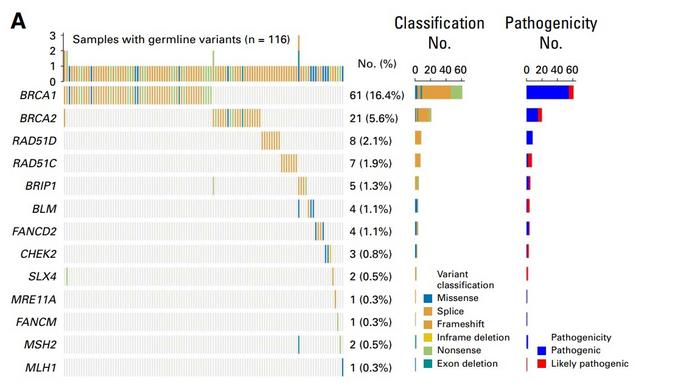
One of the standout discoveries was the identification of an enriched RAD51D variant among the patients and its functional implications. In this cohort study, the variant rates of RAD51D ranked third, and all eight patients with the RAD51D pathological variant had the same K91fs variant (c.270_271dup, p.Lys91Ilefs*13) raised the attention and curiosity of researchers to find out whether this enriched variant plays a role in the progression or treatment response of OV.
Through a series of assays, researchers found that RAD51D has a tumor growth-promoting ability, and reducing the expression of the RAD51D gene will lead to growth ability reduction in certain cancer cells (OVCA429 and OVCA433 cell lines). Re-expression of the RAD51D k91fs would not bring back the original tumor growth-promoting ability of RAD51D.
Increase Sensitivity to PARP inhibitors
Patients with the RAD51D K91fs variant showed a satisfactory response to platinum and a favorable prognosis. In the OVCA429 and OVCA433 cell lines, re-expression of RAD51D WT and K91fs variants after endogenous RAD51D knockdown revealed that the K91fs variant increased sensitivity to PARP inhibitors like olaparib and niraparib compared to the WT variant. This provides new possible treatment methods for future Chinese patients with OV.
Deleterious Variant Linked to Early-Onset OV
The genetic testing showed that 31% (116/373) of the patients had at least one deleterious germline variant, and co-variants were found in four patients. Patients with deleterious homologous recombination repair (HRR) variants experienced an earlier onset of ovarian cancer, with 42.4% being under 50 years old, compared to 37.0% of those with BRCA mutations and 30.9% with wild-type genes.
Considering the hereditary factors and treatment management of ovarian cancer (OV), genetic testing is highly recommended for all patients. These tests can help doctors choose the most effective drugs or treatments based on the specific mutations a patient carries. Epidemiological studies have shown that HRR variants are linked to inherited ovarian diseases, providing valuable guidance for early prevention and tailored treatment in the Chinese population.
The study provides a valuable reference for future genetic studies and potential new treatment targets by identifying ethnic differences in mutation rates. The discovery of the RAD51D variant and its implications for treatment response opens up new possibilities for targeted therapies, potentially improving outcomes for many patients.
About BGI Genomics
BGI Genomics, headquartered in Shenzhen, China, is the world’s leading integrated solutions provider of precision medicine. Its services cover more than 100 countries and regions, involving more than 2,300 medical institutions and 10,000 employees worldwide. In July 2017, as a subsidiary of BGI Group, BGI Genomics (300676.SZ) officially began trading on the Shenzhen Stock Exchange.
Journal
JCO Global Oncology
Article Title
Germline Mutational Landscape and Novel Targetable RAD51D Variant in Chinese Patients With Ovarian Cancer
Article Publication Date
21-Jun-2024
Cite Scienmag News
Nathaniel Bowman. (August 21, 2024). Ovarian cancer discovery: targetable variant RAD51D found in Chinese patients. Scienmag. https://scienmag.com/ovarian-cancer-discovery-targetable-variant-rad51d-found-in-chinese-patients/
Nathaniel Bowman. "Ovarian cancer discovery: targetable variant RAD51D found in Chinese patients." Scienmag, 21 August 2024, https://scienmag.com/ovarian-cancer-discovery-targetable-variant-rad51d-found-in-chinese-patients/. Accessed 5 September 2026.
Nathaniel Bowman. "Ovarian cancer discovery: targetable variant RAD51D found in Chinese patients." Scienmag. August 21, 2024. https://scienmag.com/ovarian-cancer-discovery-targetable-variant-rad51d-found-in-chinese-patients/

