


An international research team led by the Hong Kong University of Science and Technology (HKUST) has uncovered in a recent research project that people’s beliefs in science and religion are primarily shaped by the words of others, rather than their personal experiences. The study could help enhance public understanding of people’s belief formation in important scientific issues, such as climate change and vaccination.

Credit: HKUST
An international research team led by the Hong Kong University of Science and Technology (HKUST) has uncovered in a recent research project that people’s beliefs in science and religion are primarily shaped by the words of others, rather than their personal experiences. The study could help enhance public understanding of people’s belief formation in important scientific issues, such as climate change and vaccination.
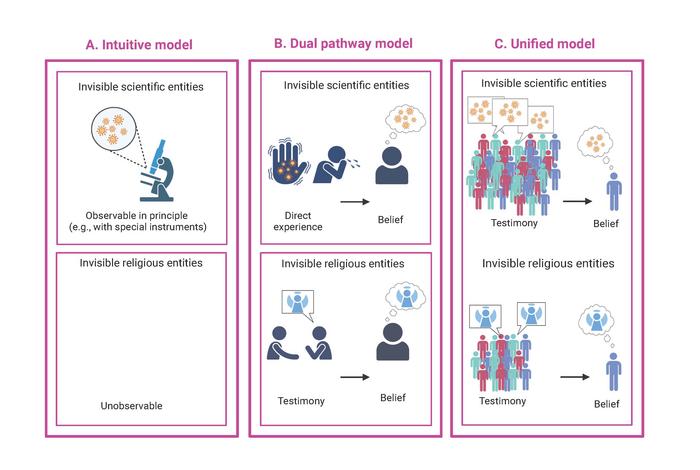
Conventionally, people are generally more confident about the existence of scientific phenomena, like oxygen, than religious phenomena, like God, as it is thought that people can experience oxygen, for instance, while it is harder to observe religious entities on one’s own.
The team, led by Prof. Mary Shaocong MA, a Research Assistant Professor from the Division of Social Science at HKUST, challenged the conventional view. They argued that both scientific and religious beliefs are primarily shaped by testimony or information we get from others, such as experts or our community, rather than personal experience.
The study highlights the decisive role of testimony in forming our beliefs and understanding of the world, contrary to the notion that direct experience is the main driver of scientific belief.
“Even when it seems like we’re experiencing something directly, our understanding is often heavily influenced by what we’ve been told by experts or our community. For example, witnessing a relative falling ill, it’s very hard for a child to detect that viruses cause illness; rather, they turn to others’ testimony, such as parents’ teaching, to understand the causal relations. Recognizing this can help determine the most effective way to communicate scientific information to the public. By highlighting the credibility and consensus of scientific evidence, it is possible to promote greater acceptance and confidence in scientific facts, especially regarding emerging scientific topics, such as climate change” says Prof. Ma.
“This insight is crucial for combating misinformation and enhancing public understanding and support for scientific matters, such as addressing climate change and getting vaccinated,” she further explains.
In the research, by reviewing empirical evidence in the past few decades, the team proposed a theoretical model that explains how people come to believe in the existence of invisible entities, such as germs in science or God in religion.
For example, it finds that people believe in germs because doctors and scientists tell us they exist, even though we cannot see them with our own eyes. Likewise, we infer that people get sick because of germs by learning this causal relation from others rather than discovering this connection through personal observation.
The model also establishes that the more credible the source of the information and the more people who agree with it, the more likely people are to believe it. “If many people around us agree that climate change is real, their consensus strengthens our belief in these concepts,” she says.
It shows that people’s confidence in these phenomena is not because they have seen them directly but because they trust the sources that tell them about them.
Unlike previous models that proposed separate pathways for belief formation in science and religion, this model provides a unified explanation. It argues that others’ testimony, rather than direct experience, predominantly shapes beliefs in both domains.
The team’s findings, realized in collaboration with researchers at Harvard University, Union College, and Massachusetts Institute of Technology, were recently published in a top international journal Trends in Cognitive Sciences by Cell Press.
Journal
Trends in Cognitive Sciences
Method of Research
Case study
Subject of Research
People
Article Title
Scientific and religious beliefs are primarily shaped by testimony
Article Publication Date
27-May-2024
Cite Scienmag News
Denise Maddox. (June 4, 2024). Others’ words, not firsthand experience, shape scientific and religious belief formation, HKUST study finds. Scienmag. https://scienmag.com/others-words-not-firsthand-experience-shape-scientific-and-religious-belief-formation-hkust-study-finds/
Denise Maddox. "Others’ words, not firsthand experience, shape scientific and religious belief formation, HKUST study finds." Scienmag, 4 June 2024, https://scienmag.com/others-words-not-firsthand-experience-shape-scientific-and-religious-belief-formation-hkust-study-finds/. Accessed 3 September 2026.
Denise Maddox. "Others’ words, not firsthand experience, shape scientific and religious belief formation, HKUST study finds." Scienmag. June 4, 2024. https://scienmag.com/others-words-not-firsthand-experience-shape-scientific-and-religious-belief-formation-hkust-study-finds/

