

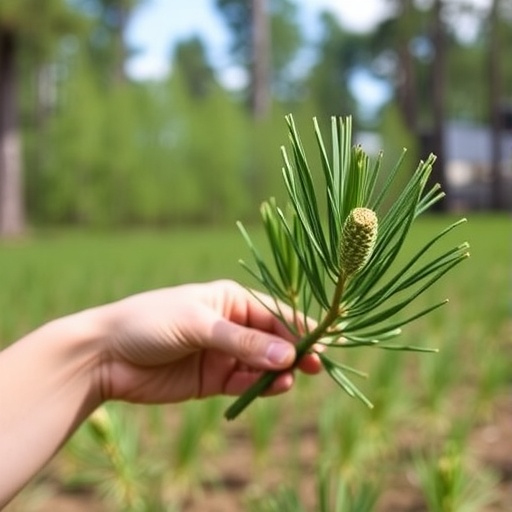
In recent years, the battle against the pinewood nematode (Bursaphelenchus xylophilus) has intensified due to its status as the most destructive parasite affecting pine forests throughout Eurasia. This microscopic nematode wreaks havoc by transmitting a lethal disease that decimates susceptible pine species, disrupting forest ecosystems and the economies dependent on them. European regulatory frameworks currently mandate the clear-cutting of all vulnerable trees within a 500-meter radius of detected infestations, a drastic measure aimed at eradicating the pest. Despite its rigorous enforcement, this method has not succeeded in eliminating the nematode in certain regions such as Portugal, exposing the limitations of broad-spectrum clear-cutting in extensive monoculture pine forests.
In a pioneering study published in the Journal of Applied Ecology, researchers have developed a comprehensive simulation model to evaluate alternative control strategies that potentially combine ecological efficacy with economic prudence. The study contrasts the traditional 500-meter clear-cutting approach against a more targeted selective felling method, wherein only trees exhibiting clear symptoms of nematode infestation are removed within a 400 square kilometer homogeneous stand of maritime pines (Pinus pinaster). The model integrates multiple variables including different monitoring intensities and methodologies—ranging from ground-based observations to advanced aerial surveys—to simulate disease spread dynamics and intervention outcomes.
Fundamental to this model is the incorporation of the biology and behavior of the nematode’s insect vector, the pine sawyer beetle (Monochamus galloprovincialis). The vector’s flight patterns and dispersal capabilities were carefully calibrated based on empirical data from previous ecological studies, allowing the simulation to realistically portray nematode transmission across the forest landscape. Such a sophisticated approach enables a nuanced assessment of monitoring regimes including visual surveys from forestry trails, trap deployments for beetle capture, and cutting-edge aerial reconnaissance augmented by artificial intelligence (AI) for image processing and symptom detection.
The research reveals striking differences in the cost-effectiveness of monitoring techniques. Aerial surveillance, despite being currently experimental for this application, demonstrates superior detection efficiency over conventional ground surveys. Rapid advancements in remote sensing technologies coupled with AI-powered image analysis are pushing the frontier of timely nematode symptom identification, promising to revolutionize forest health monitoring in the near future. However, at present, ground surveys remain the predominant detection strategy, underscoring the necessity to refine and expand aerial and automated systems for operational deployment.
Crucially, the success of eradication efforts hinges upon the precision and frequency of monitoring activities. The study emphasizes that only with high-frequency aerial surveys timed to coincide with visible symptom expression can meaningful containment or eradication be achieved. Under optimal monitoring scenarios, selective felling emerges as a highly cost-effective alternative to blanket clear-cutting—estimated to be up to 200 times less expensive. This is largely attributed to selective felling’s avoidance of unnecessary removal of healthy trees, preserving both ecological integrity and economic value within forests.
Conversely, if monitoring conditions fail to meet such stringent criteria, neither selective felling nor clear-cutting alone can eliminate the nematode. In these cases, the focus must shift toward mitigation and containment rather than outright eradication. Even in containment scenarios, selective felling maintains a more favorable cost-benefit balance by minimizing collateral damage to unaffected tree populations. Therefore, the study advocates for intensifying monitoring efforts to leverage the substantial economic and ecological benefits of targeted interventions.
This work highlights an urgent need to advance remote sensing capabilities tailored for forest pest detection. Current European satellite platforms lack the spatial resolution necessary to identify individual symptomatic pines, which often stand isolated rather than in dense mortality clusters characteristic of other forest disturbances. While drones offer high-resolution imagery, their limited coverage area renders them impractical for vast forest landscapes. Thus, manned aircraft and microlight platforms equipped with hyperspectral sensors represent the primary tools under development for large-scale, high-resolution forest health surveillance.
Moreover, the integration of AI in image analysis, though promising, remains an evolving field requiring extensive training datasets and validation. Distinguishing nematode-induced decline from other abiotic or biotic stressors is a formidable challenge, necessitating refined algorithms that can detect subtle spatiotemporal patterns unique to pinewood nematode outbreaks. To address these challenges, European collaborative initiatives such as FORSAID are currently developing innovative diagnostic frameworks that synergize remote sensing data with AI-driven interpretation models, aiming to deliver timely and accurate pest surveillance.
Beyond technological solutions, this study underscores the fundamental ecological principle that invasive pest management must be adaptive and context-specific. Understanding the interplay between vector dispersal, host susceptibility, environmental conditions, and intervention timing is essential for tailoring management strategies that are both effective and sustainable. The clear-cutting paradigm, while instinctively appealing for its apparent decisiveness, may impose prohibitive economic costs and unwarranted ecological damage, especially in homogeneous pine stands where infestation patches can be spatially dispersed.
The implications of these findings extend to policy-making and forest management practices across Europe and other affected regions. By demonstrating that selective felling combined with intensive, high-precision monitoring can achieve similar or superior outcomes at a fraction of current costs, this research provides a blueprint for more nuanced management frameworks. Implementation of such approaches requires investment in research and development of remote sensing technologies, training of forest health professionals in advanced monitoring techniques, and adjustments in regulatory standards to accommodate these innovative methodologies.
Furthermore, the long-term sustainability of European pine forests depends on the capacity to swiftly detect and respond to emerging invasive threats using state-of-the-art tools. This research adds momentum to the growing consensus that integrating ecological modeling, remote sensing, and AI analytics holds the key to forest pest management in the 21st century. As environmental pressures mount from climate change and increasing global trade, the capacity for rapid, cost-effective pest detection and control will be indispensable in safeguarding forest health and the myriad ecosystem services forests provide.
In conclusion, this groundbreaking study illuminates a transformative path toward combating the pinewood nematode without resorting to ecologically damaging and economically costly mass clear-cutting. By coupling selectivity in tree removal with high-frequency aerial monitoring and AI-enhanced image analysis, it is possible to achieve meaningful containment or even eradication of this invasive pest. Though challenges remain in operationalizing these technologies at scale, the promise of a paradigm shift in forest pest management is compelling, offering hope for resilient and thriving pinewood ecosystems amid ongoing biological invasions.
Subject of Research: The cost-effectiveness and efficacy of selective felling versus clear-cutting to control pinewood nematode infestations, incorporating various monitoring methods including remote sensing and AI.
Article Title: How to eradicate an invasive forest pest without clear-cutting
News Publication Date: 11-Mar-2026
Web References:
https://forsaid.eu/
https://doi.org/10.1111/1365-2664.70318
References:
– Robinet C. et al. 2019, Ecological Modelling
– Robinet C. et al. 2020, Journal of Applied Ecology
– Dutrieux R., Ose K., de Boissieu F., Féret J.-B. 2024, Fordead Python Package for Vegetation Anomaly Detection, Zenodo, DOI: 10.5281/zenodo.12802456
– Mariette N., Hotte H., Chappé A.-M. et al. 2023, Two decades of epidemiological surveillance of the pine wood nematode in France, Annals of Forest Science, DOI: 10.1186/s13595-023-01186-8
Image Credits: INRAE – Jean-Marie BOSSENNEC
Keywords: Pinewood nematode, Bursaphelenchus xylophilus, invasive pest management, selective felling, clear-cutting, aerial monitoring, remote sensing, artificial intelligence, forest pathology, Monochamus galloprovincialis, cost-effectiveness, ecological modeling


