

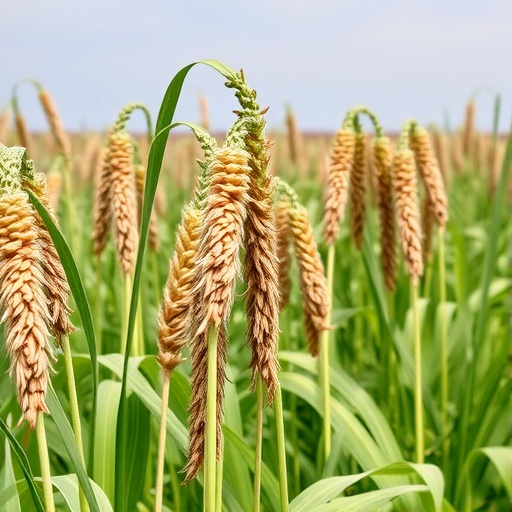
Sorghum is emerging as a vital crop in the quest for sustainable agricultural practices. Particularly, forage sorghum has gained prominence due to its adaptability and nutritional profile, making it a favored choice for farmers and livestock producers alike. Recent advancements in genetic research have opened new avenues for the selection of high-yield forage sorghum genotypes, tailored specifically for ensiling. A seminal study led by a team of researchers explores the multifaceted dimensions of these genotypes, evaluating agronomic traits, fermentation parameters, and nutritional value critical to both producer and consumer.
The significance of selecting high-yielding genotypes cannot be overstated. Forage sorghum offers numerous agronomic benefits such as drought resistance, fast growth rates, and high biomass production. These traits not only improve the efficacy of feed production but also contribute to the sustainability of agricultural practices by reducing the reliance on water and chemical inputs. The research team aimed to assess various genotypes for their ability to produce high yields under controlled conditions and field trials, fostering better practices in forage management.
Fermentation parameters play a pivotal role in the ensiling process. Ensiling, or the preservation of fodder typically in anaerobic conditions, requires careful consideration of fermentation characteristics to ensure optimal quality. The study meticulously examines these parameters, such as pH stability, lactic acid production, and the resulting silage’s overall digestibility. Understanding the nuances of fermentation can significantly enhance the nutritional profile of forage sorghum, promoting better animal health and, consequently, agricultural productivity.
Nutrition is at the heart of this research. The nutritional value of forage sorghum is primarily determined by its chemical composition, including its fiber, protein, and energy contents. The study investigates how various genotypes differ in these critical components, thereby influencing their efficacy as feed for livestock. By fostering a deeper understanding of the nutritional aspects tied to different sorghum varieties, the research establishes a roadmap for breeding initiatives aimed at producing superior genotypes that support livestock growth and health.
Moreover, the implications of these findings extend beyond immediate agricultural practices. By selecting sorghum genotypes that align with sustainable farming practices, the study contributes to a broader goal of environmental stewardship in agriculture. The benefits of improved forage sorghum extend into areas like soil health and carbon sequestration, emphasizing the importance of ecological balance in agricultural systems. As such, this research reflects a growing trend within agricultural sciences that prioritizes both productivity and sustainability.
The path to identifying suitable sorghum genotypes involves rigorous field trials and genetic analysis. The researchers employed a comprehensive methodology that included multi-location trials and phenotypic assessments, coupled with advanced genetic profiling techniques. These approaches enabled the team to systematically evaluate each genotype’s performance in various environments, ensuring the robustness of their findings and recommendations.
Innovation in forage production is paramount in the face of changing climatic conditions. The genetic diversity present within forage sorghum serves as a reservoir of traits that can be exploited to create resilient cultivars. The study highlights how genotypes exhibiting tolerance to stress conditions, such as prolonged drought, can be prioritized to mitigate the impact of climate change on agriculture. This proactive approach not only enhances food security but also aids in the adaptation of agricultural practices in a rapidly evolving environment.
The selection process for high-yield sorghum genotypes includes quantitative trait locus (QTL) mapping, a tool that allows researchers to pinpoint specific genomic regions associated with desirable traits. Through this research, insights were gleaned into the genetic factors contributing to yield, disease resistance, and nutrient content. This genetic understanding can accelerate breeding programs, facilitating the development of improved varieties that meet the diverse needs of farmers and livestock producers.
A critical takeaway from this work is the collaborative effort between researchers, farmers, and agricultural consultants. Successful implementation of high-yield forage sorghum genotypes relies on the exchange of knowledge and innovation across these stakeholders. Farmers’ practical experiences coupled with academic research create a symbiotic relationship that drives advancements in forage production and, ultimately, livestock management.
The potential economic advantages of adopting high-yield forage sorghum are substantial. Increased forage quality and quantity can lead to lower feed costs and improved animal performance. As farmers look to optimize their operations, this research positions itself as a vital reference point for decision-making. The study’s elucidation of agronomic traits and nutritional parameters provides a framework that can enhance profitability while promoting sustainable practices.
Furthermore, the study encompasses an evaluation of the sensory characteristics of silage produced from different forage sorghum genotypes. The acceptance of silage by livestock can significantly influence feeding decisions and overall animal welfare. Understanding how genetic selection impacts not only the nutritional component but also the palatability of silage speaks volumes about the holistic approach adopted by the researchers.
The implications for future agricultural research are profound. By establishing clear relationships between genotype, agronomic performance, and nutritional outcomes, this study sets the stage for future investigations into forage crops. This research could lead to innovative breeding strategies focused on integrating multiple beneficial traits, ultimately enhancing the resilience of livestock systems amid a backdrop of climate uncertainty.
In conclusion, the research undertaken by the study’s authors sheds light on the critical factors influencing the successful cultivation of high-yield forage sorghum. With agronomic traits, fermentation parameters, and nutritional value deftly addressed, this study serves as a foundation for future research aimed at optimizing forage production in alignment with sustainability goals. The outcomes have the potential to resonate throughout the agricultural community, establishing a new paradigm in forage management and livestock nutrition.
Subject of Research: High-yield forage sorghum genotypes for ensiling
Article Title: Selecting high-yield forage sorghum genotypes for ensiling: agronomic traits, fermentation parameters, and nutritional value.
Article References:
da Silva, M.F.P., Rigueira, J.P.S., da Silva, P.H.F. et al. Selecting high-yield forage sorghum genotypes for ensiling: agronomic traits, fermentation parameters, and nutritional value.
Sci Rep (2026). https://doi.org/10.1038/s41598-025-34020-4
Image Credits: AI Generated
DOI:
Keywords: Forage sorghum, high-yield genotypes, agronomic traits, fermentation parameters, nutritional value, sustainability.


