


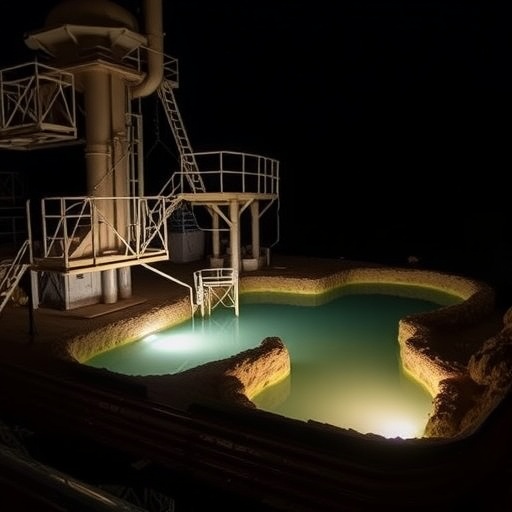
In the realm of environmental science, the challenge of mitigating pollution from mining activities is both critical and complex. A significant advancement has emerged from recent research focusing on the remediation of acid mine drainage (AMD) laden with high concentrations of fluoride. This breakthrough, led by an international team of scientists, harnesses the power of numerical modeling to optimize treatment strategies within a complex geochemical and hydrogeological setting—a large, deep mining pit. Their cutting-edge approach, detailed in a study published in Environmental Earth Sciences, signifies a promising step forward in sustainable mining remediation practices.
Acid mine drainage is a notoriously persistent environmental issue, primarily arising when sulfide minerals exposed in mining operations interact with oxygen and water, producing sulfuric acid. When this acidic water carries elevated levels of fluoride, its toxicity and environmental impact are exacerbated, posing severe risks to local ecosystems and human populations reliant on groundwater resources. Managing high-fluorine AMD thus requires sophisticated technical interventions to ensure safety and regulatory compliance, especially in large-scale mining contexts where conventional remediation methods may fall short.
The research team tackled this multifaceted problem using numerical simulation models that integrate hydrogeological, geochemical, and engineering parameters. Such models allow researchers to replicate the behavior of contaminants within the mine pit environment under various remedial scenarios. By simulating fluid flow, contaminant transport, and chemical reactions, the models provide detailed insights into how fluoride and acidity levels fluctuate spatially and temporally, offering a virtual testbed for optimization without the risks and costs of trial-and-error field experiments.
A pivotal aspect of this research lies in its ability to inform decision-making regarding the configuration and operation of remediation facilities. The numerical framework considers a range of scenarios—adjusting variables like inflow rates, treatment chemical dosages, barrier placements, and mine pit geometries. As a result, the researchers identified tailored strategies that minimize fluoride concentrations effectively and sustainably, while balancing operational feasibility and cost constraints.
The large-scale and depth of the mining pit introduce unique challenges, such as complex hydrodynamic patterns and stratification of contaminants at different depths. By capturing these complexities, the model enables an unprecedented level of precision in remediation design. The researchers demonstrated that neglecting depth-dependent variations would lead to suboptimal or even counterproductive remediation outcomes, emphasizing the necessity of advanced computational tools.
Moreover, the study brings to light the potential for adaptive management strategies in AMD remediation. Through iterative modeling and monitoring integration, treatment protocols can be continuously refined in response to evolving site conditions. This dynamic approach not only enhances long-term effectiveness but also embodies principles of resilience and sustainability—cornerstones of modern environmental engineering.
The environmental implications are far-reaching. Fluoride contamination in mining-impacted waters threatens agriculture, potable water supplies, and aquatic biodiversity. High fluoride levels have been linked to adverse health effects, including dental and skeletal fluorosis in exposed populations. By advancing optimal remediation technologies, the study contributes to safeguarding community health and preserving ecological integrity around mining regions.
This research also intersects with broader efforts to develop green mining technologies, balancing resource extraction with environmental stewardship. As mining operations delve deeper and exploit increasingly complex mineral deposits, methodologies like numerical model-guided optimization become essential to prevent long-lasting contamination legacies. The approach outlined by the authors sets a benchmark for integrating computational science with environmental engineering challenges.
The methodological framework employed hinges on a multidisciplinary integration of geoscience, chemistry, and applied mathematics. By parameterizing reaction kinetics, mass transport mechanisms, and hydrological boundary conditions, the numerical model captures the system’s nonlinear behavior. Advanced calibration against site-specific data further ensures reliability, addressing common pitfalls of oversimplification or data scarcity in environmental modeling.
Looking ahead, the research opens avenues for incorporating more complex variables into the remediation simulations, such as microbial influences on geochemical transformations or climate change impacts on hydrology. Such enhancements could amplify the precision and applicability of optimization, aligning with evolving environmental realities.
Furthermore, the study underscores the value of collaborative research efforts, blending theoretical modeling expertise with on-the-ground mining operation knowledge. This synergy accelerates the translation of scientific insights into actionable engineering solutions, bolstering the social license of mining industries through enhanced environmental responsibility.
From a technological perspective, the success of this numerical model-driven optimization could inspire novel remediation technologies beyond AMD contexts. Similar approaches might be adapted to manage other contaminated sites characterized by complex chemical interactions and fluid dynamics, including industrial waste sites or groundwater pollution plumes.
The ethical dimension should not be overlooked; by advancing more effective and scientifically grounded remediation strategies, the work contributes to reducing disproportionate environmental burdens on vulnerable communities often located near mining areas. This aligns with the increasing focus on environmental justice within resource extraction policies.
Given the mounting global demand for metals and minerals, ensuring mining activities are conducted responsibly is paramount. Innovations such as those presented in this study represent vital tools for reconciling economic development with ecological preservation, fostering a more sustainable mining future.
In conclusion, the publication of this research marks a significant milestone in environmental remediation science. The integration of numerical modeling to optimize the treatment of high-fluorine acid mine drainage within complex mine pit settings demonstrates the power of computational methods to transform environmental engineering practices. As these strategies are refined and adopted, they hold promise for mitigating mining pollution risks and enhancing global environmental health.
Cite Scienmag News
Violet Maxwell. (December 12, 2025). Optimizing Fluorine Cleanup in Deep Mine Pits. Scienmag. https://scienmag.com/optimizing-fluorine-cleanup-in-deep-mine-pits/
Violet Maxwell. "Optimizing Fluorine Cleanup in Deep Mine Pits." Scienmag, 12 December 2025, https://scienmag.com/optimizing-fluorine-cleanup-in-deep-mine-pits/. Accessed 3 September 2026.
Violet Maxwell. "Optimizing Fluorine Cleanup in Deep Mine Pits." Scienmag. December 12, 2025. https://scienmag.com/optimizing-fluorine-cleanup-in-deep-mine-pits/


