


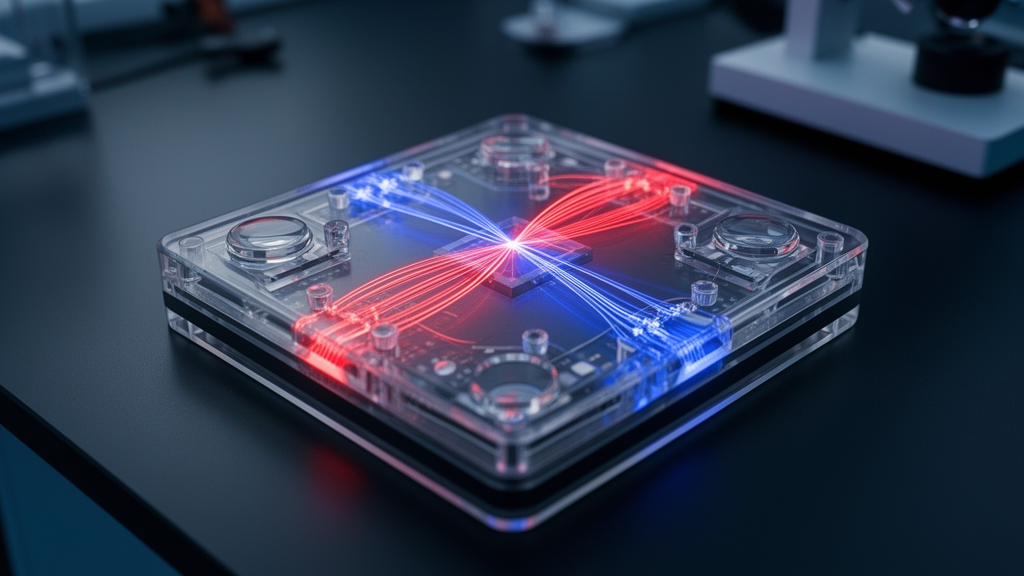
Researchers led by the University of Tokyo have developed a physics-based artificial intelligence framework running on an optical computing system that substantially reduces computational requirements while simplifying model structure and learning mechanisms, according to a peer-reviewed study published in Nature Computational Science.
Conducted by Associate Professor Kohei Nakajima from the Laboratory for Intelligent Systems and Informatics at the University of Tokyo alongside researchers from NTT, including graduate student Yongbo Zhang, the investigation sought to rethink the AI learning process so that physical systems can compute naturally rather than relying on increasingly massive and resource-intensive digital architectures.
While conventional computer chips perform calculations by transmitting electrical signals through large networks of transistors—a process that consumes heavy amounts of electrical energy and generates substantial heat—optical computing leverages light to transport information at high speeds, transmit multiple signals concurrently through parallel channels, and potentially lower overall energy consumption.
Although standard artificial intelligence algorithms can theoretically be deployed on physical and optical substrates, conventional implementations remain technically demanding because they require extensive measurement, fine-grained control, and large data storage capacities during the training phase.
To overcome these limitations, the research team redesigned the learning protocol by combining a training method designated as state-skipping direct feedback alignment (SS-DFA) with a structurally streamlined single-map network framework.
Traditional model training protocols require recording and measuring internal system states continuously as they evolve over time so that algorithms can backtrack to calculate necessary parameter adjustments; in contrast, the SS-DFA approach avoids accessing most intermediate states by utilizing the final system error in tandem with structural system dynamics to guide the learning updates.
Alongside this state-skipping learning rule, the team replaced intricate internal connection topologies with a simplified single-map framework, configuring numerous processing units to follow unified general governing rules rather than maintaining complex sets of localized internal interconnections.
The researchers verified the integrated framework through computer simulations as well as physical experiments on a dedicated optical computing platform, which processes information by converting data into optical signals, circulating them through a 200-meter optical fiber loop, and converting them back into electrical signals for analysis using a small collection of electronic components.
In experimental evaluations, the simplified optical architecture matched and in certain tests outperformed more complex neural network baselines while demanding substantially less computation, corroborating previous research by the team showing that complex activity patterns naturally emerging inside deep neural networks can be reproduced in optical systems to process information.
Currently, the team has integrated the single-map architecture as a modular computational block into several baseline modern neural network designs; however, the framework has not yet been evaluated on today’s largest language or multimodal models, making scalability to larger models and diverse data types a primary direction for future research.
If successfully scaled and miniaturized, the modular architecture could take advantage of low-heat optical hardware to curb energy consumption and cooling requirements in data centers—thereby reducing water usage—or be fabricated directly onto chips for deployment in smartphones, onboard vehicle systems, and cameras, pending further development in miniaturization, operational stability, and large-scale manufacturing.
The investigation conducted by the University of Tokyo and NTT highlights how redesigning learning algorithms allows physical hardware to process information by using the natural behavior of physical systems. Conventional computer chips execute calculations through electrical signals that pass across large numbers of transistors, a process that steadily consumes power and produces heat. Artificial intelligence models have become larger, more complicated, and increasingly resource intensive, with model training requiring vast quantities of energy. Rather than continuing to enlarge model sizes and system complexity, the researchers sought to improve efficiency by using specialized physical systems to perform computational operations. By relying on optical signals travelling through an optical fiber loop instead of electrical signals passing through transistors, the framework allows physical dynamics to process information with far less computational demand.
Graduate student Yongbo Zhang described the underlying motivation for altering the foundational learning process, emphasizing that modern artificial intelligence tools have attained remarkable capabilities while demanding vast computational resources. Zhang noted that instead of continuing to construct larger and more complicated network models, the research team aimed to rethink how artificial intelligence systems learn, enabling physical systems to compute much more naturally. To realize this goal, the team turned to optical computation, which uses light to transmit and process information rather than relying on electrical signals. However, standard learning algorithms were developed specifically for traditional digital computers and cannot operate effectively on radically different physical architectures. As a consequence, the researchers had to redesign the learning algorithm so that artificial intelligence could be successfully executed on physical optical hardware.
Optical computing presents unique physical advantages that make it an attractive platform for future machine learning applications. Light travels extremely quickly and possesses the physical capacity to carry multiple signals simultaneously across parallel channels. This combination of transmission speed, simultaneous parallel signal processing, and prospective energy efficiency gives optical systems a strong advantage over conventional electrical computing chips. Even so, deploying traditional artificial intelligence methods onto optical and other physical platforms remains technically difficult under standard practices. Conventional methods typically require extensive physical measurement, fine continuous control, and large data storage capacities, which makes running standard learning frameworks on physical systems challenging to maintain in practice. The researchers therefore focused on determining whether the learning architecture could be restructured to better accommodate the operational characteristics of physical computing systems.
To address these operational barriers, the team developed a coordinated approach combining a training algorithm called SS-DFA with a streamlined network design called the single-map framework. Associate Professor Kohei Nakajima explained that conventional training protocols require researchers to observe, measure, and record the evolving states of a system continuously as the computation proceeds. After recording these ongoing physical states, traditional algorithms backtrack step by step through earlier states to identify what modifications are required to reach an intended output. In contrast, the newly proposed SS-DFA method eliminates the requirement to monitor or record most of these intermediate physical states. Instead of tracking intermediate stages, the algorithm uses only the final error alongside structural information about the physical system to steer the learning process, which significantly reduces the necessary measurement, data storage, and computation.
In tandem with the state-skipping learning algorithm, the research group simplified the internal structural architecture of the network. Traditional deep neural network models depend on intricate configurations containing dense arrangements of internal connections between components. Nakajima noted that the single-map framework avoids this structural complexity by configuring multiple processing units to follow general rules rather than relying on complex localized internal wiring. This simplified design organizes the units so they behave in accordance with unified principles across the system. The researchers demonstrated the feasibility of this integrated approach through a combination of detailed computer simulations and experimental validation on physical optical hardware, proving that simplified network structures can successfully learn without requiring complicated internal topologies.
The physical computing setup used to validate the single-map approach relies on a physical transmission loop combined with a limited collection of electronic parts. In this optical configuration, input data is converted from digital values into an optical signal, which is then transmitted into a 200-meter optical fiber loop. As the light circulates through this 200-meter loop, information is processed through the inherent physical behavior of the optical channel. Once this physical propagation is complete, the optical signal is converted back into an electrical signal so that electronic components can analyze the computed output. By using this 200-meter fiber loop and only a small number of electronic components, the experimental system demonstrated that physical dynamics can perform artificial intelligence calculations without requiring massive arrays of electronic processors.
Experimental evaluations showed that the simplified single-map design matched the computational performance of more complex neural network architectures, and in certain tests the simplified design outperformed them while requiring far less computation. This outcome verified previous findings from Nakajima and his colleagues, which demonstrated that complex activity patterns emerge naturally inside deep neural networks, including large language models. In their earlier work, the team proposed that these naturally emerging activity patterns could be utilized to improve information processing. The current investigation confirmed that those underlying principles can be successfully reproduced within an optical system, showing that physical dynamics can match or exceed the performance of complicated artificial neural network baselines while dramatically reducing computational overhead.
At present, the researchers have integrated the single-map architecture into several relatively baseline modern neural network designs, and the results demonstrate that it improves performance while decreasing computational demands. Because the framework is modular, it can be inserted as a computational block directly into existing network architectures, providing a practical route toward scaling up the system. However, Nakajima noted an important limitation of the present work: the framework has not yet been tested on today’s largest artificial intelligence models, specifically large language models and multimodal models that handle multiple data types. Evaluating whether this modular architecture can scale effectively to these massive models and handle diverse data formats represents a primary direction for future research.
Beyond expanding to larger models, the team intends to explore implementing the approach across a wider range of physical computing platforms. Nakajima emphasized that if the system can eventually be miniaturized and integrated directly onto a computer chip, it could process data locally inside mobile phones, digital cameras, and autonomous self-driving cars. Such on-device optical computing would enable faster responses with lower energy consumption across various consumer applications. However, the researchers cautioned that before optical computing chips can become practical in real-world consumer devices, further research and development will be necessary to resolve key engineering challenges, including physical miniaturization, system stability, and large-scale manufacturing techniques.
If these scaling and manufacturing efforts succeed, the framework could dramatically lower the computational and environmental costs of artificial intelligence across future data centers. Because optical computing hardware generates very little heat during operation, adopting light-based physical processing could lower the extensive energy currently needed to run computing hardware and power data center cooling systems. Furthermore, because cooling facilities consume substantial resources to manage excessive heat output, lowering thermal generation in optical systems could also reduce data center water consumption. By simplifying both how models learn and how they are structured, the researchers hope that physics-based optical computing will pave the way toward faster, less resource-intensive artificial intelligence hardware that curtails rising energy demands while maintaining high computational performance.
Subject of Research: Optical computing framework for physical deep learning using state-skipping training and a single-map architecture
Article Title: Let there be light – novel AI framework runs on optical hardware
Article References: Let there be light – novel AI framework runs on optical hardware. Original publication (Bibliographic details unavailable.)
Image Credits: AI Generated
DOI: Not provided
Keywords: Optical computing, Artificial intelligence, Physical deep learning, Energy efficiency, Neural networks, Computer hardware, University of Tokyo, Photonics, there, light, novel, framework
Cite Scienmag News
Blake Davidson. (November 9, 2026). Optical Computing Framework Slashes AI Processing Demands Using Light-Based Learning. Scienmag. https://scienmag.com/optical-computing-framework-slashes-ai-processing-demands-using-light-based-learning/
Blake Davidson. "Optical Computing Framework Slashes AI Processing Demands Using Light-Based Learning." Scienmag, 9 November 2026, https://scienmag.com/optical-computing-framework-slashes-ai-processing-demands-using-light-based-learning/. Accessed 9 November 2026.
Blake Davidson. "Optical Computing Framework Slashes AI Processing Demands Using Light-Based Learning." Scienmag. November 9, 2026. https://scienmag.com/optical-computing-framework-slashes-ai-processing-demands-using-light-based-learning/




