

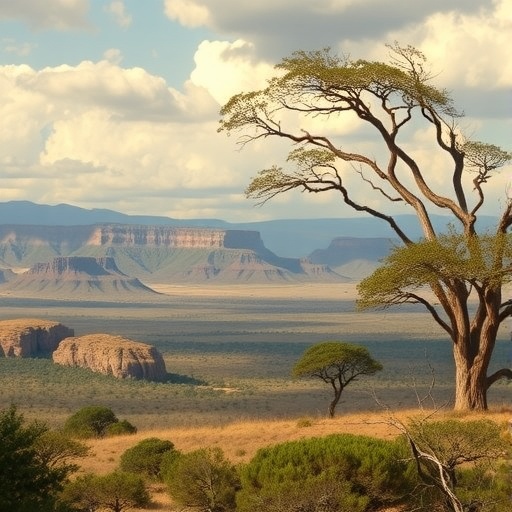
A recent groundbreaking study, published in Commun Earth Environ, sheds new light on the complex interplay between environmental factors and the emergence of hominins during the early Pleistocene. The research led by Fan, B., Li, Y., and Wang, F., explores how relatively open vegetation landscapes may have played a crucial role in shaping hominin evolution. This landmark study is being touted as a significant advancement in our understanding of early human ancestors’ adaptation strategies in a changing environment.
The early Pleistocene epoch, spanning from approximately 2.6 million to 11,700 years ago, is characterized by drastic climatic changes and fluctuating habitats. It is during this time that our ancestors began to diverge from their common primate relatives. The research presented by these scholars suggests that the shift towards open landscapes facilitated better mobility, foraging opportunities, and social interactions among early hominins. The implications of such a theory could reshape our understanding of human evolution.
According to the study, the transition from dense forest environments to more open grasslands and savannas facilitated the emergence of bipedalism and other physiological adaptations advantageous for survival. This environmental shift would not only require early humans to travel greater distances in search of food but would also influence their social structures and behaviors. The authors argue that the ability to traverse open landscapes enhanced group dynamics and communication, critical elements for survival during times of resource scarcity.
The significance of open vegetation ecosystems cannot be overstated in the context of hominin evolution. As these landscapes became more prevalent, they offered diverse food sources and allowed for a greater variety of interactions among different hominin species. This diversity, according to the researchers, would have been pivotal for the development of complex social behaviors and communication skills, establishing a foundation for future cultural evolution.
Interestingly, the study also delves deeply into the types of vegetation that dominated these environments during the early Pleistocene. The authors suggest that a mosaic of grasslands, scattered trees, and water sources created a unique ecological niche that would favor specific hominin adaptations. These elements combined fostered a rich habitat for various species, including herbivores that early humans would eventually hunt.
The findings challenge long-standing hypotheses that centered solely on climatic changes as the primary drivers of hominin development. By emphasizing the importance of open vegetation, the study underscores how anthropogenic factors, akin to the modern modification of landscapes, could spark evolutionary changes. This perspective invites further exploration into how current ecological shifts might influence future human evolution.
The research team’s multidisciplinary approach, employing paleoclimatology, archaeology, and evolutionary biology, provides a robust foundation for their claims. They analyzed fossil records, contemporaneous vegetation patterns, and archaeological finds to construct a compelling argument for the role of open landscapes in shaping hominin evolution. This integrative methodology not only bolsters their hypothesis but encourages an interconnected understanding of environmental and biological factors.
Moreover, the implications of their study extend beyond the realm of anthropology and evolutionary science. It poses critical questions about contemporary human interactions with the environment. As humans continue to alter landscapes at an unprecedented rate, understanding the consequences of such transformations becomes imperative. The research thus bridges the gap between past ecosystems and present-day environmental policies.
Further backing their claims, the researchers provided comparative analyses with other hominin species and their respective adaptations to varied environments. The study highlights the fact that while some species thrived in open landscapes, others were better suited for forested areas. This additional layer of complexity not only enriches our understanding of hominin diversity but also informs conservation efforts aimed at preserving existing ecosystems.
The collaborative effort is poised to inspire additional research aimed at diluting the assumptions surrounding human evolutionary pathways. Scholars and students alike will find fertile ground in dissecting these findings, potentially leading to new inquiries into how social structures and environmental interactions continue to evolve.
In summary, the implications of this research are vast. By situating early hominin evolution within the context of environmental transformations, Fan, Li, Wang, and colleagues offer a refreshing approach in understanding human ancestry. This study not only enriches the narrative of our evolutionary history but also serves as a cautionary tale about the potential consequences of human-induced ecological changes.
As researchers continue to unravel the complexities of human evolution, studies like this remind us of the profound connections between species and their environments. The adaptability of early hominins, spurred by their open vegetation surroundings, serves as a historical testament to the ever-changing dance between nature and mankind.
Ultimately, Commun Earth Environ has successfully published a compelling investigation that challenges previous narratives within human evolution. The findings of this research are likely to incite further academic debate and exploration in evolutionary studies as new evidence comes to light.
The dialogue that this study initiates is crucial. It encourages not only deeper reflections on our past but also mindful considerations regarding our present and future interactions with the world around us. The intersection of environment and evolution is a topic that warrants ongoing inquiry and engagement, making it essential for scholars, environmentalists, and policymakers alike.
Subject of Research: Early Pleistocene hominin evolution and the impact of open vegetation landscapes.
Article Title: Relatively open vegetation landscapes promoted early Pleistocene hominin evolution.
Article References:
Fan, B., Li, Y., Wang, F. et al. Relatively open vegetation landscapes promoted early Pleistocene hominin evolution.
Commun Earth Environ 6, 1014 (2025). https://doi.org/10.1038/s43247-025-02983-x
Image Credits: AI Generated
DOI: https://doi.org/10.1038/s43247-025-02983-x
Keywords: Hominin evolution, early Pleistocene, vegetation landscapes, environmental change, bipedalism, social behavior, ecological niches.


