

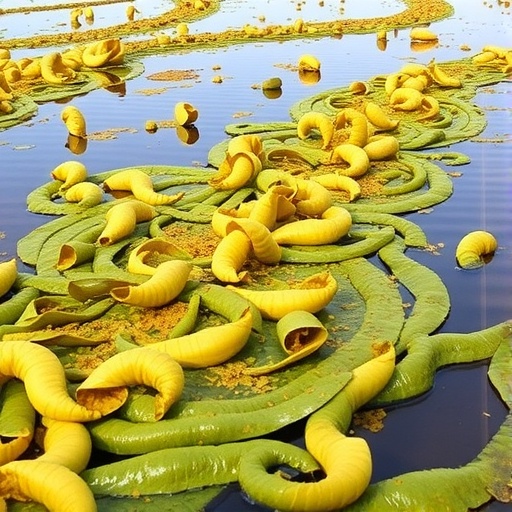
In a groundbreaking initiative poised to reshape the marine biotechnology landscape in the Arabian Peninsula, researchers from the Center of Excellence in Marine Biotechnology at Sultan Qaboos University (SQU) have embarked on an ambitious pilot seaweed cultivation project off the northern coast of Oman. This pioneering endeavor, executed in collaboration with Macro Algae Industries, aims to systematically evaluate the commercial viability and ecological adaptability of native seaweed species within Oman’s unique marine environment, marking a significant stride toward establishing a sustainable blue economy rooted in aquaculture innovation and biotechnological advancement.
The pilot project is strategically located near the Al Sawadi Islands in Barka, a site selected for its representative coastal conditions and accessibility for monitoring. It employs a sophisticated 10 × 20 meter floating raft cultivation system, engineered to optimize the growth environment for seaweed while enabling precise experimental controls. This floating platform design facilitates structured, side-by-side comparisons among different species by maintaining consistent environmental conditions, thus ensuring reliable data collection critical for scaling operations in the future.
Central to this study are three indigenous seaweed species—Gracilaria debilis, Martensia insipiens, and Sargassum ilicifolium—chosen for their promising ecological resilience and economic potential. Gracilaria debilis, known for its high agar yield, represents a commercially valuable red algae strain. Martensia insipiens, a lesser-studied red seaweed, offers intriguing prospects due to its rapid growth rates and bioactive compounds. Meanwhile, Sargassum ilicifolium, a brown seaweed with a robust holdfast structure, is recognized for its multifunctional uses from fertilizer to biofuel precursor.
The biomass used to inoculate the cultivation raft was meticulously sourced from the Dhofar Governorate, ensuring genetic integrity and adaptation appropriateness. The project’s experimental timeline, spanning December 2025 through April 2026, is designed to encompass critical seasonal variations impacting growth rates and biomass quality, thereby enabling comprehensive performance profiling under authentic marine conditions. This temporal span facilitates the capture of data related to reproductive cycles, nutrient uptake, and stress response.
Researchers are conducting rigorous weekly assessments employing a combination of in situ measurements and laboratory analyses. Regular monitoring of seawater physicochemical properties—temperature, salinity, pH, dissolved oxygen, and nutrient concentrations such as nitrates and phosphates—is integral to correlating environmental parameters with biomass productivity. Advanced sensors and data loggers have been deployed to continuously record environmental fluctuations, facilitating the development of predictive models for yield optimization.
A pivotal component of the methodology involves mitigating herbivory pressures, which can significantly compromise biomass accumulation and distort growth metrics. Protective measures, including mesh guards and selective cultivation site positioning, have been implemented to minimize grazing by local marine fauna. This control allows for an unadulterated evaluation of species-specific growth characteristics and biochemical profiles, integral to downstream applications such as food additives and pharmaceuticals.
The project’s endpoint aims to harvest at least one complete growth cycle, contingent upon biomass health indicators and sustained growth rates. This iterative harvest will enable the assessment of yield consistency, biochemical composition, and market readiness of the cultivated biomass. Data obtained will serve as the empirical foundation to transition from experimental trials to scalable industrial cultivation systems, addressing vital issues such as site selection, species performance, and optimal cultivation techniques.
Beyond the immediate experimental outcomes, this initiative represents a strategic collaboration between academic research and private sector investment, amplifying the potential for innovative marine biotechnology solutions within the Omani economy. Macro Algae Industries’ funding bolsters a synergistic framework, wherein scientific investigation informs commercial development pathways while ensuring adherence to sustainability principles essential for long-term ecosystem health.
Sustainable aquaculture, especially seaweed farming, holds immense promise for diversifying Oman’s economic portfolio by harnessing marine bioresources responsibly. Seaweed cultivation offers multifaceted benefits, including carbon sequestration, nutrient bioextraction, habitat provision, and generation of bioactive compounds with nutritional and industrial utility. The pilot farm serves as a vital testbed for integrating these benefits into a cohesive production model tailored to the Gulf of Oman’s marine conditions.
The data generated through this project will yield a comprehensive baseline dataset critical for informed policymaking, investor confidence, and regional capacity building. By quantifying growth dynamics, environmental tolerances, and biochemical yields, the study addresses key knowledge gaps that have historically impeded large-scale seaweed industry development in the Arabian Peninsula.
Ultimately, this pioneering pilot aligns with global trends emphasizing sustainable ocean resource management and the bioeconomy’s expansion. The success and learnings from this project have the potential to position Oman as a regional leader in marine biotechnology, setting benchmarks for ecological compatibility, economic feasibility, and technological innovation in seaweed cultivation. The wider implications extend toward fostering resilient coastal communities, enhancing food security, and advancing marine ecosystem restoration efforts through cultivation-based interventions.
Researchers and stakeholders eagerly anticipate the project’s outcomes, which will not only illuminate the path forward for Omani aquaculture but also contribute valuable insights to the global scientific community engaged in marine biotechnology. This initiative exemplifies how targeted research, supported by cutting-edge technology and cross-sector collaboration, can transform local marine resources into sustainable economic opportunities with far-reaching environmental and social impacts.
Subject of Research: Not applicable
Article Title: Not provided
News Publication Date: Not provided
Web References: Not provided
References: Not provided
Image Credits: Center of Excellence in Marine Biotechnology, Sultan Qaboos University (SQU)
Keywords: Environmental sciences, Marine biology, Aquaculture, Sustainability


