


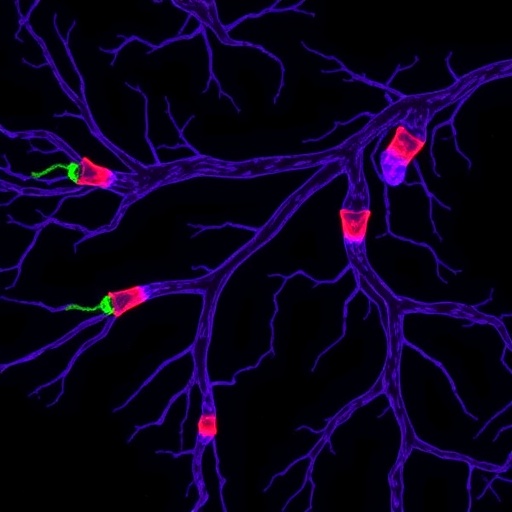
In a groundbreaking study published in Nature Metabolism, researchers have uncovered a pivotal cellular mechanism that safeguards the intricate process of myelination and remyelination within the central nervous system (CNS). The investigation, led by Sun, Zhang, Men, and colleagues, delves into how oligodendrocyte precursor cells (OPCs) uniquely circumvent metabolic stress induced by low glucose conditions through selective inhibition of AMP-activated protein kinase (AMPK) activation. This discovery challenges previous assumptions about energy metabolism in OPCs and opens new avenues for therapeutic strategies targeting demyelinating diseases such as multiple sclerosis (MS).
Myelination, the process by which oligodendrocytes produce the myelin sheath that insulates neuronal axons, is fundamental for rapid electrical conduction and overall nervous system functionality. OPCs are the progenitor cells responsible for generating mature myelinating oligodendrocytes. However, the vulnerability of these cells to energy deprivation is a critical concern, especially in pathologies where glucose availability is compromised. Until now, the influence of cellular energy sensors like AMPK on OPC differentiation and function remained poorly understood.
AMPK acts as a master regulator of cellular energy homeostasis, typically activated under conditions of low energy, such as glucose deprivation, to restore balance by modulating multiple metabolic pathways. Intuitively, activation of AMPK in OPCs under glucose scarcity would be expected to promote survival and adaptation. Contrasting this, the new study demonstrates that OPC-specific blocking of AMPK activation in response to low glucose is essential to ensure proper myelination and efficient remyelination following injury.
Utilizing sophisticated genetic tools to selectively disrupt AMPK activation in OPCs, the authors revealed that preventing AMPK-induced metabolic adaptations paradoxically facilitates the preservation of OPC function and myelin production. This counterintuitive result suggests that AMPK activation in OPCs under low glucose conditions triggers pathways that impair differentiation, thus hindering the repair processes vital for restoring myelin integrity.
High-resolution imaging and metabolic flux analyses provided further clarity on the cellular consequences of AMPK signaling modulation. The blockade of AMPK activity preserved mitochondrial function and maintained the anabolic processes necessary for lipid synthesis, which is crucial for generating the myelin sheath. Conversely, AMPK activation diverted resources toward catabolic pathways, reducing the availability of substrates required for myelin assembly.
Moreover, this research elucidates how OPCs exhibit a unique metabolic profile compared to other CNS cell types. While neurons and astrocytes activate AMPK to survive energy stress, OPCs appear to have evolved a protective mechanism that circumvents this energy sensor to prioritize their differentiation and myelin-producing functions. Such specialization underscores the complexity of CNS cellular metabolism and the need for cell-type-specific therapeutic approaches.
The implications of these findings extend beyond fundamental neurobiology. Remyelination is central to recovery in demyelinating disorders, and current treatments primarily focus on immunomodulation rather than promoting intrinsic repair mechanisms. By identifying AMPK as a regulatory node that restricts OPC-mediated remyelination under metabolic stress, this study proposes a novel target for enhancing myelin regeneration.
Pharmacological or gene therapy approaches designed to transiently inhibit AMPK activation in OPCs may potentiate remyelination without compromising overall energy homeostasis in other cell types. Such precision medicine strategies could ameliorate disability in MS patients, especially in progressive stages where remyelination capacity declines.
The study also prompts a reevaluation of metabolic interventions aimed at supporting myelin repair. Traditional approaches often seek to bolster energy supply or activate AMPK to mimic caloric restriction benefits. However, these findings suggest that indiscriminate activation of AMPK could be detrimental to myelin-producing cells, emphasizing the necessity for cell-specific therapies.
Furthermore, the researchers underscore the significance of low-glucose microenvironments created by vascular dysfunction or inflammation, common in neurodegenerative diseases. The OPC-centric AMPK blockade mechanism may represent an adaptive response to such pathological contexts, ensuring sustained myelin production despite metabolic adversity.
Future research is warranted to dissect the downstream signaling pathways suppressed by AMPK inhibition in OPCs and identify molecular targets that can be modulated to fine-tune the balance between energy sensing and myelination. Additionally, investigating the interaction between AMPK signaling and other metabolic regulators such as mTOR and SIRT1 in OPC biology could yield comprehensive insights.
The study sets a precedent for exploring metabolic regulation in CNS cell types with an unprecedented resolution. It also highlights the intricate balance cells must strike between energy conservation and executing specialized functions like myelin generation, which is paramount for CNS health and recovery.
As neurodegenerative diseases continue to impose a substantial global health burden, insights into cellular metabolism and energy sensing within progenitor cells mark a promising frontier. This research exemplifies how targeting metabolic nodes selectively in OPCs can potentially shift the paradigms of regenerative neurology.
In summary, the discovery that OPC-specific suppression of low-glucose-induced AMPK activation ensures effective myelination and remyelination not only advances our understanding of CNS biology but also chart a course toward innovative treatments that capitalize on the metabolic nuances of oligodendrocyte function.
Cite Scienmag News
Ophelia Keating. (October 22, 2025). Oligodendrocyte Precursors Block AMPK to Ensure Myelination. Scienmag. https://scienmag.com/oligodendrocyte-precursors-block-ampk-to-ensure-myelination/
Ophelia Keating. "Oligodendrocyte Precursors Block AMPK to Ensure Myelination." Scienmag, 22 October 2025, https://scienmag.com/oligodendrocyte-precursors-block-ampk-to-ensure-myelination/. Accessed 4 September 2026.
Ophelia Keating. "Oligodendrocyte Precursors Block AMPK to Ensure Myelination." Scienmag. October 22, 2025. https://scienmag.com/oligodendrocyte-precursors-block-ampk-to-ensure-myelination/


