

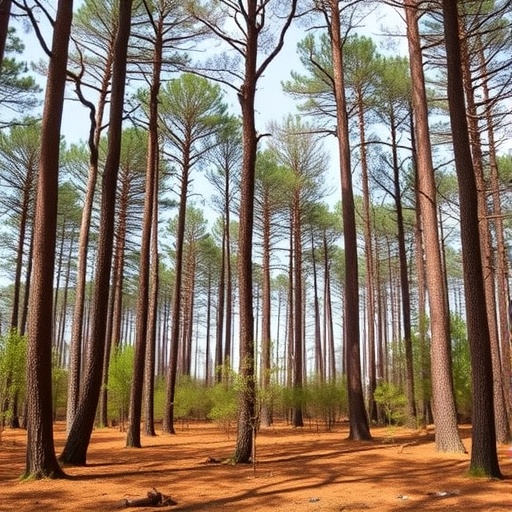
A Groundbreaking Study Reveals Swedish Old-Growth Forests Store Significantly More Carbon Than Previously Estimated
In an unprecedented new study conducted by researchers at Lund University, the old-growth forests of Sweden have been shown to store a staggering 83 percent more carbon than their managed counterparts. This revelation dramatically reshapes our understanding of forest carbon dynamics and highlights the crucial role of soil in carbon storage—an aspect that has been vastly underestimated in earlier assessments. Published in the highly regarded journal Science, this comprehensive research offers the most detailed mapping to date of carbon stocks within Sweden’s primary boreal forests, casting new light on forest management’s impact on climate mitigation strategies.
This groundbreaking study involved meticulous fieldwork spanning nearly a decade, reflecting an extraordinary commitment to scientific rigor and ecological understanding. The research team embarked on an extensive campaign to identify and map old-growth forests—those ecosystems largely untouched by direct human interference over long periods. Given the absence of any previous national cartography delineating these pristine forest areas, this initial phase required synthesizing historical data, satellite imagery, and on-the-ground verification, creating a baseline for subsequent ecological analysis.
Central to the findings is the revelation that carbon storage in old-growth forests surpasses that of managed forests by between 78 to 89 percent across all carbon pools, including living biomass, dead organic matter, and soil carbon, measured to depths of 60 centimeters. This contrasts sharply with prior estimates which often focused predominantly on aboveground biomass, neglecting the substantial carbon sequestered below the soil surface. Anders Ahlström, lead researcher from Lund’s Department of Environmental and Earth Sciences, emphasized that the soil’s carbon reservoir in these old-growth systems alone rivals the total carbon content found in managed forests’ living trees, dead wood, and soil combined.
The implications of this soil carbon dominance cannot be overstated. Soils in old-growth boreal forests function as vast carbon sinks, accumulated over centuries, providing a stable storage medium resistant to rapid turnover. This challenges the prevailing assumption that carbon held in wood products could offset losses from forest management. Didac Pascual, another key scientist involved in the study, pointed out that carbon retained in harvested wood products is relatively minor and transient because many such products, including paper and bioenergy feedstocks, release carbon back into the atmosphere on short timescales.
Moreover, the quantification of total carbon differences—accounting not only for forest biomass but also for carbon embedded in wood products—reveals discrepancies that dwarf previous projections by a factor of three to eight. When contextualized within Sweden’s carbon emission profile, these carbon stock differences equate to approximately 211 years of the nation’s current fossil fuel-derived CO₂ emissions, or about 1.5 times the cumulative fossil fuel emissions since the onset of industrialization in 1834. This startling comparison vividly underscores the climatic importance of preserving primary forest ecosystems.
The researchers elucidated that these pronounced discrepancies stem from long-term land use changes, particularly the advent and intensification of large-scale forestry operations starting in the mid-20th century. Managed forests, shaped by repeated clear-cutting, thinning, and other interventions, have fundamentally altered forest carbon dynamics versus the largely undisturbed old-growth stands. These changes not only affect living and dead biomass carbon but also have profound consequences for soil carbon stability and accumulation.
Notably, the study highlights the critical role of historical carbon losses, often overlooked in contemporary carbon uptake measurements. While contemporary forest growth may indicate net carbon sequestration rates, it fails to capture the substantial carbon deficits accrued over past centuries due to forest management and land use changes. Old-growth forests serve as ecological benchmarks, providing insight into the potential carbon storage capacity of boreal ecosystems absent anthropogenic pressures.
The ramifications of these findings for climate policy are substantial. If converting natural forests into managed ones causes carbon losses much greater than previously believed, then current climate benefit estimations for forest-derived bioenergy and construction materials must be revisited. This underscores a need for integrating historical carbon stock assessments into lifecycle analyses of wood products to accurately evaluate their net climate impacts.
Conservation strategies gain new urgency in light of these results. Protecting extant old-growth forests and facilitating the recovery of unmanaged forest areas could unlock far greater carbon sequestration potentials than earlier documented. Alarmingly, a significant proportion of Sweden’s annual clear-cutting occurs within old-growth forest areas, implying considerable ongoing carbon emissions that could be mitigated through better forest stewardship.
These insights challenge forest management paradigms and advocate for a shift towards approaches that prioritize carbon sequestration and ecosystem integrity. As Anders Ahlström articulated, comparing primary and managed forests is essential to understanding how forestry practices shape carbon balances and affect climate mitigation potential at landscape scales.
Furthermore, this study’s methodical and exhaustive approach—encompassing nearly 220 soil pits reaching depths of one meter—sets a new standard for carbon stock assessments in forest ecosystems globally. The integration of soil carbon data with aboveground biomass measurements offers a holistic understanding of ecosystem carbon dynamics that previous research had not achieved.
In conclusion, Lund University’s study fundamentally alters the narrative around boreal forest carbon storage. It provides compelling scientific evidence advocating the urgent preservation of old-growth forests, not solely for biodiversity conservation but as a pivotal climate mitigation strategy. This enhanced recognition of soil carbon storage alongside biomass provides a vital roadmap for policymakers, forest managers, and environmental scientists aiming to reconcile forestry with global climate goals.
Subject of Research: Carbon storage comparison between old-growth (primary) and managed (secondary) boreal forests in Sweden.
Article Title: Higher carbon storage in primary than secondary boreal forests in Sweden
News Publication Date: 19-Mar-2026
Web References: 10.1126/science.adz8554
Keywords: old-growth forests, carbon storage, boreal forests, soil carbon, forest management, carbon sequestration, climate mitigation, Lund University, boreal ecosystem, forest conservation, bioenergy, carbon emissions


