


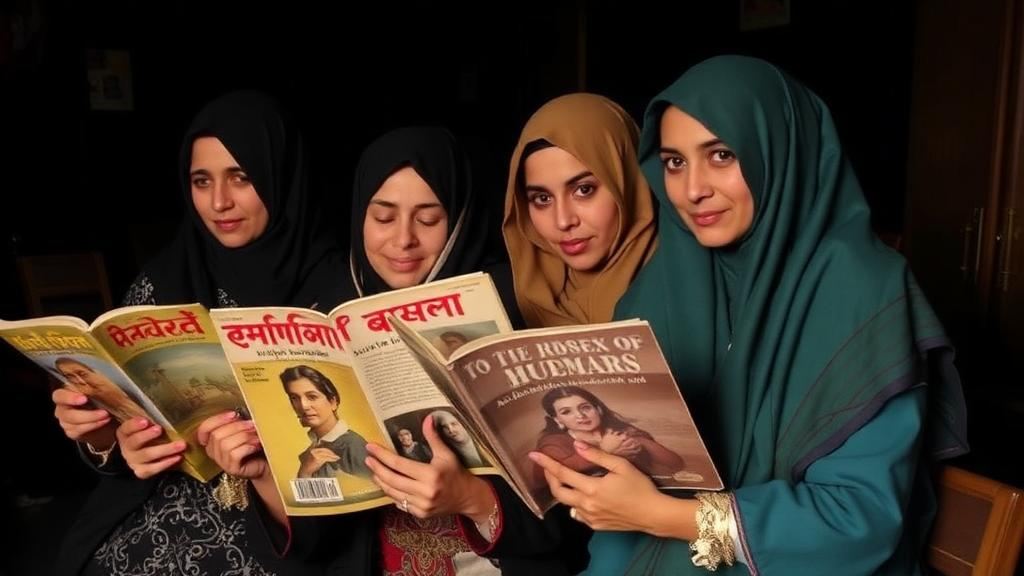
A new historical study published in SN Social Sciences examines how Bengali Muslim edited newspapers and magazines of the early twentieth century documented, debated, and sometimes challenged the marginalised social position of Muslim women in colonial Bengal. The research, conducted by Tuhina Islam of the Department of History at Aliah University in Kolkata, mines a rich archive of periodicals including Kohinoor, Roushan Hedayat, Islam Darshan, Islam Pracharak, Nabanoor, Masik Muhammadi, Samyabadi, Sabuj Palli, and Saogat to reconstruct the reformist discourses that swirled around questions of women’s education, child marriage, widow remarriage, polygamy, divorce, and veiling. The result is a detailed portrait of a community wrestling with the tension between religious tradition and social change, and of the pioneering women who used the printed page as their platform.
The study situates its analysis against the backdrop of the nineteenth century, when a wave of reform movements sought the overall improvement of women’s status across Indian society. Yet, as the paper argues, Muslim women confined to the antahpur, the secluded inner quarters of the household, remained markedly marginalised within these efforts. According to the research, their condition was considerably more lamentable than that of their Hindu counterparts, a disparity rooted in lower rates of formal education, stricter practices of seclusion, and social customs that kept women largely invisible in public life. Over the course of the century, however, as education expanded among the Muslim elite, prominent men of the community began to address women’s issues more actively, and the emerging medium of print became the principal arena for those discussions.
The legal framework of the era forms an important part of this context. The study notes that the first law aimed at preventing child marriage was passed in 1860, setting the minimum age of marriage for girls at ten years, a figure that was later raised to twelve. In 1891, the Age of Consent bill was enacted, legalising the notion of a girl’s consent in marriage. These legislative milestones, while limited in scope, gave reformers concrete reference points for their arguments in the press, and the periodicals studied by Islam repeatedly returned to the gap between statutory reform and everyday practice in Muslim households across Bengal.
Central to the paper’s analysis is the emergence of Muslim women themselves as writers and public intellectuals. Eminent figures such as Begum Rokeya Sakhawat Hossain, Mrs. M. Rahman, and Shamsunnahar Mahmud began publishing in Muslim edited newspapers and journals in the early twentieth century, voicing their concern about what they described as the deplorable condition of Muslim women and linking their writing to active engagement in reform movements. Begum Rokeya, whose essays appeared in Nabanoor between 1904 and 1905 under titles such as Griha (Home), Amader Obonoti (Our Degradation), and Arthangini (Better-Half), used these columns to argue that the seclusion and neglect of women were dragging the entire community backward. Her writings, the study shows, combined sharp social critique with an appeal to the community’s own interests, framing women’s advancement as inseparable from collective progress.
The institutional groundwork for this awakening had been laid decades earlier. The study traces the origins of Muslim educational and associational life in Bengal to organisations such as the Mohammedan Literary Society, founded on 2 April 1863 to promote education and religious consciousness among Muslims, and the National Mohammedan Association, established on 12 May 1878 through the initiatives of Syed Ameer Ali to promote western education. The latter organisation spread its branches beyond Calcutta and played a crucial role in serving village-based students. Such bodies, dominated by male elites, gradually opened space for the discussion of women’s education, even as their own priorities remained focused on the advancement of Muslim men in colonial administration and the professions.
Among the specific debates the study reconstructs is the controversy over purdah, or veiling. Periodicals carried contributions both defending and criticising the practice. An essay titled Muslim Ramanir Purdah Pratha, published in Islam Pracharak in 1903–1904, examined the veiling of Muslim women, while decades later a piece in Sabuj Palli in 1926 addressed the burqa directly. In 1929, Mohammad Nasiruddin published an essay in Saogat titled Purdah Bonam Probanchona, Veil versus Deception, signalling a shift in the debate from whether veiling was religiously mandated to whether it served as a cover for social stagnation. Writers also turned to religious texts themselves, with one 1922 essay in Islam Darshan discussing the doctrine of veiling in Islam, indicating that reformers sought to argue their case within, rather than against, the Islamic framework.
Polygamy and widow remarriage generated equally heated exchanges. A 1905 essay in Nabanoor by Maulvi Imdad-Ul-Haq and Imdad Ali took up the question of polygamy, while a 1926 contribution in Roushan Hedayat defended widow marriage in Islam, pointing to the gap between scriptural permissibility and social practice. The study also records discussions of divorce and of the suffering of women, including essays titled Nari Jatir Durgati, The Suffering of Women, published in Al-Eslam in 1917 and 1921. These interventions, the paper argues, show that the periodical press functioned as a genuine deliberative forum in which the gender norms of the Muslim socio-religious framework were negotiated in real time, with contributors citing the Quran, including Surah Al Nisa, alongside contemporary social argument.
Women writers did not limit themselves to broadsides against custom; they also developed constructive programmes. Khairunnessa’s 1905 essay in Nabanoor, Shikhar Antaray, or Obstacles to Our Education, identified the practical barriers that kept girls out of schools, while S. Khatun’s 1923 piece Adhunik Shiksha, Modern Education, in the Bangiya Muslim Sahitya periodical set out an affirmative vision of what schooling could offer. The study highlights dedicated women’s writing sections that gave these voices institutional support. The magazine Saogat ran a women’s section known as Zenana Mehfil, which the Muslim women of the early twentieth century used as a platform to publish their writings. Similarly, Masik Muhammadi carried a special column called Mahila Mehfil from the first issue of its second year, corresponding to October 1928, through 1930–31, publishing contributions from writers including Mrs. R. S. Hossain, Amina Khatun, Razia Khatun Choudhurani, Subodh Bala Biswas, and Abu Lohani on a range of women’s and social issues.
The study also documents the international horizons of this reformist moment. It notes that the first Indian Muslim woman to receive a senior degree from the University of Cambridge followed close on the achievements of Chandramukhi Basu and Kadambini Ganguly, the pioneering women graduates of India, a fact the author cites to illustrate how quickly the boundaries of the possible were shifting for Muslim women in this era. Scholarly works by Gail Minault on secluded scholars and Muslim social reform in colonial India, and by Siobhan Lambert-Hurley on Muslim women, reform, and princely patronage, are drawn upon to place the Bengali material within the broader landscape of South Asian Muslim women’s history, while more recent scholarship on Muslim enlightened thought in South Asia frames the period’s intellectual currents.
Ultimately, the paper argues that the Bengali Muslim edited periodicals of the early twentieth century constitute an indispensable archive for understanding both the social marginalisation of Muslim women and the strategies by which they and their allies sought to overcome it. By reading men’s and women’s reformist writings side by side across titles ranging from Kohinoor in 1898 to Saogat in the 1930s, the study shows a community in transition: elites beginning to acknowledge women’s grievances, women seizing the printed page to speak in their own names, and a gradual, contested redefinition of what education, marriage, and public life could mean within the Muslim socio-religious framework. The research, supported by a project grant from the Aliah University Research and Development Cell, received on 1 July 2025, was accepted on 1 September 2026, and published on 26 September 2026, adds a significant chapter to the social history of gender reform in colonial Bengal and underscores how much of women’s history survives in the humble columns of long-forgotten magazines.
Subject of Research: Social realities of Bengali Muslim women as reflected in early twentieth-century Bengali Muslim edited periodicals
Article Title: Unveiling social realities of the lives of Muslim women through the lens of Bengali Muslim edited periodicals of early twentieth century
Article References: Islam, T. (2026). Unveiling social realities of the lives of Muslim women through the lens of Bengali Muslim edited periodicals of early twentieth century. SN Social Sciences, 6(10), Article 481. https://doi.org/10.1007/s43545-026-01699-9
Image Credits: AI Generated
DOI: 10.1007/s43545-026-01699-9
Keywords: Bengali Muslim women, periodicals, social reform, women's education, child marriage, purdah, polygamy, widow remarriage, colonial Bengal, Begum Rokeya, print culture, social history
Cite Scienmag News
Courtney Benton. (October 2, 2026). Old Bengali Magazines Reveal How Muslim Women Fought for Reform a Century Ago. Scienmag. https://scienmag.com/old-bengali-magazines-reveal-how-muslim-women-fought-for-reform-a-century-ago/
Courtney Benton. "Old Bengali Magazines Reveal How Muslim Women Fought for Reform a Century Ago." Scienmag, 2 October 2026, https://scienmag.com/old-bengali-magazines-reveal-how-muslim-women-fought-for-reform-a-century-ago/. Accessed 4 October 2026.
Courtney Benton. "Old Bengali Magazines Reveal How Muslim Women Fought for Reform a Century Ago." Scienmag. October 2, 2026. https://scienmag.com/old-bengali-magazines-reveal-how-muslim-women-fought-for-reform-a-century-ago/


