


EMBARGO: THIS CONTENT IS UNDER EMBARGO UNTIL 9 A.M. U.S. EASTERN STANDARD TIME ON JULY 16. INTERESTED MEDIA MAY RECIVE A PREVIEW COPY OF THE JOURNAL ARTICLE IN ADVANCE OF THAT DATE OR CONDUCT INTERVIEWS, BUT THE INFORMATION MAY NOT BE PUBLISHED, BROADCAST, OR POSTED ONLINE UNTIL AFTER THE RELEASE WINDOW.

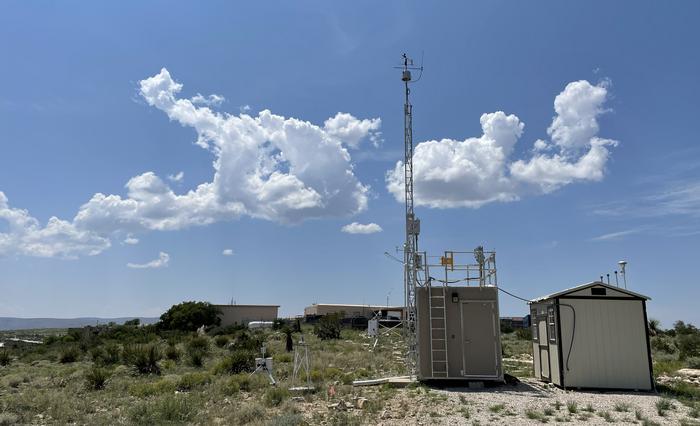
Credit: Credit: Colorado State University Department of Atmospheric Science
EMBARGO: THIS CONTENT IS UNDER EMBARGO UNTIL 9 A.M. U.S. EASTERN STANDARD TIME ON JULY 16. INTERESTED MEDIA MAY RECIVE A PREVIEW COPY OF THE JOURNAL ARTICLE IN ADVANCE OF THAT DATE OR CONDUCT INTERVIEWS, BUT THE INFORMATION MAY NOT BE PUBLISHED, BROADCAST, OR POSTED ONLINE UNTIL AFTER THE RELEASE WINDOW.
New research shows that ozone concentrations at Carlsbad Caverns National Park frequently exceed Environmental Protection Agency health standards, likely due to oil and natural gas development in the Permian Basin and surrounding region.
The work was led through the Department of Atmospheric Science at Colorado State University and is part of ongoing air quality research across the national park system by University Distinguished Professor Jeffrey Collett and his team. Andrey Marsavin, a Ph.D. student in the department, served as first author on the work, which was published in the Journal of Geophysical Research-Atmospheres.
The park is in southeast New Mexico and in the summer frequently sits downwind from the Permian Basin – one of the largest and most productive oil and natural gas areas in the country. Data from the paper comes from a 2019 field survey and is part of a series of air quality studies in the area. The paper shows that eight-hour ozone concentrations frequently exceed the EPA health standard of 70 parts per billion during the summer months.
Marsavin said the research explores the different potential sources of ozone precursors in the area and confirms that oil and gas development – which has increased fivefold in the basin over the last decade – is a major contributor.
“Our model focused on specific compounds that are known to be associated with oil and gas production to help us understand how that activity specifically contributes to the ongoing ozone issues in the region,” he said. “Our measurements confirm that activity such as drilling and natural gas flaring is a major driver of the high ozone levels we see.”
Unhealthy ozone concentrations are a serious problem worldwide, including urban areas like Colorado’s Front Range. It can lead to health issues in humans such as asthma, while also damaging crops and natural ecosystems.
Ozone is a highly reactive gas that forms when emissions from both natural sources and human activities react in the atmosphere. Major sources of ozone precursors include motor vehicles, industrial facilities, solvents and coatings, personal care products, vegetation, and lawn and garden equipment. Energy exploration and production systems like those found in the Permian Basin are also large contributors to emission totals.
Tracking ozone levels near Carlsbad and other national parks
Federal requirements have helped reduce U.S. emissions of nitrogen oxides and volatile organic compounds that can lead to ozone over the last 20 years. However, some areas of the western U.S. have only seen small declines or even increases due to wildfire activity, increased oil and gas development, and production activity like flaring and fracking.
Marsavin said a goal of this research was to untangle possible sources of ozone precursors in the region and quantify the impact of extensive oil and gas development on high ozone concentrations. The team found that while both nitrogen oxides and volatile organic compounds contribute to ozone, the largest impact comes from nitrogen oxide emissions. These emissions come primarily from high-temperature combustion activity. They then tracked dispersal patterns across the region to show that activity in the Permian Basin was a primary driver, with emissions from other oil and gas basins farther upwind appearing to also contribute to elevated ozone on some days.
The team’s research also considered how a switch in production methods such as the use of electric power for drilling rigs could lower ozone levels in the area.
Professor Collett’s team has partnered with the U.S. National Park Service on a range of air quality research projects for years. He said this paper’s findings were likely relevant to nearby areas like Guadalupe Mountains National Park in Texas and the broader region.
He said the team will continue to work with more recently collected data and potentially begin to include satellite observations in their approach as well.
“Many of the country’s largest oil and gas production basins are located near national parks. These are fragile ecosystems that the park service is entrusted with protecting for everyone – so they are very interested in these findings and how actions can be taken to address them,” Collett said. “So, we are not quite done with studying ozone formation in this region as development in the Permian continues.”
The research was done in partnership with the National Park Service’s Air Resources Division, and NPS scientists Barkley Sive, Bret Schichtel and Anthony Prenni are co-authors. Other CSU-affiliated authors on the work include Monfort Professor Emily Fischer; research scientists Yong Zhou, Ilana Pollack, Amy Sullivan, Da Pan and Katherine Benedict; and graduate students Lillian Naimie and Julieta Juncosa Calahoranno.
Journal
Journal of Geophysical Research Atmospheres
Article Title
Summertime ozone production at Carlsbad Caverns National Park, New Mexico: influence of oil and natural gas development
Article Publication Date
16-Jul-2024
Cite Scienmag News
Ophelia Keating. (July 16, 2024). Oil and natural gas development in Permian is a key source of ozone pollution in Carlsbad Caverns National Park. Scienmag. https://scienmag.com/oil-and-natural-gas-development-in-permian-is-a-key-source-of-ozone-pollution-in-carlsbad-caverns-national-park/
Ophelia Keating. "Oil and natural gas development in Permian is a key source of ozone pollution in Carlsbad Caverns National Park." Scienmag, 16 July 2024, https://scienmag.com/oil-and-natural-gas-development-in-permian-is-a-key-source-of-ozone-pollution-in-carlsbad-caverns-national-park/. Accessed 5 September 2026.
Ophelia Keating. "Oil and natural gas development in Permian is a key source of ozone pollution in Carlsbad Caverns National Park." Scienmag. July 16, 2024. https://scienmag.com/oil-and-natural-gas-development-in-permian-is-a-key-source-of-ozone-pollution-in-carlsbad-caverns-national-park/

