

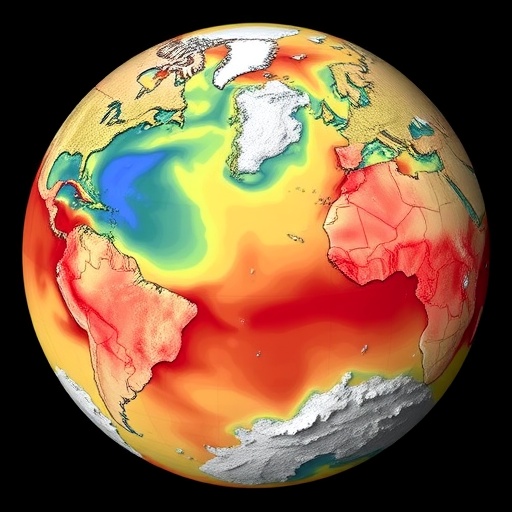
In a groundbreaking study, researchers have delved into the intricate connections between regional oceanic variability and the phenomenon of global drought synchrony. The paper, authored by Bhatia, Poonia, Mansoor Tantary, and a team of experts, presents key findings that illuminate how fluctuations in ocean conditions can significantly influence drought patterns across the world. This research sheds light on the critical role that oceanic systems play in shaping terrestrial climates, a connection that has become increasingly important as the world grapples with climate change.
The authors argue that understanding the relationship between oceanic variability and drought is pivotal to forecasting future climatic trends. The study identifies that when certain ocean regions experience variability—such as temperature shifts in the Atlantic or Pacific Oceans—these changes can lead to simultaneous droughts in distant locations. This synchronization presents a unique challenge for agricultural practices and water resource management in regions that may traditionally be viewed as isolated from one another.
One of the major contributions of this research is the use of sophisticated climate models that simulate the interactions between oceanic and atmospheric variables. With these models, the researchers were able to identify patterns that show how oceanic conditions, like El Niño and La Niña events, can trigger a cascade of ecological responses, thereby impacting weather systems thousands of miles away. By employing a multi-faceted approach that combines observational data with modeling techniques, the authors were able to elucidate the mechanisms driving these global climate interactions.
The study highlights the importance of regional studies that examine specific oceanic areas in detail, as these investigations can reveal localized impacts that may otherwise be overlooked. For instance, the research reveals how the Indian Ocean Dipole affects precipitation patterns over East Africa, demonstrating that climatic anomalies in remote oceanic regions can culminate in severe drought scenarios on land. This insight is crucial for developing more effective regional climate adaptations strategies.
Furthermore, Bhatia and colleagues emphasize the historical context, demonstrating through their findings how previous climatic events have set precursors for present-day drought occurrences. By tracing back to significant drought years and correlating them with oceanic data, they construct a narrative that links past and present climatic challenges. This type of retrospective analysis not only enhances our understanding of climatic behavior but also assists policymakers in crafting informed responses to potential future crises.
The publication importantly underscores the role of interdisciplinary approaches to address climatic issues. The collaboration of meteorologists, oceanographers, and ecologists is highlighted as essential in dissecting the complexities of ocean-atmosphere interactions. Such collaborative efforts are seen as crucial to advancing the scientific community’s understanding of environmental changes on a global scale.
Another aspect of this paper that stands out is its implications for food security. As meteorological phenomena increasingly lead to erratic agricultural yields due to synchronized droughts, understanding these associations becomes imperative for ensuring crop stability. Climate models informed by this research can help predict potential agricultural disappointments based on anticipated oceanic conditions, thus allowing for preemptive measures to be taken by stakeholders in the agricultural sector.
Moreover, the research stresses the looming threat posed by climate change, which is expected to exacerbate the existing variability in oceanic conditions. The authors argue that as temperatures rise, the frequency and intensity of ocean-related anomalies could become more pronounced, leading to greater instances of drought both locally and globally. This dire forecast requires urgent action in terms of climate mitigation and adaptation strategies to safeguard vulnerable populations from the negative impacts of such environmental shifts.
In one of the significant findings of the research, the authors pointed out that socio-economic systems are intricately tied to climatic conditions, particularly in developing nations where agriculture forms the backbone of the economy. This interconnectedness emphasizes the importance of integrating climate resilience into economics and urban planning. By recognizing that factors like solid infrastructure can help buffer against the adverse impacts of drought, communities can better prepare for the future.
As the global population continues to grow and the demand for freshwater increases, the findings from this research could not come at a more crucial time. It calls for a comprehensive re-evaluation of current water management practices and promotes the notion that a systems-based approach should be adopted in addressing water scarcity issues. This could involve policies that incentivize conservation, innovative water technology solutions, and collaborative governance that respects both ecological constraints and human needs.
Finally, the significance of public awareness and education regarding these global phenomena cannot be overstated. The authors call for greater dissemination of this knowledge, urging scientific institutions, governments, and NGOs to work collaboratively to better inform the public about climate risks and adaptive strategies. By embedding environmental education into curricula and community outreach programs, society can cultivate a more informed populace that is prepared to face climate-related challenges ahead.
In conclusion, “Regional Responses to Oceanic Variability Constrain Global Drought Synchrony” offers a detailed exploration of the complex interplay between our oceans and drought conditions worldwide. With its multidimensional research approach, the paper not only enriches our understanding of climate science but also serves as a clarion call for immediate action in the face of climate change. The integration of oceanography and meteorological studies in this context heralds a new era of climate literacy necessary to combat the multifaceted challenges posed by global warming.
Subject of Research: The impact of oceanic variability on global drought synchrony.
Article Title: Regional responses to oceanic variability constrain global drought synchrony.
Article References:
Bhatia, U., Poonia, H., Mansoor Tantary, D. et al. Regional responses to oceanic variability constrain global drought synchrony.
Commun Earth Environ (2026). https://doi.org/10.1038/s43247-025-03111-5
Image Credits: AI Generated
DOI: 10.1038/s43247-025-03111-5
Keywords: oceanic variability, global drought, climate change, climate models, agricultural impact, food security, environmental education.


