

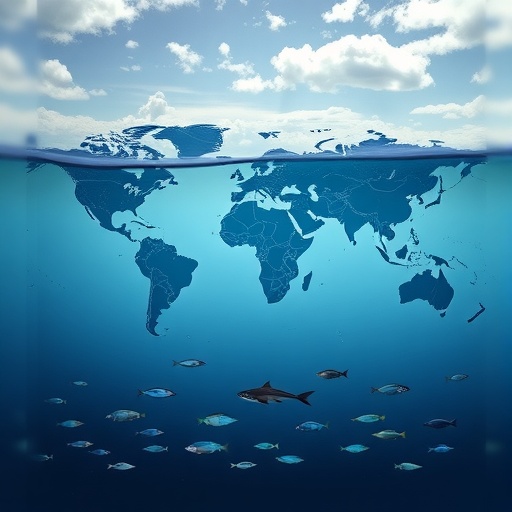
The oceans, vast and mysterious, have long been regarded as continuous highways for marine species, enabling their free movement across immense distances. Yet new research published in Nature Communications is challenging this longstanding notion by uncovering the surprisingly potent barrier effects imposed by ocean fronts on global fish distributions and fisheries. This paradigm-shifting study authored by Xing, Gao, Ito, and colleagues emphasizes the crucial, previously underestimated role these dynamic oceanographic boundaries play in shaping where fish stocks thrive—and where they don’t—reshaping our understanding of marine ecology and the sustainability of global fishing industries.
Ocean fronts are regions where distinct water masses with contrasting physical and chemical properties such as temperature, salinity, and density meet. These borders form sharp transition zones that can extend for hundreds of kilometers and vary in intensity seasonally or due to climatic phenomena such as El Niño. Although the ecological importance of ocean fronts as hotspots of productivity and biodiversity is well documented, their potential to act as semi-permeable barriers restricting fish migration and gene flow has received surprisingly little attention until now.
The authors combined satellite-derived oceanographic data, state-of-the-art ecological modeling, and comprehensive global fishery catch records spanning decades to investigate the influence of ocean fronts on fish distributions worldwide. Their multidisciplinary approach integrated high-resolution mapping of ocean fronts with mechanistic models of fish movement constrained by environmental conditions, providing an unprecedented synthesis of how these physical features sculpt the spatial patterns of marine life exploited by fisheries.
One of the most striking findings revealed that numerous commercially valuable fish species—ranging from tunas and cods to flatfishes—exhibit strong avoidance behavior or reduced dispersal across certain ocean fronts. These natural barriers can significantly limit gene flow, isolate subpopulations, and thereby create distinct ecological domains separated by invisible yet formidable boundaries. Such structuring challenges the traditional assumption of open connectivity among marine populations and calls for revisiting stock assessments and management units that to date have largely ignored front-induced segregation.
The implications of these insights are profound for fisheries science and ocean conservation. By acting as ecological chokepoints, ocean fronts can concentrate fish biomass and enhance the productivity of fishing grounds on one side while depleting them on the other. This uneven distribution requires nuanced, region-specific approaches to fishing quotas and conservation measures. Existing regulatory frameworks based on oversimplified connectivity models risk overexploiting isolated stocks or failing to protect critical nursery habitats bounded by these fronts.
From a technical perspective, the study harnessed a novel front-detection algorithm that combined sea surface temperature gradients with chlorophyll-a concentration anomalies to delineate stable and ephemeral fronts with remarkable accuracy. Coupled with agent-based fish behavior models calibrated through acoustic tagging data, this approach allowed the team to simulate fish dispersal dynamics constrained by oceanographic conditions realistically. These simulations elucidated how fronts act not merely as passive physical structures but as behavioral cues influencing movement decisions in fish species sensitive to environmental heterogeneity.
Additionally, the study addressed the temporal variability of barrier strength by analyzing seasonal and interannual changes in front intensity and position. Notably, some barriers strengthened during colder months or under certain climate oscillations, intensifying population isolation. This temporal dimension underscores the necessity of integrating dynamic oceanographic phenomena into fisheries models traditionally based on static assumptions, improving predictions under changing climate conditions.
The research also highlights the role of ocean fronts in shaping not only fish distributions but broader marine ecosystem dynamics. By altering predator-prey interactions and nutrient cycling within front-bounded zones, these boundaries contribute to the formation of distinct trophic communities. This ecological compartmentalization likely influences resilience to environmental perturbations such as pollution or ocean acidification, emphasizing fronts’ importance beyond fisheries alone.
Importantly, the findings underscore the urgent need for international cooperation and data-sharing initiatives to incorporate oceanographic barrier effects into global fisheries management frameworks. Stock assessments and harvest control rules must be revisited to incorporate spatial segregation driven by ocean fronts if we are to avoid stock collapses and promote equitable exploitation across jurisdictions sharing transboundary marine resources.
The study’s revelations also open exciting avenues for technological innovations in ocean monitoring. Enhanced satellite platforms capable of detecting fine-scale oceanographic features in near real-time combined with autonomous underwater vehicles equipped with environmental sensors can revolutionize the precision of fish stock assessments. By coupling such technologies with machine learning techniques, fisheries science is poised to enter a new era of spatially explicit, adaptive management.
At a fundamental scientific level, the newfound recognition of ocean fronts as semi-permeable barriers challenges existing paradigms in marine biogeography and population genetics. It compels researchers to reassess connectivity estimates, gene flow models, and evolutionary processes in marine environments where boundaries are defined not by land but by invisible lines in the water.
The insights gleaned from this work have profound implications amid the growing pressures on ocean ecosystems from climate change, overfishing, and habitat degradation. By accentuating the complexity of spatial structure in marine populations, the study provides a more realistic foundation for predicting and mitigating the cumulative impacts of human activities and environmental change.
In conclusion, the work by Xing, Gao, Ito, and their colleagues offers a compelling new lens through which to view ocean front dynamics—not simply as zones of enhanced productivity but as significant ecological barriers with far-reaching consequences for global fishery sustainability. Their interdisciplinary approach exemplifies how combining physical oceanography, behavioral ecology, and fisheries science can yield transformative insights critical for balancing human demands with marine conservation.
With ocean fronts now recognized as pivotal players in shaping marine biodiversity and fishery yields, future research will undoubtedly focus on refining predictive models, expanding observational capabilities, and integrating these findings into policy frameworks. This study heralds a new frontier in ocean science that promises to redefine how we understand and manage the blue heart of our planet.
Subject of Research:
The barrier effects of ocean fronts on global fish distribution and their implications for fisheries management.
Article Title:
Underestimated barrier effects of ocean fronts shape global fishery distribution.
Article References:
Xing, Q., Gao, Z., Ito, Si. et al. Underestimated barrier effects of ocean fronts shape global fishery distribution. Nat Commun (2026). https://doi.org/10.1038/s41467-026-71250-0
Image Credits: AI Generated
DOI:
https://doi.org/10.1038/s41467-026-71250-0
Keywords:
Ocean fronts, marine ecology, fish migration barriers, global fisheries, oceanographic boundaries, fish population connectivity, ecological modeling, fisheries management, satellite remote sensing, marine biodiversity


