


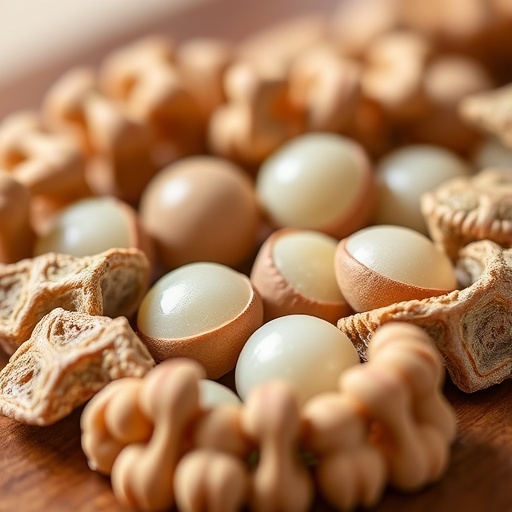
In a groundbreaking study conducted at New York University Abu Dhabi, researchers have unlocked the secrets behind the extraordinary toughness of the marri nut, a hard seed produced by the Corymbia calophylla tree native to Western Australia. This nut exhibits a formidable resilience against natural predators due to its robust shell, presenting a biological marvel that has intrigued scientists striving to understand the synergy of natural materials and structural design in impact resistance. The research delves into the fascinating interplay between the nut’s architecture and material properties, providing a blueprint for engineering next-generation protective materials.
The architectural ingenuity of the marri nut is rooted in its sophisticated internal structure, which combines a rigid outer shell with a soft, flexible inner core. This dual-layered composition allows the nut to withstand significant impacts without fracturing catastrophically. Instead of simply relying on hardness, the nut’s shell manages to balance stiffness with energy dissipation, enabling it to absorb shock and prevent crack propagation. This discovery challenges traditional notions in materials science that equate strength solely with hardness, highlighting the importance of structural complexity in determining mechanical resilience.
Advanced three-dimensional imaging techniques were pivotal in revealing the nuts’ intricate interior organization. Employing high-resolution scanning and mechanical testing, the research team characterized how the marri nut deforms under pressure and redistributes forces to avoid sudden failure. Remarkably, the seed’s cellulosic makeup, mostly composed of plant fiber, orchestrates a mechanical behavior where the exterior resembles the rigidity of acrylic polymers, while the interior mimics the malleable energy-absorbing properties of materials like Teflon. This unique combination of attributes endows the marri nut with an exceptional ability to endure environmental stresses while maintaining a lightweight form factor.
The underlying mechanism of toughness is embedded in the gradation of material properties throughout the nut’s cross-section. The outer shell, fortified by dense cellulose networks and complex layering, provides a formidable barrier against external threats. Contrasting this is the inner core that exhibits remarkable flexibility, allowing the structure to sustain high strain and undergo reversible deformation without structural failure. This gradation ensures a controlled transfer of stress waves, thereby preventing the initiation and growth of cracks. Through this, the marri nut exemplifies a natural strategy to optimize both protective strength and resilience.
A leading researcher on the project, postdoctoral associate Wegood Awad, emphasized the biological elegance of this design. “The marri nut balances strength and flexibility seamlessly within one natural structure,” he stated, pointing out how this principle could revolutionize human-made protective materials. By mimicking this approach, engineers could develop products that do not sacrifice toughness for rigidity, potentially leading to innovations in safety gear, such as helmets, body armor, and cushioning materials, capable of absorbing shocks more effectively than current options.
Professor Panče Naumov, who spearheaded the study, echoed these sentiments, highlighting nature’s gift to material science. “This research underscores that strength is more than sheer hardness; it’s about intelligently managing how energy travels through a material,” he stated. The marri nut’s ability to convert potentially destructive forces into benign ones through its structural configuration sets a new paradigm for bioinspired materials engineering, where cracks are not merely resisted but tactically managed to prevent total failure.
The investigative efforts spanned over five years within NYU Abu Dhabi’s Center for Smart Engineering Materials, specifically the Smart Materials Lab, combining interdisciplinary expertise in chemistry, materials science, and biomechanics. This meticulous examination involved subjecting the nut to various stress tests, correlating structural features with mechanical outputs. The findings have immediate implications for industries prioritizing lightweight yet durable components, marking a major advance over conventional materials that often compromise on performance when weight is reduced.
Building on the biological insights, the research team synthesized a novel bioinspired material emulating the nuts’ internal design philosophy. This engineered composite replicates the gradient between rigid and flexible layers, achieving a material that is both impact-resistant and lightweight—a challenging trade-off in materials science. The innovation holds promise for applications ranging from aerospace components to medical protective devices, where minimizing weight without weakening mechanical integrity is essential.
This study’s revelations extend beyond their practical applications, inviting a new dialogue about how evolutionary processes refine natural materials over millions of years to achieve mechanical feats unattainable by conventional engineering. It elevates the marri nut from a biological curiosity to a wellspring of design principles that could underpin future material breakthroughs. The nut’s cellular configuration and material gradation serve as a living laboratory demonstrating that multifunctionality and toughness can coalesce naturally.
The implications of this research reach into sustainability as well. By utilizing cellulose—a renewable and biodegradable material—as a core constituent, the marri nut exemplifies how eco-friendly design principles can achieve high performance without reliance on synthetic polymers or metals, which often have larger environmental footprints. Emulating such natural architectures can guide the production of greener materials that do not compromise on durability or safety standards.
The publication of this research in the esteemed journal Advanced Science marks a significant milestone in translating biological mechanics into innovative engineering solutions. The work serves as a testament to how observational studies, powered by cutting-edge imaging and analytical tools, can uncover the latent potential within natural systems, informing the future trajectory of materials development. It also exemplifies cross-disciplinary collaboration, showcasing the synergy between biology, materials science, and mechanical engineering.
The research was generously supported by the NYU Abu Dhabi Research Institute, underscoring the importance of institutional backing in pioneering scientific inquiries. Through such support, the study exemplifies how targeted investments in smart materials research can yield innovations with broad societal impact, particularly in creating safer, more efficient, and environmentally conscious materials for everyday use. The journey from understanding the marri nut’s natural armor to replicating its properties synthetically heralds a promising frontier in bioinspired materials science.
News Publication Date: 25-Mar-2026
Web References: http://dx.doi.org/10.1002/advs.202515273
References: Advanced Science, DOI: 10.1002/advs.202515273
Keywords
Applied sciences and engineering, bioinspired materials, impact resistance, structural biology, cellulose composites, marri tree nut, toughness mechanisms, smart materials, energy absorption, materials science, biomimicry, lightweight composites
Cite Scienmag News
Denise Maddox. (April 15, 2026). NYU Abu Dhabi Study Uncovers Marri Nut’s Structure, Paving the Way for Stronger, Safer Materials. Scienmag. https://scienmag.com/nyu-abu-dhabi-study-uncovers-marri-nuts-structure-paving-the-way-for-stronger-safer-materials/
Denise Maddox. "NYU Abu Dhabi Study Uncovers Marri Nut’s Structure, Paving the Way for Stronger, Safer Materials." Scienmag, 15 April 2026, https://scienmag.com/nyu-abu-dhabi-study-uncovers-marri-nuts-structure-paving-the-way-for-stronger-safer-materials/. Accessed 4 September 2026.
Denise Maddox. "NYU Abu Dhabi Study Uncovers Marri Nut’s Structure, Paving the Way for Stronger, Safer Materials." Scienmag. April 15, 2026. https://scienmag.com/nyu-abu-dhabi-study-uncovers-marri-nuts-structure-paving-the-way-for-stronger-safer-materials/


