

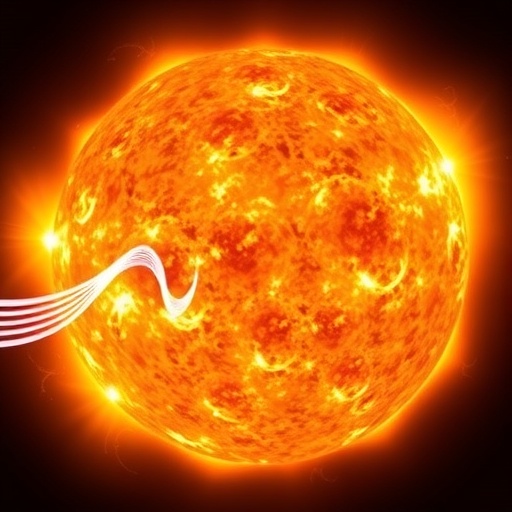
Deep Beneath the Sun’s Surface: Unveiling Hidden Magnetic Waves Reshaping Solar Science
For decades, understanding the inner workings of the Sun has been one of the greatest challenges in astrophysics. The Sun’s opaque, turbulent interior conceals complex magnetic interactions driving solar phenomena that affect our entire solar system. Now, a groundbreaking new study led by researchers at New York University Abu Dhabi has revealed the presence of vast, previously unknown waves moving deep within the solar interior, shaped and modulated by powerful magnetic fields far below the visible surface. This discovery offers an unprecedented glimpse into the Sun’s concealed magnetic architecture and is poised to revolutionize our understanding of solar dynamics and activity cycles.
The Sun is not a static ball of glowing gas; rather, it is a dynamic, roiling sphere of electrically charged plasma governed by magnetic fields generated by complex motions and rotation within its layers. These internal magnetic fields are the engines behind sunspots, solar flares, coronal mass ejections, and the approximately 11-year solar cycle, all of which have direct impacts on space weather affecting satellite operations, global communications, and power infrastructure on Earth. Despite their importance, these magnetic processes deep inside the Sun have been notoriously difficult to study because sunlight only reveals the surface, leaving the interior a realm veiled in mystery.
In a novel approach, the NYU Abu Dhabi team analyzed over ten years of helioseismic data, which capture subtle vibrations and oscillations naturally occurring on the Sun’s surface. Similar to how seismologists study Earth’s interior through earthquake waves, astrophysicists probe the Sun’s inner structure by examining these oscillation patterns. By focusing on low-frequency, large-scale waves previously unnoticed, the researchers uncovered evidence of global-scale Rossby waves—vast planetary-like waves commonly known in atmospheric science—but these are magnetically modified and deeply embedded within the solar plasma.
Rossby waves, named after meteorologist Carl-Gustaf Rossby, arise from the rotational dynamics of fluids on spherical bodies. On Earth, they govern large-scale weather patterns. In the Sun, however, these waves are influenced not only by rotation but also by the Sun’s intense internal magnetic fields, adding complexity to their behavior. The magnetic modulation discovered alters wave speed and structure, thereby encoding detailed information about magnetic field strength and configuration beneath the Sun’s surface, inaccessible through conventional observation methods.
The ability to detect and characterize these magnetically influenced Rossby waves constitutes a significant leap forward. It furnishes researchers with a new diagnostic tool to map the Sun’s internal magnetism—a key piece of the solar puzzle that holds implications for predicting solar activity cycles more reliably. Precise knowledge of how magnetic fields evolve deep inside the Sun promises to enhance our understanding of solar eruptions, providing critical forewarnings of space weather events that can disrupt technological systems on Earth.
Shravan Hanasoge, co-principal investigator at NYU Abu Dhabi’s Center for Astrophysics and Space Science and lead author of the study, emphasized the breakthrough nature of the findings: “These deep magnetically modified waves give us a unique window into the Sun’s hidden magnetic machinery. By monitoring their signatures, we gain insights into processes that govern solar magnetism and evolution—a fundamental step toward improving our predictive capabilities for solar storms and other activity.” This work shifts the paradigm from surface-based observations to probing the Sun’s unseen magnetic heartbeat.
The research, published in the prestigious journal Nature Astronomy, pioneers a compelling synergy between theory, observational data, and computational modeling. By integrating advanced simulations with comprehensive helioseismic measurements, the NYU Abu Dhabi team was able to detect these elusive waves with unprecedented clarity. These findings not only challenge existing models of solar interior dynamics but also open the door to studying magnetic activity in other stars, broadening our astrophysical horizons.
Understanding magnetic wave phenomena deep inside the Sun also has broad-reaching implications for stellar astrophysics beyond our solar system. Stars similar to the Sun often exhibit magnetic cycles and activity-induced variability, which impact their planetary environments and habitability conditions. The methods developed in this study could be adapted to investigate magnetic interiors of diverse stars, providing vital clues about the universality and mechanisms of magnetism in astrophysical bodies.
Another exciting prospect from this work is its potential to refine space-weather forecasting models, offering more lead time for mitigating the risks posed by solar storms. By unraveling the Sun’s magnetodynamics, scientists can better anticipate disruptive events, protecting satellites, communications networks, and power grids critical to modern civilization. The insights gained here underscore the synergy between fundamental science and practical technological applications.
The discovery of these large-scale, magnetically influenced Rossby waves exemplifies the power of long-duration, precise observational campaigns and innovative analytical techniques in solar physics. It highlights the intricate dance between fluid dynamics and magnetism within our nearest star and reminds us that even familiar celestial objects can hold surprising secrets beneath their surface.
As solar researchers build on these findings, the next frontier lies in continuous monitoring of these magnetic wave patterns and integrating them into comprehensive solar dynamo models. Such advances will enhance our ability to understand and predict the Sun’s magnetic variability and its profound influence across the solar system.
This transformative work was supported by the NYU Abu Dhabi Research Institute and signifies a major milestone in heliophysics, opening new pathways for exploration of the Sun’s inner magnetic life and its cosmic effects.
Subject of Research: Not applicable
Article Title: Evidence for global-scale magnetically modified Rossby waves in the Sun
News Publication Date: 24-Feb-2026
Web References: https://www.nature.com/articles/s41550-026-02794-w
References: DOI: 10.1038/s41550-026-02794-w
Keywords
Solar interior, magnetic fields, Rossby waves, helioseismology, solar cycle, space weather, solar magnetism, sunspots, solar flares, solar dynamics, helioseismic vibrations, astrophysics


