

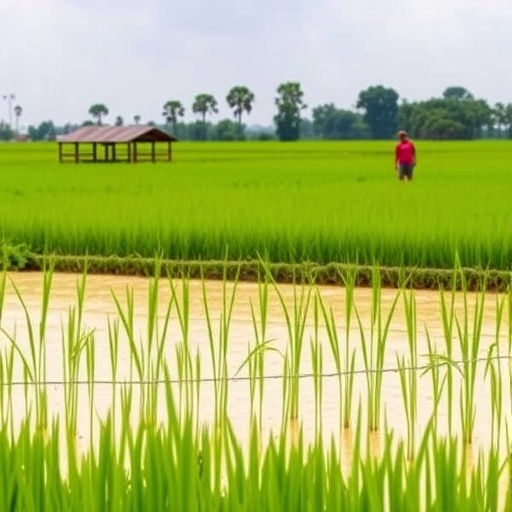
In the fertile paddy fields of China, a silent crisis is unfolding—one that threatens not only food security but also human health. Recent cutting-edge research has illuminated the complex interplay between soil acidification, cadmium contamination, and nutrient management practices, highlighting alarming consequences for crop yields and safety. The study, led by Xu, Ros, Liu, and colleagues, employs an innovative coupling of cadmium dynamic modeling with the widely respected soil acidification model, VSD+, to unravel the spatial and temporal dynamics shaping this multifaceted agricultural challenge.
Soil acidification, exacerbated by excessive mineral fertilizer applications, has long been recognized as a detriment to crop productivity. In China’s paddy rice systems, the deleterious effects of acidification have compounded over years of intensive cultivation, depleting soil fertility and disrupting nutrient availability. This phenomenon has been tightly linked to decreased rice yields, threatening food supply sustainability in a country that feeds over a billion people. Yet, the acidification issue is intertwined with a more insidious problem— the accumulation of cadmium, a toxic heavy metal, within the soil and rice grains themselves.
Cadmium accumulation in soil is a multifactorial process, influenced by inputs from atmospheric deposition, mineral fertilizers, and organic amendments such as manure. Agricultural soils act as reservoirs for cadmium, which gradually bioaccumulates and poses serious health risks when it migrates into edible crops. Rice, as a staple food, can absorb cadmium from contaminated soils, thus serving as a key exposure pathway for human populations. This dual crisis of soil acidification and cadmium contamination necessitates nuanced nutrient management strategies that can balance yield optimization against food safety concerns.
A promising avenue for addressing soil acidification has been the enhancement of manure recycling, which supplies essential nutrients and organic matter, increases soil pH, and reduces reliance on acidifying mineral fertilizers. However, manure itself is a double-edged sword—it can introduce significant cadmium loads into the soil depending on the contamination levels in animal feed and regional deposition rates. The research sought to quantify this trade-off by simulating multiple nutrient management scenarios using a model integrating cadmium dynamics with soil acidification status.
The simulations revealed that enhanced manure recycling effectively alleviates soil acidification, stabilizing and often improving soil pH over time. In particular, increased organic amendments allowed for near-complete elimination of mineral phosphorus fertilizers, traditionally linked to acidification. This indicates a substantial potential to reverse soil degradation trends through altered nutrient sourcing. Yet, paradoxically, this strategy also accelerated cadmium accumulation in soils due to elevated cadmium inputs from manures and a concurrent reduction in cadmium leaching driven by higher pH conditions.
The rise in soil pH induced by manure application proves to be a temporary safeguard against cadmium uptake by rice in the short to medium term. Because cadmium bioavailability decreases under less acidic conditions, rice grains initially exhibit lower cadmium concentrations despite accumulating soil cadmium. However, the long-term outlook remains grim. Prolonged accumulation of cadmium within soils ultimately negates the initial protective effect on rice grain safety, resulting in elevated cadmium levels in food crops over extended periods.
Crucially, the study delineates thresholds of safe manure recycling based on cadmium deposition scenarios. Under current cadmium atmospheric deposition rates, the maximum manure recycling sustainable without breaching cadmium safety limits is approximately 20%. This figure starkly contrasts with the existing manure recycling ratio of 30%, underscoring the latent risks concealed within present agricultural practices. The imbalance implies that current manure management practices may unwittingly exacerbate cadmium-related food safety hazards.
The research further explored scenarios where cadmium atmospheric deposition is minimized—a plausible outcome considering future environmental regulations aimed at heavy metal emissions. In such improved deposition conditions, the manure recycling ratio could be safely extended up to 85%, heralding a revolution in sustainable nutrient management that maximizes organic resource utilization while curbing toxic metal risks. This finding highlights the pivotal role of integrated environmental and agricultural policies in safeguarding both ecosystem health and food safety.
One of the imperative takeaways is the urgent need to reduce cadmium content within manures themselves. This could be achieved by regulating animal feed quality, controlling industrial and environmental cadmium sources, and refining manure treatment methods to remove or immobilize cadmium. Coupled with reduction in atmospheric deposition, these measures would enable enhanced manure recycling practices that simultaneously combat soil acidification and limit cadmium bioaccumulation.
This integrated modeling approach offers a novel lens for agricultural scientists and policymakers to balance competing objectives in paddy rice cultivation. By quantifying the nonlinear interactions between nutrient inputs, soil chemistry, and heavy metal dynamics, the study provides a sophisticated toolkit to design context-specific, evidence-based nutrient management regimes. This ensures maximum yield returns without compromising environmental sustainability or food safety.
Beyond China, the research holds global implications. Many intensive rice-producing regions worldwide wrestle with soil acidification and cadmium contamination issues, often exacerbated by industrial emissions and mining activities. The generalizable modeling framework and the study’s insights offer a valuable reference for international efforts aimed at sustainable intensification of rice production, especially in vulnerable developing regions.
The study also underscores the importance of long-term monitoring and adaptive management policies. Soil health dynamics and heavy metal bioaccumulation evolve over decades, necessitating sustained data inputs and model refinements. Agricultural extension services, environmental surveillance, and farmer engagement are critical components to translate scientific findings into practical soil and nutrient management practices that protect both yield stability and public health.
From a scientific perspective, this research exemplifies the power of coupling biogeochemical models to unravel complex agro-environmental challenges. The VSD+ soil acidification model, integrated with dynamic cadmium simulations, captures feedback loops and spatial heterogeneity rarely addressed in single-issue frameworks. Such multidisciplinary tools pave the way for more holistic agroecological management approaches in the face of escalating global food security concerns.
Ultimately, the research by Xu et al. offers a cautionary yet optimistic narrative. While intensifying manure recycling emerges as a potent lever against soil acidification, it simultaneously unveils hidden hazards associated with cadmium accumulation. The pathway forward demands concerted efforts to minimize anthropogenic cadmium sources, optimize manure quality, and tailor nutrient management to local environmental contexts. Through these combined strategies, the vision of safe, productive, and sustainable rice farming in China and beyond may be realized.
As we reflect on the intricate dance between soil chemistry and toxic metals within our food systems, this study serves as a clarion call for integrated science-based stewardship. The stakes transcend agronomy; they touch on human health, ecosystem integrity, and the very resilience of food systems amid unprecedented environmental pressures. The future of paddy rice cultivation, a cornerstone of global nutrition, hinges on navigating these intertwined challenges with innovation, vigilance, and collaboration.
Subject of Research: The study focuses on the impact of nutrient management on soil acidification and cadmium accumulation in Chinese paddy rice systems, analyzing the effects of enhanced manure recycling on soil chemistry, crop yield, and food safety.
Article Title: Nutrient management modulates acidification-induced risks to yield and cadmium contents in paddy rice.
Article References:
Xu, D., Ros, G.H., Liu, P. et al. Nutrient management modulates acidification-induced risks to yield and cadmium contents in paddy rice. Nat Food (2026). https://doi.org/10.1038/s43016-026-01315-2
Image Credits: AI Generated


