

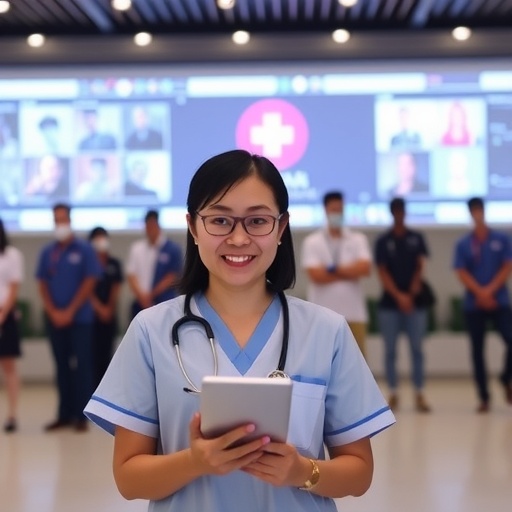
The National University of Singapore’s Yong Loo Lin School of Medicine has inaugurated a groundbreaking academic initiative—Singapore’s first integrated nursing-informatics degree program. This innovative Concurrent Degree Programme (CDP) uniquely combines the Bachelor of Science (Nursing) (Honours) with the Master of Science (Biomedical Informatics) into a seamless 4.5-year full-time curriculum. Hosted by the Alice Lee Centre for Nursing Studies within NUS Medicine, this programme positions itself at the intersection of clinical nursing and data-driven healthcare, directly responding to the accelerated digital transformation of the medical field.
The advent of digital health systems and the expansion of electronic health records have revolutionized healthcare delivery worldwide, with Singapore’s National Electronic Health Record (NEHR) standing as a hallmark example. This national framework integrates patient data from both public and private sectors, enabling a comprehensive clinical picture accessible across settings. Within this complex digital ecosystem, nursing professionals now require sophisticated informatics expertise to navigate and influence technology that underpins patient safety, clinical workflow, and care coordination.
The CDP addresses this demand by equipping nurses with dual proficiency, spanning both hands-on clinical skills and advanced biomedical informatics capabilities. Students delve into data analytics, harnessing real-time clinical data flows to enhance decision-making processes. They learn to critically evaluate AI-supported tools—ranging from predictive risk models to automated documentation systems—and develop competencies to ethically implement these technologies while safeguarding patient privacy and data security. Such skills are imperative to advancing healthcare quality in an era where AI is increasingly embedded in nursing practices.
This integrated curriculum transcends traditional nursing education by embedding key themes such as health information system design, clinical decision support engines, informatics leadership, and cybersecurity protocols. The accelerated degree pathway condenses the education timeline, allowing future nurses to earn both bachelor’s and master’s qualifications in less than five years—significantly reducing time and economic costs relative to sequential degrees. Moreover, students can specialize in either Analytics or Hospital Management, enabling them to tailor their expertise to various facets of the evolving health informatics landscape.
The inaugural cohort, slated to commence studies in August 2026 with approximately 20 students, will benefit from interdisciplinary interactions by learning alongside peers in Medicine, Allied Health, Computing, and Engineering. This multidisciplinary approach mirrors the collaborative nature of modern healthcare teams, fostering an environment where technological innovation is integrated with clinical empathy and patient-centered care.
Nursing informatics expands traditional career trajectories by creating new professional roles that bridge clinical practice with technological innovation. Graduates are expected not only to function effectively as bedside nurses but also to pioneer roles as clinical informatics specialists, digital health project leaders, EHR implementation consultants, and healthcare data analysts. Through this diverse skill set, they become instrumental in shaping the future of healthcare delivery systems.
The launch event coincided with the East Asian Forum of Nursing Scholars (EAFONS) 2026 conference, hosted in Singapore by NUS Nursing. The forum, which attracted 1,800 international experts from 34 countries, emphasized the theme “Innovate, Integrate, Inspire: Advancing Nursing Excellence in the Digital Age.” Central discussions highlighted how the fusion of informatics, data analytics, and emerging technologies like AI is transforming nursing education, research, and practice frameworks globally.
Healthcare’s increasing digitalization necessitates a paradigm shift from training nurses merely as end-users of digital tools toward empowering them as key stakeholders in the design, evaluation, and governance of health informatics systems. Associate Professor Lydia Lau, Deputy Head (Undergraduate Education) at NUS Nursing, emphasizes this shift by underlining the need for nurses who can integrate technological proficiency with clinical judgment to optimize patient outcomes effectively.
NUS Nursing’s CDP curriculum is carefully structured to not only impart theoretical understanding but also foster practical expertise. Students undergo immersive training that enables them to navigate the complexities of data governance, informatics strategy, and ethical considerations including patient confidentiality, consent, and cybersecurity measures. Such comprehensive education ensures that graduates are prepared to meet the challenges of a rapidly evolving healthcare environment.
The integration of AI into nursing practices is a particularly critical focus area. AI algorithms assist in clinical decision support by processing vast datasets to identify risk patterns and suggest personalized treatment pathways. By equipping nurses with the skills to interpret and critically assess these AI outputs, the CDP empowers them to maintain clinical oversight and safeguard against possible biases or errors inherent in automated systems.
Furthermore, graduates will be strategically positioned to influence innovation within healthcare technology enterprises and policy-making bodies. Their dual expertise facilitates collaboration between engineers, clinicians, policymakers, and researchers, creating a synergistic environment where patient care is enhanced through technology that is not only advanced but also clinically relevant and ethically sound.
The NUS Concurrent Degree Programme represents a visionary leap in nursing education, addressing the urgent need for healthcare professionals who are not only adept caregivers but also pioneers in digital health. In doing so, it strengthens Singapore’s position as a hub for healthcare innovation and prepares a new generation of nursing leaders to navigate and positively shape the digital future of medicine.
Subject of Research: Integrated Nursing-Informatics Education and Digital Health Transformation
Article Title: NUS Nursing Launches Singapore’s First Concurrent Degree in Nursing and Biomedical Informatics
News Publication Date: Not specified (to be updated)
Web References: https://mediasvc.eurekalert.org/Api/v1/Multimedia/6c6fa8a5-257f-465b-b59b-0d03958e0767/Rendition/low-res/Content/Public
Image Credits: Alice Lee Centre for Nursing Studies, NUS Medicine
Keywords: Nursing Informatics, Biomedical Informatics, Concurrent Degree Programme, Electronic Health Records, Artificial Intelligence, Digital Health, Clinical Decision Support, Healthcare Innovation, Nursing Education, Data Analytics


