

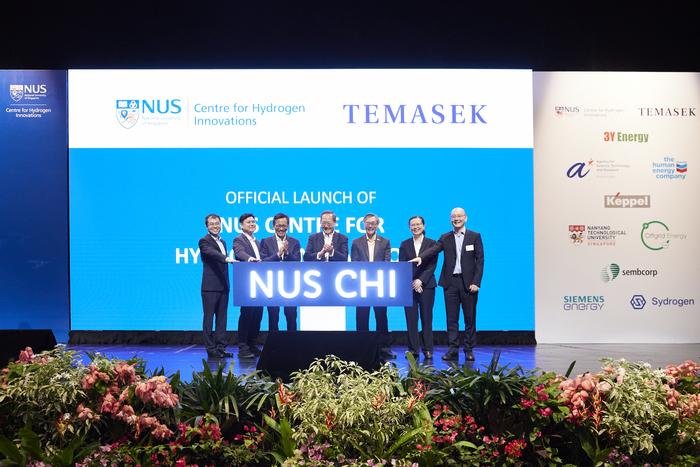
Giving Singapore’s National Hydrogen Strategy a big push, the National University of Singapore (NUS) today officially launched its Centre for Hydrogen Innovations (CHI) with the inauguration of an advance research facility as the Centre’s flagship innovation hub. Spanning over 600 square metres and furnished with state-of-the-art research equipment, the new facility aims to boost hydrogen research and commercial application in Singapore.

Credit: NUS Centre for Hydrogen Innovations
Giving Singapore’s National Hydrogen Strategy a big push, the National University of Singapore (NUS) today officially launched its Centre for Hydrogen Innovations (CHI) with the inauguration of an advance research facility as the Centre’s flagship innovation hub. Spanning over 600 square metres and furnished with state-of-the-art research equipment, the new facility aims to boost hydrogen research and commercial application in Singapore.
The launch of CHI was officiated by Dr Tan See Leng, Minister for Manpower and Second Minister for Trade and Industry, in the presence of distinguished guests from the hydrogen research and industry ecosystem in Singapore.
CHI was first established as a virtual Centre in July 2022 through an investment of S$25 million, comprising a S$15 million endowed gift from Temasek, and along with additional funding from NUS. The Centre takes a holistic approach to tackle technological and infrastructural challenges in enabling a hydrogen economy through harnessing a broad spectrum of expertise, including science and engineering, from various entities at NUS. At CHI, research activities are organised under four key areas: green hydrogen production, hydrogen storage, hydrogen carrier systems, and hydrogen utilisation.
Over the last two years, CHI has provided more than S$4.2 million in grants to support 17 innovative projects in hydrogen-related research. The Centre has also been very successful in securing external grants, including a grant of S$8 million awarded recently to CHI under the Low Carbon Energy Research programme to conduct research on ammonia combustion.
NUS President Professor Tan Eng Chye said, “NUS strives to catalyse change and shape a more sustainable future in our core mission areas of education, research and innovation, and in operations and administration. The launch of the Centre for Hydrogen Innovations represents a bold, significant step that NUS is taking towards building a sustainable future. The Centre is taking off on a strong start, and I look forward to its contributions towards knowledge building, Singapore’s climate target of net zero emissions target by 2050, and the global fight against climate change.”
Mr Russell Tham, Head, Emerging Technologies, Temasek, said, “Tackling today’s complex sustainability challenges demands a comprehensive, whole-of-system approach, and multi-stakeholder collaboration. A blend of sustained STEM-based R&D; technology-savvy entrepreneurs and investors; global and cross-sector partnerships; and diverse public and private capital with the risk appetite and stamina, can cultivate a vibrant deep-tech innovation ecosystem. As a co-founder of Centre for Hydrogen Innovations with NUS, we are committed to leveraging our capabilities and networks to help advance low-carbon hydrogen technologies and strengthen their pathways for broader adoption.”
CHI’s new research facility will anchor the Centre’s cutting-edge research while boosting its efforts in education and industry collaboration. Some state-of-the-art equipment featured in the facility include a four-channel reactor for carbon dioxide hydrogenation; a catalyst synthesis robot that automates the process of creating catalysts required for hydrogen-related research; prototyping, testing and characterisation tools; as well as a dedicated section for scientific work involving ammonia, which requires special handling and storage precautions.
Pushing the boundaries of hydrogen research
To further strengthen the research infrastructure of Singapore’s future hydrogen economy, CHI has selected eight promising projects for potential funding, and these projects are in two broad areas: disruptive research to achieve a quantum leap in hydrogen technologies, and creation of market-oriented prototypes to pave the way for the commercialisation of innovative hydrogen technologies.
Please refer to the Annexe for some of these interesting projects.
Building a strong talent pool for a vibrant hydrogen economy
CHI intends to further expand the talent pool for hydrogen professionals in Singapore. The Centre plans to recruit about 10 polymathic scholars with interdisciplinary expertise and train 10 PhD students to enhance its research capabilities and strengthen CHI’s current team of 32 principal investigators and 4 PhD students. CHI will also be introducing courses in hydrogen technologies to prepare learners for the future hydrogen economy.
To promote greater public awareness of the benefits of hydrogen energy, CHI has recently organised the “Hydrogen Innovation Challenge”. In this competition, student teams created Instagram reels to express their visions for Singapore’s transition to hydrogen energy. These videos were open for public voting and reviewed by a judging panel comprising experts in the field, and the shortlisted teams were then challenged with a quiz. Three winning teams received prizes during today’s official opening event.
Partnering the industry to boost hydrogen transition
To promote the adoption of hydrogen technologies, CHI has been actively engaging industry partners to leverage complementary strengths in a bid to accelerate innovation, scale up technologies more efficiently, and address complex challenges associated with hydrogen production, distribution, and utilisation.
CHI has established close collaborations with 17 industry partners – ranging from global companies to small and medium-size enterprises. For example, CHI researchers are working with Siemens Energy to develop a novel gas turbine technology that can utilise partially cracked ammonia as feedstock. In another project, CHI researchers are working with Chevron to develop a direct “liquid hydrogen carrier” production process via electrocatalysis.
CHI aims to further enhance its engagement with industry, and ultimately driving the transition towards a more sustainable energy future.
Please visit hydrogen.nus.edu.sg for more information on CHI.

