


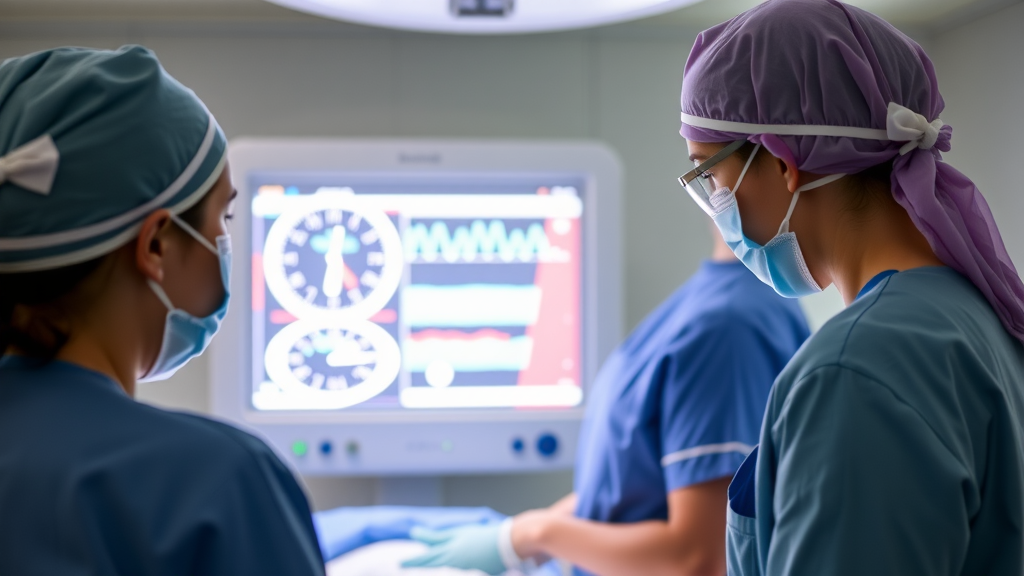
When a patient slips under general anaesthesia, someone in the operating room must answer a deceptively simple question: how deeply asleep is this person? Too light, and the patient risks intraoperative awareness — the rare but devastating experience of waking, paralyzed but conscious, mid-surgery. Too deep, and the anaesthetic burden can destabilize blood pressure and may leave lasting cognitive shadows. Now a new survey from Sweden suggests that the nurse anaesthetists charged with walking that tightrope rely far more on their own clinical judgement than on the electronic monitors designed to measure anaesthetic depth, a finding that exposes a persistent gap between what the evidence recommends and what actually happens in operating theatres.
The study, published in the journal Nursing Open, is a cross-sectional web survey of 79 Swedish nurse anaesthetists conducted between June and September 2024. The researchers, Kati Knudsen and Magnus Lindberg, adapted a questionnaire previously used among Australian anaesthesiologists, translating it through a rigorous forward-backward process and tailoring it to the Swedish healthcare context and the specific scope of nurse anaesthesia practice. Respondents worked in university, county, regional and private hospitals, had on average thirteen years of professional experience, and were predominantly women based in southern Sweden. The Swedish Ethical Review Authority approved the study, and the survey instrument was reviewed for clarity and relevance by the Swedish National Association for Anaesthesia and Intensive Care before deployment.
The headline numbers are striking. Although 65 of the 79 respondents reported having access to a Bispectral Index monitor — the widely used BIS device that processes a patient’s electroencephalogram into a dimensionless index of hypnotic depth — only a minority used it routinely. Twenty-two nurse anaesthetists, more than 28 percent, said they never used anaesthesia depth monitoring at all, while just two said they always did. A quarter estimated using the technology in up to every fourth patient, and only about one in nine applied it to most of their cases. Only two respondents had access to Entropy, an alternative EEG-based monitor, and eleven reported no such devices at their workplaces. Notably, professional experience showed no statistically significant association with how often the monitors were used, suggesting that this is a system-wide culture rather than a generational divide.
Even more revealing is what the respondents believed. Roughly half considered that judging anaesthetic depth from clinical signs — blood pressure, heart rate, pupil responses, eye reflexes and tear secretion — was equivalent to using an electronic monitor, and nearly as many rated clinical signs as superior. Strikingly, a statistically significant association emerged between years of experience and the opinion that clinical signs are equivalent to monitoring, with a large effect size, indicating that the most seasoned practitioners were the most confident in their unaided assessments. Yet this confidence runs counter to systematic reviews, which have reported that BIS-guided anaesthesia reduces intraoperative awareness, enables earlier extubation, and speeds recovery of orientation and discharge from the operating room and post-anaesthesia care unit — though the authors caution that this evidence base remains of low certainty.
The survey also probed when the devices are deemed worthwhile. Two-thirds of respondents said they would use depth of anaesthesia monitoring during total intravenous anaesthesia, or TIVA, where no inhalational agent is administered and clinical signs of gas concentration vanish entirely. Six in ten would deploy it for patients with a previous history of awareness, and around seven in ten saw monitoring as appropriate when muscle relaxants paralyze the patient, a scenario in which any movement that might otherwise signal light anaesthesia is pharmacologically abolished. Almost eight in ten agreed that monitoring was necessary during TIVA. By contrast, ketamine anaesthesia and nitrous oxide were considered situations where monitoring added little, reflecting the distinct pharmacology of those agents.
Statistical analysis sharpened the picture. When the researchers applied the Fisher-Freeman-Halton exact test with Holm-Bonferroni correction for multiple comparisons, only two clinical scenarios showed a significant association with self-reported monitoring frequency: trauma surgery and caesarean section under general anaesthesia, with Cramer’s V effect sizes of 0.67 and 0.53 respectively. This suggests that usage is driven less by anaesthetic technique per se than by procedural context and perceived clinical risk — the highest-stakes, least-forgiving operations command the technology, while routine cases run on experience and vigilance. Whether that selective pattern represents judicious resource use or a blind spot, the authors argue, is exactly the kind of question that national guidelines should be answering.
Guidelines do exist elsewhere. UK recommendations on standard monitoring during general anaesthesia state that depth of anaesthesia monitoring should be a minimum standard when TIVA is administered with neuromuscular blockade, precisely because a paralysed patient under intravenous anaesthesia is the classic setup for awareness. Sweden, however, lacks national guidelines on this point, and the survey’s authors suggest that in this vacuum it is unsurprising that Swedish nurse anaesthetists rated clinical parameters as superior to the devices. An ongoing international debate about the practical utility of processed-EEG monitoring has only deepened the uncertainty at the bedside, leaving individual practitioners to weigh conflicting messages.
Some of the survey’s answers gave the researchers genuine pause. A quarter of the nurse anaesthetists believed that a prolonged period of low anaesthetic depth values during surgery does not increase the risk of serious postoperative complications. Most respondents did not agree that depth monitoring facilitates a controlled and safe awakening, or that it reduces postoperative cognitive dysfunction and complications — positions at odds with studies showing benefits for extubation time, orientation and discharge. When confronted with hypothetical index readings, most responded appropriately: at a value of 15, far below the suggested target range of 40 to 60, nine in ten would decrease anaesthetic administration, though two respondents said they would administer more. At a value of 35, almost all would maintain or lighten anaesthesia, while at 50, six in ten would deepen it. Still, the authors note that the belief about prolonged low values appeared to disregard patients’ postoperative well-being, and they conclude that knowledge about depth of anaesthesia assessment methods needs to be enhanced.
The study carries caveats that the authors acknowledge openly. Web-based surveys typically attract low response rates, and because the invitation was distributed through a professional association, the exact denominator — the number of members who actually received the survey — is unknown, making a response rate impossible to calculate. Selection and non-response bias are real risks: those with strong opinions about monitoring devices may have been more likely to answer, and all utilisation figures were self-reported, inviting reporting bias. The researchers also chose privacy over precision, having an association administrator send the invitations so that researchers never handled members’ personal data. The findings should therefore be read as indicative of prevailing opinion at Swedish anaesthesia units rather than a definitive national measurement.
Even with those limitations, the implications are hard to ignore. The authors argue that clinical assessment and technological monitoring should be seen as complementary rather than mutually exclusive, and they call for continued professional education, structured clinical guidelines, and larger studies — particularly involving frail patients, who may be most vulnerable to both over- and underdosing. Respondents themselves rated the devices valuable for preventing over- and underdosing and for better controlling general anaesthesia, even while doubting benefits for awakening and recovery. Perhaps the survey’s quietest observation is its most consequential: little has changed in clinical practice in over a decade, echoing earlier scepticism documented among anaesthesia professionals. Until national recommendations translate evidence into routine, the depth of a patient’s sleep may depend less on the algorithm than on the trained eye watching the monitors that surround it.
Subject of Research: Nurse anaesthetists' opinions on and use of depth of anaesthesia assessment methods during general anaesthesia
Article Title: Opinions and Use of Depth of Anaesthesia Assessment Methods: A Cross‐Sectional Survey
Article References: Knudsen, K., & Lindberg, M. (2026). Opinions and Use of Depth of Anaesthesia Assessment Methods: A Cross‐Sectional Survey. Nursing Open, 13(9), Article e70801. https://doi.org/10.1002/nop2.70801
Image Credits: AI Generated
DOI: 10.1002/nop2.70801
Keywords: nurse anaesthetists, depth of anaesthesia, Bispectral Index, intraoperative awareness, total intravenous anaesthesia, clinical assessment, Swedish survey, anaesthesia monitoring, patient safety, cross-sectional study, entropy monitoring, postoperative recovery
Cite Scienmag News
Ophelia Keating. (September 27, 2026). Nurse Anaesthetists Trust Clinical Instinct Over Depth of Anaesthesia Monitors, Swedish Survey Finds. Scienmag. https://scienmag.com/nurse-anaesthetists-trust-clinical-instinct-over-depth-of-anaesthesia-monitors-swedish-survey-finds/
Ophelia Keating. "Nurse Anaesthetists Trust Clinical Instinct Over Depth of Anaesthesia Monitors, Swedish Survey Finds." Scienmag, 27 September 2026, https://scienmag.com/nurse-anaesthetists-trust-clinical-instinct-over-depth-of-anaesthesia-monitors-swedish-survey-finds/. Accessed 4 October 2026.
Ophelia Keating. "Nurse Anaesthetists Trust Clinical Instinct Over Depth of Anaesthesia Monitors, Swedish Survey Finds." Scienmag. September 27, 2026. https://scienmag.com/nurse-anaesthetists-trust-clinical-instinct-over-depth-of-anaesthesia-monitors-swedish-survey-finds/


