

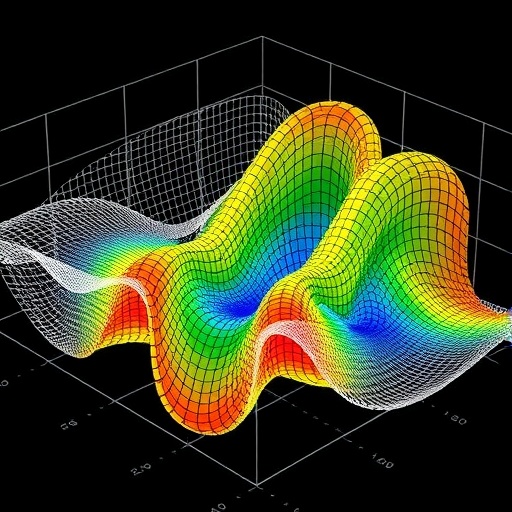
In an age defined by rapid technological advancements and growing global concerns regarding seismic activity, researchers have made remarkable strides in the field of elastodynamics. One noteworthy contribution comes from the recent work of Méndez Salas, Choi, and Klinkel, who introduce a revolutionary NURBS-based, perfectly matched layer method specifically designed for transient elastodynamics in unbounded domains. This novel approach not only promises significant enhancements in computational efficiency but also aims to advance our understanding of wave propagation and energy absorption in the context of earthquake engineering.
The study meticulously explores the dynamics of transient elastodynamics, which is pivotal in understanding how structures respond to fast-acting forces such as those generated by earthquakes. Traditionally, analyzing such phenomena in unbounded domains presents intricate challenges, particularly due to the artificial reflections that can affect simulation accuracy. These reflections can propagate back into the computational domain, thereby distorting results and misleading interpretations. The researchers’ work addresses this gap by proposing a method that effectively mitigates these unwanted artifacts through the implementation of perfectly matched layers (PML).
PML techniques are not new; they have been employed in various fields ranging from electromagnetics to acoustics. However, the innovation presented in this study lies in its tailored application to elastodynamics using Non-Uniform Rational B-Splines (NURBS). By leveraging the geometric flexibility of NURBS, the researchers enhance the capability to accurately represent complex geometries that are often encountered in real-world applications. This is especially crucial in earthquake engineering, where structures may have intricate shapes and configurations that need to be modeled precisely.
The paper delves into the mathematical foundation of the proposed method, showcasing how the NURBS basis facilitates the computation of stress and strain distributions in structures subjected to seismic forces. The authors detail the algorithms developed for integrating the PML methodology within NURBS representations, leading to improved stability and convergence in numerical simulations. Readers are reminded that the interaction between seismic waves and structural elements is a field of great interest, particularly as urbanization continues to escalate in seismically active regions.
One of the main challenges in simulating unbounded domains is managing the computational load while maintaining accuracy. The authors highlight how their method reduces the computational resources typically required for such simulations, thus making it more accessible for broader applications in engineering practice. This is particularly significant for practitioners who often struggle with resource limitations when executing large-scale simulations.
Additionally, the study presents benchmark tests that demonstrate the effectiveness of the NURBS-based PML method. By comparing results against traditional methods, the authors highlight a marked improvement in both accuracy and computational speed. These findings are crucial, as they substantiate the practical advantages of this new approach and encourage further investigation into its applicability across different types of structures and loading scenarios.
In addition to the technical advancements, the implications of this research extend to real-world applications. Urban planners and engineers working in earthquake-prone regions can utilize the insights gained from this research to design more resilient infrastructure. The ability to simulate and analyze the behavior of structures in response to seismic forces using more efficient and accurate methods paves the way for innovative solutions to enhancing building safety.
Moreover, this work contributes to the broader scope of research in computational mechanics and structural engineering. As the demand for advanced computational tools grows, methodologies like the one proposed by Méndez Salas and his colleagues become increasingly important. They illustrate the necessity for ongoing research and development in computational methods that can keep up with the evolving challenges posed by natural disasters and urban development.
Another significant aspect of this study is its contribution to the body of knowledge surrounding elastodynamic phenomena. By improving our understanding of wave propagation in complex structures and unbounded domains, the research lays the groundwork for future studies aimed at further unraveling the intricacies of seismic interactions. This understanding is vital for not only designing safe structures but also developing effective emergency response strategies in the wake of seismic events.
The authors also engage with the growing field of artificial intelligence (AI) in their discussion, recognizing its potential role in enhancing computational efficiency and accuracy. As machine learning techniques become more prevalent in engineering, there exists an exciting opportunity to merge these methodologies with traditional computational techniques, creating a robust hybrid approach to tackling challenges in elastodynamics.
Looking ahead, the research team emphasizes the need for collaborative efforts between academia and industry. By fostering partnerships, they believe that the insights gained from their work can be transformed into practical applications that significantly enhance our ability to predict and mitigate earthquake impacts. The imperative for innovation in engineering practices has never been clearer, and this research serves as a beacon for what is possible through dedicated exploration and collaboration.
In conclusion, Méndez Salas, Choi, and Klinkel’s groundbreaking work presents a promising step forward in the realm of transient elastodynamics. Their NURBS-based, perfectly matched layer method not only addresses long-standing challenges in simulating unbounded domains but also sets the stage for future innovations in earthquake engineering. As researchers continue to explore the implications of their findings, we can anticipate a new era of resilient infrastructure capable of withstanding the forces of nature while safeguarding lives and property.
This research does not merely represent a technical achievement; it signifies a proactive approach to enhancing safety and resilience in our built environment. The journey towards understanding and mastering elastodynamics is far from over, but with diligent effort and continual exploration, the future looks promising.
Subject of Research: NURBS-based methods for transient elastodynamics in unbounded domains.
Article Title: A NURBS-based, perfectly matched layer method for transient elastodynamics in unbounded domains.
Article References:
Méndez Salas, A., Choi, MJ. & Klinkel, S. A NURBS-based, perfectly matched layer method for transient elastodynamics in unbounded domains.
Earthq. Eng. Eng. Vib. 24, 723–742 (2025). https://doi.org/10.1007/s11803-025-2333-5
Image Credits: AI Generated
DOI:
Keywords: elastodynamics, NURBS, computational mechanics, civil engineering, seismic waves, earthquake engineering, perfectly matched layers, numerical simulation.


