

Tuesday, October 20, 2026
Science
No Result
View All Result
  • Login
  • HOME
  • SCIENCE NEWS
  • CONTACT US
  • HOME
  • SCIENCE NEWS
  • CONTACT US
No Result
View All Result
Scienmag
No Result
View All Result
Home Science News Technology and Engineering

Numerical simulation links wall-thickness ratio to race-tracking and air entrapment during polymer filling

October 20, 2026
in Technology and Engineering
Neil Sanderson
By Neil Sanderson Scienmag Editorial Profile - Materials Characterization
Reading Time: 2 mins read
0
Hidden Flaws in Injection Molding Tracked in 3D Polymer Flow Simulations

Hidden Flaws in Injection Molding Tracked in 3D Polymer Flow Simulations

65
SHARES
587
VIEWS
Share on FacebookShare on Twitter
ADVERTISEMENT

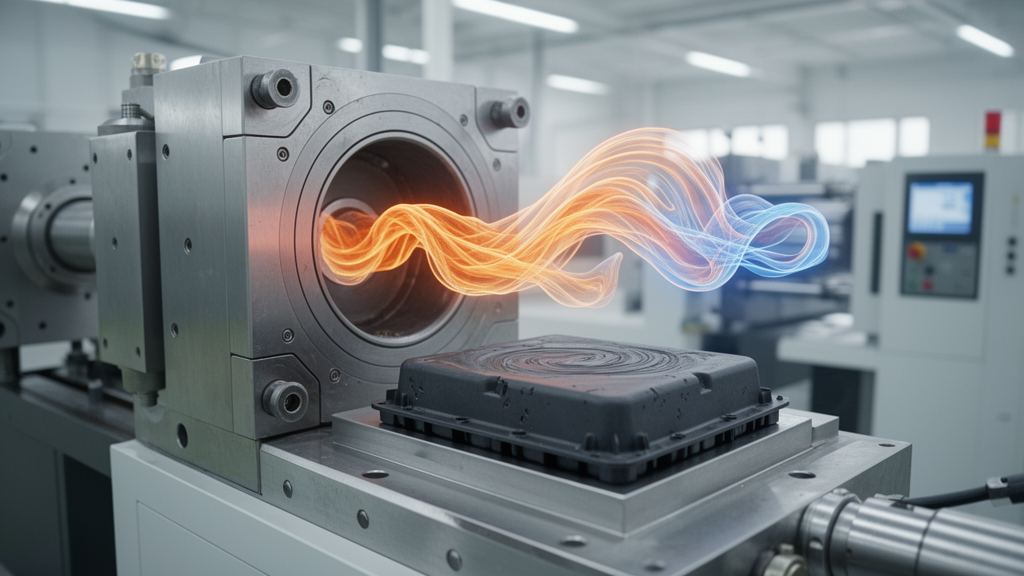
A numerical and experimental study reports that the thin-to-thick wall-thickness ratio influences two phenomena during polymer melt filling: race-tracking and air entrapment. In the simulations, reducing the ratio intensified race-tracking, while for circular cavities it also increased the area of trapped air.

The researchers investigated two types of parts with different wall-thickness distributions. They developed a three-dimensional, two-phase flow model that coupled the Navier–Stokes equations with the level set equation. The model used a collocated-grid finite-volume discretization, with the SIMPLE algorithm handling pressure–velocity coupling.

According to the published abstract, the model accurately predicted the evolution of the melt front in complex cavities and captured race-tracking and air entrapment during filling. The results also indicate that wall-thickness distribution is an important factor in both effects, with the response of trapped-air area differing by cavity geometry: the increase associated with a decreasing thin-to-thick ratio was reported for circular cavities.

This is a study of polymer filling processes based on numerical simulation combined with experimental observations, rather than a clinical or biological investigation. The reported evidence concerns two part geometries and focuses specifically on the influence of the thin-to-thick wall-thickness ratio. Because only the abstract and article summary were available for this report, details of the experimental protocol, quantitative uncertainty, validation measurements, and the range of geometries and ratios examined cannot be assessed. The source also identifies the publication as an early-access version of accepted peer-reviewed research that may undergo further editing.

Subject of Research: Numerical modeling of race-tracking and air entrapment during polymer filling

Article Title: 3D numerical study of race-tracking and air entrapment phenomena in polymer filling process

Article References: Liu, Y., Liu, Q., & Jiang, C. (2026). 3D numerical study of race-tracking and air entrapment phenomena in polymer filling process. Scientific Reports. https://doi.org/10.1038/s41598-026-74878-6

Image Credits: AI Generated

DOI: 10.1038/s41598-026-74878-6

Keywords: polymer filling, injection molding, race-tracking, air entrapment, two-phase flow, numerical simulation, melt-front evolution, wall-thickness ratio, circular cavities, numerical, entrapment, phenomena

Cite Scienmag News

Neil Sanderson. (October 20, 2026). Numerical simulation links wall-thickness ratio to race-tracking and air entrapment during polymer filling. Scienmag. https://scienmag.com/numerical-simulation-links-wall-thickness-ratio-to-race-tracking-and-air-entrapment-during-polymer-filling/


Neil Sanderson. "Numerical simulation links wall-thickness ratio to race-tracking and air entrapment during polymer filling." Scienmag, 20 October 2026, https://scienmag.com/numerical-simulation-links-wall-thickness-ratio-to-race-tracking-and-air-entrapment-during-polymer-filling/. Accessed 20 October 2026.

Neil Sanderson. "Numerical simulation links wall-thickness ratio to race-tracking and air entrapment during polymer filling." Scienmag. October 20, 2026. https://scienmag.com/numerical-simulation-links-wall-thickness-ratio-to-race-tracking-and-air-entrapment-during-polymer-filling/

Tags: air entrapmentair entrapment in polymer cavity fillingcircular cavitiesentrapmentfinite-volume discretization in polymer mold simulationsimpact of wall-thickness distribution on flow phenomenainfluence of cavity geometry on trapped airinjection moldinglevel set method for cavity filling simulationmelt-front evolutionNavier–Stokes equations in polymer processingNumericalnumerical and experimental study of polymer fillingnumerical simulationphenomenapolymer fillingpolymer filling process optimization through simulationpolymer melt filling simulationrace-trackingrace-tracking during polymer injection moldingthree-dimensional two-phase flow modeling in polymerstwo-phase flowwall-thickness ratiowall-thickness ratio effects on polymer flow
Share26Tweet16
Previous Post

Contrast-enhanced ultrasound planning linked to more successful, faster venturi-like LVA in retrospective cohort of 29 women

Next Post

CMR atrial measures track AF readmission risk in small retrospective cohort

Related Posts

Nickel-Doped Manganese Oxide Destroys Bisphenol A in Minutes Through Dual-Metal Redox Cycles
Technology and Engineering

Nickel-doped Mn2O3 catalyst activates PMS to remove bisphenol A in laboratory tests

October 20, 2026
Erratic Drug Levels May Double Risk of Losing a Transplanted Kidney, Study Finds
Technology and Engineering

Meta-analysis links high tacrolimus variability with kidney graft loss and rejection

October 20, 2026
Fish Oil Fats After Weaning Ease Depression-Like Behavior in Rats Born to Mothers on High-Fat Diets
Technology and Engineering

DHA or EPA after weaning reduced depressive-like behavior and restored some myelin measures in maternal high-fat-diet rat offspring

October 20, 2026
AI and Simulation Join Forces to Crack the Code of 3D-Printing the World’s Toughest Metals
Technology and Engineering

Review: finite element modeling, artificial intelligence, digital twins and applications for additive manufacturing of refractory alloys

October 20, 2026
AI Learns to Map a Baby’s Brain: 3D Patch-Wise U-Net Delivers Millimeter-Precise Tissue Segmentation
Technology and Engineering

Patch-wise 3D U-Net segments six-month-old infant brain MRI in benchmark study

October 20, 2026
When Pain Meets Depression: The Combined Threat to Your Heart
Technology and Engineering

Pain and depressive symptoms linked with cardiovascular risk in Chinese adults

October 20, 2026
Next Post
CMR atrial measures track AF readmission risk in small retrospective cohort

CMR atrial measures track AF readmission risk in small retrospective cohort

  • Mothers who receive childcare support from maternal grandparents show more optimized

    Mothers who receive childcare support from maternal grandparents show more parental warmth, finds NTU Singapore study

    27656 shares
    Share 11059 Tweet 6912
  • University of Seville Breaks 120-Year-Old Mystery, Revises a Key Einstein Concept

    1061 shares
    Share 424 Tweet 265
  • Bee body mass, pathogens and local climate influence heat tolerance

    682 shares
    Share 273 Tweet 171
  • Researchers record first-ever images and data of a shark experiencing a boat strike

    546 shares
    Share 218 Tweet 137
  • Groundbreaking Clinical Trial Reveals Lubiprostone Enhances Kidney Function

    531 shares
    Share 212 Tweet 133
Science

Embark on a thrilling journey of discovery with Scienmag.com—your ultimate source for cutting-edge breakthroughs. Immerse yourself in a world where curiosity knows no limits and tomorrow’s possibilities become today’s reality!

RECENT NEWS

  • Sri Lankan medical undergraduates report widespread AI use, with limited formal training
  • CMR atrial measures track AF readmission risk in small retrospective cohort
  • Numerical simulation links wall-thickness ratio to race-tracking and air entrapment during polymer filling
  • Contrast-enhanced ultrasound planning linked to more successful, faster venturi-like LVA in retrospective cohort of 29 women

Categories

  • Agriculture
  • Anthropology
  • Archaeology
  • Athmospheric
  • Biology
  • Biotechnology
  • Blog
  • Bussines
  • Cancer
  • Chemistry
  • Climate
  • Earth Science
  • Editorial Policy
  • Marine
  • Mathematics
  • Medicine
  • Pediatry
  • Policy
  • Psychology & Psychiatry
  • Science Education
  • Science News
  • Social Science
  • Space
  • Technology and Engineering

Subscribe to Blog via Email

Enter your email address to subscribe to this blog and receive notifications of new posts by email.

Join 5,150 other subscribers

© 2025 Scienmag - Science Magazine

Welcome Back!

Login to your account below

Forgotten Password?

Retrieve your password

Please enter your username or email address to reset your password.

Log In
No Result
View All Result
  • HOME
  • SCIENCE NEWS
  • CONTACT US

© 2025 Scienmag - Science Magazine

Discover more from Science

Subscribe now to keep reading and get access to the full archive.

Continue reading