


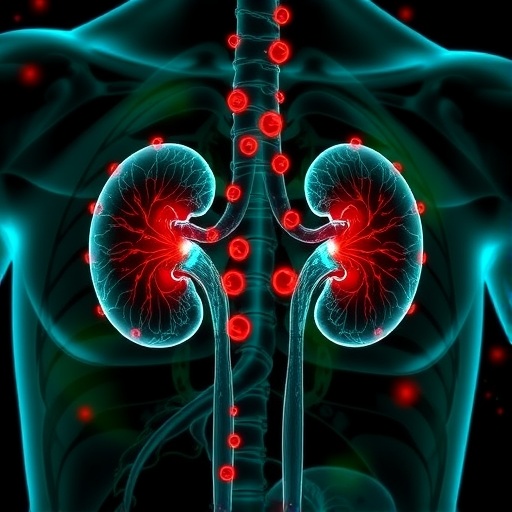
In recent years, the search for robust biomarkers to guide treatment and predict outcomes in cancer has taken on new urgency, especially in the context of clear cell renal cell carcinoma (ccRCC). This aggressive malignancy poses significant clinical challenges due to its heterogeneous nature and the variable response of patients to existing therapeutic regimens. A groundbreaking study set to be published in BMC Cancer brings new insights into the role of nucleoside diphosphate linked moiety X hydrolase 16 (NUDT16), an enzyme historically known for its function in mRNA quality control, revealing its prognostic and immunological significance in ccRCC.
The investigative team conducted a comprehensive molecular and immune profiling of NUDT16 expression by leveraging multi-omics datasets including The Cancer Genome Atlas (TCGA), Genotype-Tissue Expression (GTEx), and multiple Gene Expression Omnibus (GEO) data series. Their approach combined large-scale transcriptomic analyses with rigorous clinical correlation and advanced bioinformatics methods, breaking new ground in understanding the molecular underpinnings that govern ccRCC progression.
Findings revealed that NUDT16 is markedly downregulated in ccRCC tumor tissues compared to normal renal tissues. This downregulation was not only consistent but also exhibited a progressive decline in parallel with tumor advancement and increasing histological grades. Such a pattern suggests that NUDT16 suppression may be intricately linked to tumor aggressiveness, providing a credible biomarker for disease staging and prognosis.
Importantly, the researchers developed a novel prognostic model integrating NUDT16 expression levels alongside established clinicopathological features. This model demonstrated high predictive accuracy, potentially equipping clinicians with a new tool to stratify patients according to risk and tailor treatment strategies more effectively. The integration of molecular data here represents a shift towards precision oncology paradigms in managing ccRCC.
Delving deeper into molecular mechanisms, the study employed Gene Set Enrichment Analysis (GSEA) on genes co-expressed with NUDT16. The results illuminated significant enrichment in biological processes linked to proximal tubule transport and DNA methylation pathways. These findings highlight that NUDT16’s role extends beyond canonical mRNA decapping toward influencing epigenetic regulation and renal physiology, areas critical in tumor biology and therapeutic resistance.
Immunologically, NUDT16 expression correlated significantly with distinct immune cell infiltration patterns within the tumor microenvironment. Notably, the frequencies of natural killer (NK) CD56bright cells, regulatory T cells (TReg), and central memory T cells (Tcm) were associated with its expression. Such interactions suggest that NUDT16 modulates immune surveillance and immune evasion mechanisms in ccRCC, impacting immunotherapy responses.
A particularly intriguing discovery was the association between low NUDT16 expression and enhanced responses to immune checkpoint blockade phenotypes characterized by CTLA4-positive, PD1-negative status. Patients exhibiting reduced NUDT16 levels also presented with elevated tumor mutation burden (TMB) and higher tumor immune dysfunction and exclusion scores, factors known to influence immunotherapy efficacy and clinical outcomes.
At the epigenetic level, the research highlighted promoter region hypermethylation as a significant contributor to NUDT16 downregulation in ccRCC. This epigenetic silencing was linked to unfavorable survival outcomes, pinpointing DNA methylation as both a mechanism impacting NUDT16 expression and a potential therapeutic target to modulate its activity in tumors.
To establish functional relevance, the study conducted in vitro assays by overexpressing NUDT16 in ccRCC cell lines such as ACHN and 786-O. These experiments demonstrated that heightened NUDT16 expression markedly suppressed cellular proliferation, colony formation, migration, and invasion capabilities, confirming its tumor-suppressive properties and potential as a therapeutic target.
Single-cell omics analyses further dissected NUDT16 activity at cellular resolution, offering insights into its diverse biological roles within tumor and immune cell populations. This granular view supports the notion that NUDT16 functions through multifaceted regulatory pathways, influencing both cellular metabolism and immune contexture in ccRCC.
This multifaceted investigation collectively positions NUDT16 as a pivotal biomarker and molecular player in ccRCC pathogenesis. Its downregulation and epigenetic silencing not only herald poor prognostic implications but also modulate immune cell dynamics that are crucial for effective cancer immunotherapy. Hence, targeting pathways involving NUDT16 may open new avenues for therapeutic intervention.
Moreover, the study underscores the growing importance of combining transcriptomic, epigenetic, and immunological data to construct comprehensive predictive models in oncology. Such integrative analyses enable deeper mechanistic understanding and pave the way for personalized medicine approaches tailored to individual tumor biology.
Future research directions could explore pharmacologic or epigenetic means to restore NUDT16 expression or function, potentially reversing immune evasion and enhancing treatment responses. Additionally, expanding investigations into other cancers with dysregulated NUDT16 expression might uncover broader applications for this enzyme in oncology.
In conclusion, this landmark study not only advances our understanding of NUDT16’s biological and prognostic role in clear cell renal cell carcinoma but also exemplifies how cutting-edge multi-omics approaches can redefine biomarker discovery and therapeutic targeting strategies in challenging cancers.
Cite Scienmag News
Nathaniel Bowman. (November 21, 2025). NUDT16’s Role in Kidney Cancer Explored. Scienmag. https://scienmag.com/nudt16s-role-in-kidney-cancer-explored/
Nathaniel Bowman. "NUDT16’s Role in Kidney Cancer Explored." Scienmag, 21 November 2025, https://scienmag.com/nudt16s-role-in-kidney-cancer-explored/. Accessed 4 September 2026.
Nathaniel Bowman. "NUDT16’s Role in Kidney Cancer Explored." Scienmag. November 21, 2025. https://scienmag.com/nudt16s-role-in-kidney-cancer-explored/


