


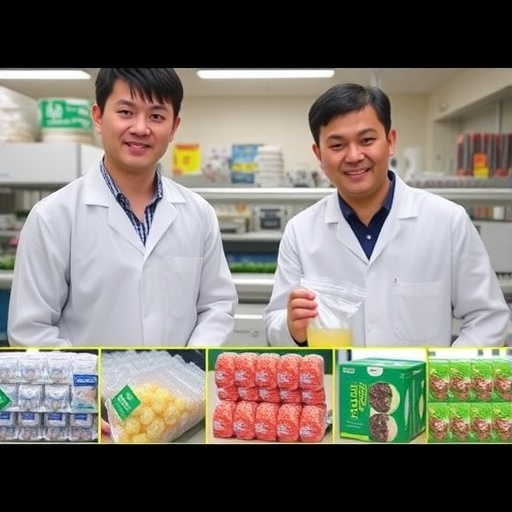
Scientists at Nanyang Technological University, Singapore (NTU Singapore), have pioneered a groundbreaking technique to revolutionize the recycling of mixed plastic packaging—a notoriously challenging waste category. This innovation introduces a chemical process that can separate and recover individual plastics from multilayer packaging without the use of harmful solvents, offering a cleaner, safer, and more economically viable pathway to deal with one of the planet’s most persistent environmental problems.
Mixed plastic packaging is ubiquitous in the consumer market, especially in food products like snacks and instant noodles. These multilayered materials combine various polymers, bonded to ensure durability and airtight preservation, but these same properties make them incredibly difficult to recycle. Traditional mechanical recycling methods often degrade the quality of the polymers, resulting in low-value materials frequently destined for landfill or incineration. The global scale of this challenge is immense, with plastic production expected to surge to over 700 million tonnes by 2040, intensifying the urgency for effective recycling innovations.
The team from NTU’s School of Materials Science and Engineering alongside the Nanyang Environment and Water Research Institute (NEWRI), led by Professor Hu Xiao, has developed a technology called depolymerisation-induced polymer separation (DIPS). This sophisticated process selectively targets specific plastic components within mixed packaging, breaking down one polymer chemically while leaving others intact, thus enabling their clean separation and recovery. This nuanced chemical intervention is carried out without introducing solvents, eliminating many environmental and health hazards associated with conventional recycling practices.
At the heart of the DIPS method is reactive extrusion, an industrial process that combines melting, shaping, and chemical reaction stages within a single continuous operation. During this process, poly(ethylene terephthalate) (PET)—commonly used in beverage bottles—is mixed with glycerol, a readily available, nontoxic reagent. The process induces a targeted depolymerization of PET, converting it to smaller molecular units with altered physical and chemical properties. This reaction is finely tuned to maintain the integrity of other plastics like polypropylene (PP), a staple in food packaging.
What makes this technique exceptional is the natural separation that occurs post-depolymerization. The qualitative differences in polarity and viscosity between the chemically altered PET and unaffected PP drive an automatic phase separation, allowing the materials to be isolated without laborious sorting or hazardous chemicals. This solvent-free environment operates at ambient pressure, markedly reducing energy consumption and supporting safer industrial scale-up potential.
Laboratory analysis of the recycled PP material revealed it retained mechanical strengths up to 90% of virgin polypropylene under optimized conditions. This remarkable retention of tensile strength underscores the practical viability of this recycled plastic for high-performance applications, a notable improvement over conventional mechanical recycling, which often results in material downgrading. Besides offering environmental benefits, this enhances the economic value proposition of recycling mixed plastics.
While the PET fraction cannot be directly reprocessed into new packaging materials, its chemical profile post-depolymerization makes it a valuable feedstock for specialty applications. These include precursor materials for high-strength epoxy resins used in advanced composites like wind turbine blades. Furthermore, its chemical groups offer pathways to transform it back into monomers, potentially enabling closed-loop recycling and creating a circular economy for PET-based products.
The potential of the DIPS process extends beyond PET and PP. The principles of selective depolymerization and exploitation of differing material properties signal feasibility for broad applicability across various multilayer plastic combinations prevalent in the packaging industry. This adaptability could dramatically reshape industrial recycling practices, minimizing reliance on sorting and solvent-based treatments.
PhD candidate Kathirvel Periasamy, who contributed significantly to developing the DIPS methodology, highlights that this process aims to bridge the gap between laboratory innovation and industrial application. By integrating separation and depolymerization into a single, streamlined operation, DIPS addresses the economic and environmental challenges hampering widespread adoption of mixed plastic recycling.
The implications of efficiently remediating mixed plastic waste go beyond environmental sustainability—they represent a potential economic boon. It is estimated that unlocking effective recycling solutions for mixed plastics could generate annual economic value exceeding $250 billion globally. This transformative impact could drive market incentives for recycling infrastructure development and elevate the quality standards for recycled materials.
Looking forward, the NTU Singapore team plans collaborative efforts with industrial partners to pilot this technology under scaled-up manufacturing conditions. These partnerships aim to validate the process’s commercial feasibility, operational robustness, and integration with existing recycling systems. The researchers actively invite industry stakeholders interested in advancing sustainable plastic waste management to engage in this next phase.
This innovative approach to depolymerization and polymer separation is poised to be a major step forward in tackling one of the most recalcitrant components of plastic pollution. By eliminating harmful solvents, minimizing energy consumption, and producing high-quality recycled plastics, DIPS aligns technological ingenuity with environmental stewardship, potentially rewriting the narrative around mixed plastic recycling for decades to come.
News Publication Date:
16-Mar-2026
Web References:
OECD Policy Scenarios for Eliminating Plastic Pollution by 2040
OECD Global Material Resources Outlook to 2060
References:
- OECD Policy Scenarios for Eliminating Plastic Pollution by 2040; OECD, 2024.
- OECD Global Material Resources Outlook to 2060: Economic Drivers and Environmental Consequences; OECD, 2019.
Keywords
Industrial chemistry, Materials processing, Chemical separation, Separation techniques, Sustainable chemistry, Plastic recycling, Polymer science, Depolymerization, Reactive extrusion, Environmental engineering, Circular economy, Mixed plastics
Cite Scienmag News
Bethany Barker. (June 3, 2026). NTU Singapore Scientists Innovate Sustainable Method for Recycling Mixed Plastic Packaging. Scienmag. https://scienmag.com/ntu-singapore-scientists-innovate-sustainable-method-for-recycling-mixed-plastic-packaging/
Bethany Barker. "NTU Singapore Scientists Innovate Sustainable Method for Recycling Mixed Plastic Packaging." Scienmag, 3 June 2026, https://scienmag.com/ntu-singapore-scientists-innovate-sustainable-method-for-recycling-mixed-plastic-packaging/. Accessed 4 September 2026.
Bethany Barker. "NTU Singapore Scientists Innovate Sustainable Method for Recycling Mixed Plastic Packaging." Scienmag. June 3, 2026. https://scienmag.com/ntu-singapore-scientists-innovate-sustainable-method-for-recycling-mixed-plastic-packaging/


