


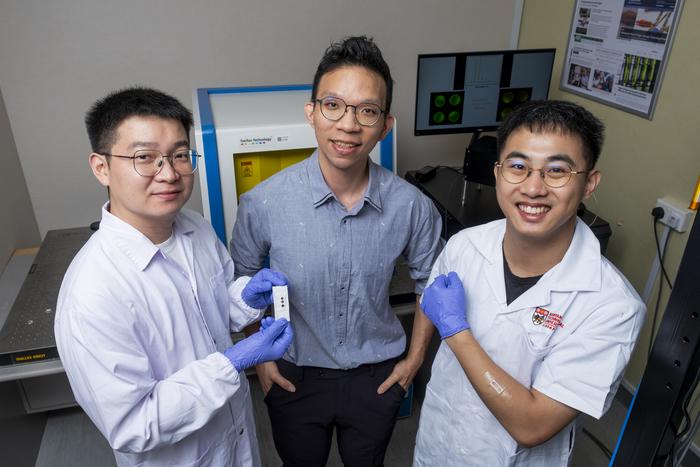
Scientists from Nanyang Technological University, Singapore (NTU Singapore) have developed a ‘band-aid’ or plaster that measures body ‘biomarkers’ that can indicate health or disease through sweat, paving the way for a new non-invasive and effective way for patients to monitor their health.

Credit: NTU Singapore
Scientists from Nanyang Technological University, Singapore (NTU Singapore) have developed a ‘band-aid’ or plaster that measures body ‘biomarkers’ that can indicate health or disease through sweat, paving the way for a new non-invasive and effective way for patients to monitor their health.
Human sweat contains biomarkers such as glucose, lactate and urea that indicate various health conditions and can be collected in a non-invasive and painless manner, making it ideal for daily monitoring, said the team of NTU researchers at the School of Electrical and Electronic Engineering (EEE).
Diabetic patients typically use an invasive finger prick test to self-monitor blood glucose levels. Patients have to prick their fingers to collect a small drop of blood on a strip before inserting it into a portable glucose meter for a reading. An alternative is sensor-based monitoring devices, which are expensive and rigid and must be attached to the patient’s skin over prolonged periods.
By encapsulating a microlaser in liquid crystal droplets and embedding the liquid within a soft hydrogel film, the NTU team created a compact and flexible light-based sensing device – like a plaster which can provide highly accurate biomarker readings within minutes.
Nanyang Assistant Professor Chen Yu-Cheng at the School of EEE and Director of the Centre for Biodevices and Bioinformatics at NTU said, “Our innovation represents a non-invasive, quick and effective way for diabetic patients to monitor their health. By combining a microlaser with a soft hydrogel film, we have demonstrated the feasibility of a wearable laser to provide a more pleasant health monitoring experience for patients.”
The NTU research team said that their innovation supports healthcare in Singapore and globally, where diabetes is rising in prevalence. In Singapore, over 400,000 Singaporeans live with the disease, with the number projected to surpass one million by 2050.
The innovation, reported in the journal Analytical Chemistry, aligns with the University’s research pillar of NTU 2025, a five-year strategic plan that aims to leverage innovative research to benefit society and the health of the population.
Detecting multiple biomarkers
The NTU team created their plaster device by embedding microlasers in liquid crystal droplets. The microlasers are customised to pick up three different types of biomarkers (lactate, glucose, urea). A different coloured liquid crystal dot on the plaster distinguishes each biomarker.
When sweat interacts with the plaster, the amount of light emitted by the microlasers fluctuates based on the concentration of biomarkers present. To read the biomarker levels, users shine a light source on the plaster, and the light emitted from the microlaser sensors is analysed and translated using a mobile application.
In real-live experiments, the plaster successfully picked up tiny fluctuations of glucose, lactate and urea levels in sweat down to 0.001 millimetre (mm), which is 100 times better than current similar technology.
The NTU team believes their innovation to be the first reported wearable sensing device that is capable of measuring multiple biomarkers in sweat with ultra-high sensitivity and dynamic range. The sensitivity enables tracking of a dynamic range (low to high) in biomarkers levels, which provide comprehensive information on patients’ health, say the team.
First author of the study, NTU PhD candidate Nie Ningyuan, said, “Our device is capable of detecting both the high and low range of biomarkers levels. This is particularly beneficial for diabetic patients as current similar health monitoring devices focus on tracking only high glucose levels, but not abnormal or low glucose levels, which may indicate other health complications. In comparison, our device will provide a clearer picture of the users’ health condition with a variety of readings captured.”
Commenting as an independent expert, Dr Lin Chun-Hsien, MD, Physician of National Taiwan University Hospital, Taiwan, said: “Diabetic patients need to frequently monitor their blood glucose level for their safety, for example, to avoid hypoglycaemia, which is a condition where blood sugar level drops too low. As an endocrinologist, I often come across patients who fear pain and bleeding when using the finger prick test. I am hopeful that this laser-based, non-invasive wearable device developed by the NTU Singapore team can provide a more convenient and effective way to monitor patients’ blood glucose. Its ability to measure other biomarkers is also an added bonus, which will offer more health data to the benefit of both patients and physicians.”
For their next steps, the research team plans to fine-tune the microlaser sensors to detect a wider variety of substances, including drugs and other chemicals found in sweat.
Journal
Analytical Chemistry
Method of Research
Experimental study
Subject of Research
Not applicable
Article Title
A Wearable Thin-Film Hydrogel Laser for Functional Sensing on Skin
Article Publication Date
10-May-2024
Cite Scienmag News
Courtney Benton. (July 8, 2024). NTU Singapore scientists develop ‘band-aid’ that measures glucose levels in sweat using microlaser technology. Scienmag. https://scienmag.com/ntu-singapore-scientists-develop-band-aid-that-measures-glucose-levels-in-sweat-using-microlaser-technology/
Courtney Benton. "NTU Singapore scientists develop ‘band-aid’ that measures glucose levels in sweat using microlaser technology." Scienmag, 8 July 2024, https://scienmag.com/ntu-singapore-scientists-develop-band-aid-that-measures-glucose-levels-in-sweat-using-microlaser-technology/. Accessed 7 September 2026.
Courtney Benton. "NTU Singapore scientists develop ‘band-aid’ that measures glucose levels in sweat using microlaser technology." Scienmag. July 8, 2024. https://scienmag.com/ntu-singapore-scientists-develop-band-aid-that-measures-glucose-levels-in-sweat-using-microlaser-technology/

