

(Memphis, Tenn. – May 14, 2024) Deaths from cancer or infections can occur when available treatments are ineffective. Once turned on, pregnane X receptor (PXR) activates the expression of genes encoding enzymes that metabolize external chemicals, including drugs. This causes a significant drop in the effectiveness of chemotherapy, antivirals and other pharmaceuticals. Blocking the PXR activity is notoriously difficult, as many drugs that bind the protein, whether intentionally or unintentionally, activate it. Scientists at St. Jude Children’s Research Hospital have leveraged chemical and structural studies in the design of PXR inhibitors to better understand this process. The findings, published in Nature Communications, provide new insights into the relationship between compounds that activate PXR and ones that block its activity, with implications for designing more effective therapeutics.

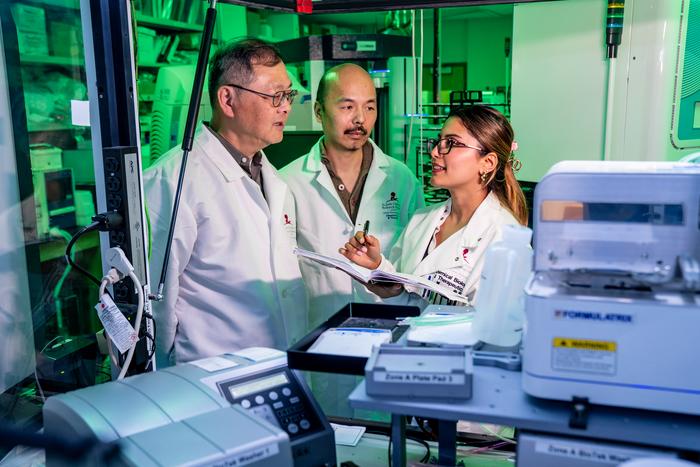
Credit: St. Jude Children’s Research Hospital
(Memphis, Tenn. – May 14, 2024) Deaths from cancer or infections can occur when available treatments are ineffective. Once turned on, pregnane X receptor (PXR) activates the expression of genes encoding enzymes that metabolize external chemicals, including drugs. This causes a significant drop in the effectiveness of chemotherapy, antivirals and other pharmaceuticals. Blocking the PXR activity is notoriously difficult, as many drugs that bind the protein, whether intentionally or unintentionally, activate it. Scientists at St. Jude Children’s Research Hospital have leveraged chemical and structural studies in the design of PXR inhibitors to better understand this process. The findings, published in Nature Communications, provide new insights into the relationship between compounds that activate PXR and ones that block its activity, with implications for designing more effective therapeutics.
Removing toxic compounds from our bodies is a vital process to maintain overall health and wellbeing. To accomplish this, the human body has a toxin removal system. A family of proteins called cytochrome P450 plays a significant role in this process; however, these proteins do not discriminate between toxins and well-intentioned therapeutics. Higher drug doses are often needed to overcome the work these proteins do to eliminate drugs and toxins alike from the body. Cytochrome P450 protein levels are elevated when a drug binds to and activates their respective regulators, such as nuclear receptors, which in turn activates cytochrome P450 genes’ expression. In particular, PXR regulates the expression of a central player in drug metabolism, CYP3A4.
PXR activates drug-removing cytochrome P450 hitmen
“PXR is a transcription factor that regulates the gene expression of CYP3A4, and when a drug binds to and activates PXR, it upregulates CYP3A4,” said corresponding author Taosheng Chen, PhD, St. Jude Department of Chemical Biology & Therapeutics. “CYP3A4 metabolizes more than half of drugs on the market, so it’s clear how important it is.”
CYP3A4 inhibitors, such as ritonavir, have shown benefit when used in combination with the anti-SARS-CoV-2 drug Paxlovid by stopping its active ingredient, nirmatrelvir, from being metabolized by CYP3A4 too quickly. Directly inhibiting PXR activity represents an alternative solution to control drug metabolism by CYP3A4. If drug-metabolizing proteins like CYP3A4 are the hired goons, then PXR represents the mob boss.
The researchers’ challenge was overcoming generations of PXR evolution, which has turned the protein into a juggernaut of ligand promiscuity. “Lots of compounds can bind to PXR,” explained Chen. “There are even very small compounds that by themselves, are inactive. But if you combine a few of them, they can bind to different areas of PXR and together activate it.” The flexibility that allows it to bind thousands of different compounds also means inhibiting its function requires a deft touch.
Previous work from the Chen lab on PXR inhibitor discovery identified the inhibitor SPA70 as a potent candidate. But as a testament to PXR’s unique capabilities, very minor changes to SPA70 flipped it into an activator rather than an inhibitor. In this study, Chen and his team leveraged chemical and structural studies to understand the molecular basis behind the subtle differences between activator and inhibitor binding.
Structures pinpoint the activator/inhibitor gatekeeper
To address these differences, the researchers used X-ray crystallography to obtain the first-ever atomic structures of PXR bound to an inhibitor, presenting four new PXR structures with different inhibitors bound. These could be used to compare old and new structures of PXR bound to activators with almost identical chemical structures to the inhibitors to pinpoint the exact protein regions that govern PXR activity.
“The activator and inhibitor structures are very similar, except that the activators interact with a region of PXR we call activation function-2, AF2,” said Chen. “The inhibitor failed to interact effectively.”
The AF2 region appeared to be crucial in determining whether a drug would function as an activator or inhibitor. “When you have an activator, the conformation of the AF2 is different from that induced by an inhibitor. And it would favor either co-activator or co-repressor recruitment, respectively,” explained Chen. “So, it’s almost like a gatekeeper.”
Building on the information gained from these structures, the researchers found they could flip the drugs between activator and inhibitor by rationally adding or taking away pieces of the molecules based on the identified “hot spots” within the protein. Chen hopes these findings will spark new research into more effective PXR inhibitors, which could potentially be used to prevent PXR-mediated drug metabolism.
Authors and funding
The study’s co-first authors are Efren Garcia-Maldonado, Andrew Huber, Sergio Chai, Stanley Nithianantham and Yongtao Li, all of St. Jude. The study’s other authors are Jing Wu, Shyaron Poudel, Darcie Miller and Jayaraman Seetharaman, all of St. Jude.
The study was supported by grants from the National Institute of General Medical Sciences (R35GM118041), the National Institutes of Health (S10_RR25528, S10_RR028976, S10_OD027000 and P30GM133893), the U.S. Department of Energy Office of Biological and Environmental Research (KP1607011) and ALSAC, the fundraising and awareness organization of St. Jude.
St. Jude Media Relations Contacts
Chelsea Bryant
Desk: (901) 595-0564
Cell: (256) 244-2048
chelsea.bryant@stjude.org
media@stjude.org
Rae Lyn Hartley
Desk: (901) 595-4419
Cell: (901) 686-2597
raelyn.hartley@stjude.org
media@stjude.org
St. Jude Children’s Research Hospital
St. Jude Children’s Research Hospital is leading the way the world understands, treats and cures childhood cancer, sickle cell disease and other life-threatening disorders. It is the only National Cancer Institute-designated Comprehensive Cancer Center devoted solely to children. Treatments developed at St. Jude have helped push the overall childhood cancer survival rate from 20% to 80% since the hospital opened more than 60 years ago. St. Jude shares the breakthroughs it makes to help doctors and researchers at local hospitals and cancer centers around the world improve the quality of treatment and care for even more children. To learn more, visit stjude.org, read Progress: A Digital Magazine and follow St. Jude on social media at @stjuderesearch.

