


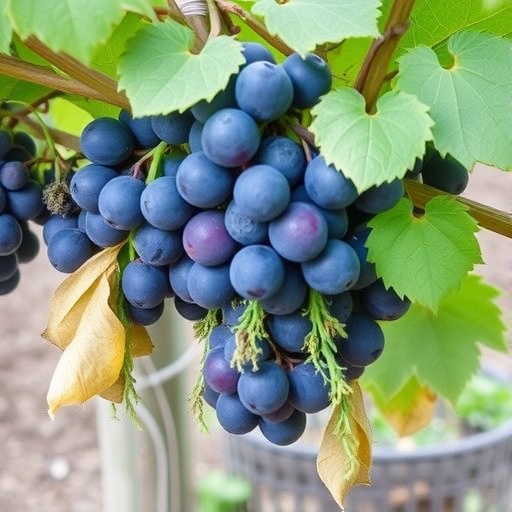
In an era where sustainability and eco-friendliness are becoming paramount in scientific research, the exploration of natural resources for material extraction holds immense promise. One such innovative study has been published by researchers P. Rana and S. Sethi, which focuses on Grapevine shoots—an often-overlooked agricultural byproduct. Their research explores the extraction and characterization of fibers from these shoots, presenting groundbreaking data that contributes to both environmental sustainability and material science.
The researchers initially aimed to address the need for renewable materials in industries traditionally reliant on synthetic fibers and resources. By tapping into the potential of grapewines, which are typically discarded after harvest, they sought to unveil new applications for this organic material. Grapevine shoots are abundant, and their transformation into fibers could pave the way for innovative products that minimize waste while enhancing the circular economy.
The comprehensive comparative study conducted by Rana and Sethi juxtaposes two primary methods of fiber extraction: dry and wet pretreatment. These techniques serve as vital starting points for improving the efficiency of fiber retrieval from the shoots, which are known to be rich in cellulose, hemicellulose, and lignin. The cellular composition of these fibers presents an opportunity to develop materials with unique properties, ranging from robustness to biodegradability.
In the dry pretreatment method, the shoots were subjected to high-temperature exposure, which acted to break down the lignin and facilitate the release of cellulose fibers. This technique is noteworthy for its efficiency and simplicity, potentially allowing for large-scale applications in industrial processes. However, the research did not stop there; Rana and Sethi also described the wet pretreatment process, which involves the use of chemical solutions to aid in fiber extraction. This method was found to yield higher purity levels in the final product but requires careful consideration of environmental impacts due to the chemicals involved.
The characterization of the fibers extracted through both methods revealed intriguing differences in physical and mechanical properties. The researchers employed a range of techniques, including scanning electron microscopy (SEM) and tensile strength testing, to analyze the structural integrity and performance of the fibers. The undeniable variations between the dry and wet pretreatment outcomes could influence decisions in material selection for diverse applications.
Furthermore, the study also reflects on the potential commercial implications of utilizing grapewine shoots as a source of sustainable materials. As industries inquire more into alternative fibers for textiles, composites, and biodegradable products, the viability of grapewine-derived fibers could be groundbreaking. Not only could it satisfy the increasing demand for environmentally friendly materials, but it could also contribute to reducing resource wastage in grape production.
Attention is also drawn towards the socioeconomic benefits that could arise from such innovations. Wine-producing regions that generate significant volumes of grapewine waste could potentially boost local economies by establishing fiber production lines. Becoming leaders in sustainable material innovations might offer these regions both visibility and economic resilience, all while addressing environmental concerns.
Yet, it is important to acknowledge the challenges presented by this research initiative. Both the dry and wet pretreatment methods require optimization to ensure scalability and economic feasibility. Future research is essential for understanding the environmental benefits thoroughly and ensuring that the processes put in place do not inadvertently contribute to pollution or ecological degradation.
Moreover, as the research emphasizes the physical characteristics of the fibers extracted, the next steps will likely involve comprehensive testing of the fibers in real-world applications. This could encompass various domains, including fashion, construction, and packaging, allowing the versatile nature of these fibers to be fully realized in practical scenarios.
Public interest in sustainable materials is also on the rise, evident in trends that favor products boasting organic or eco-friendly labels. Grapevine fibers resonate well with this sentiment, appealing to consumers who advocate for responsible sourcing and ethical production. This inclination suggests that the transition towards utilizing grapewine fibers in various industries could be met with enthusiasm and support.
The findings presented by Rana and Sethi not only contribute to the scientific understanding of alternative fiber sources but also ignite a discussion surrounding the relationship between agriculture and material science. The research drives home the message that innovation can sprout from the remnants of traditional industries if only we are willing to explore and invest in these avenues further.
As the world continues to grapple with environmental concerns, the path forward must incorporate creative solutions gleaned from our resources. The study reflects a promising start—one that may inspire further exploration into other agricultural residues for fiber extraction. The future of sustainable materials hinges on the ability of researchers and industries alike to see potential in what is often considered waste.
In conclusion, the work of Rana and Sethi serves as a critical reminder of the innovation that can emerge when we seek to align our productivity with the principles of sustainability. Their examination of grapewine shoots as a source of novel fibers highlights the urgent need for alternative materials that support ecological balance. With further exploration and implementation, we may see a shift towards a more sustainable future that leverages the very foundations of our agricultural practices.
Rana, P., Sethi, S. Correction to: Extraction and characterization of novel fibers from Grapevine shoots: a comparative study of dry and wet pretreatment.
Environ Sci Pollut Res (2025). https://doi.org/10.1007/s11356-025-36916-0
Cite Scienmag News
Sloane Callahan. (August 27, 2025). Novel Fiber Extraction from Grapevine Shoots: Method Comparison. Scienmag. https://scienmag.com/novel-fiber-extraction-from-grapevine-shoots-method-comparison/
Sloane Callahan. "Novel Fiber Extraction from Grapevine Shoots: Method Comparison." Scienmag, 27 August 2025, https://scienmag.com/novel-fiber-extraction-from-grapevine-shoots-method-comparison/. Accessed 5 September 2026.
Sloane Callahan. "Novel Fiber Extraction from Grapevine Shoots: Method Comparison." Scienmag. August 27, 2025. https://scienmag.com/novel-fiber-extraction-from-grapevine-shoots-method-comparison/


